
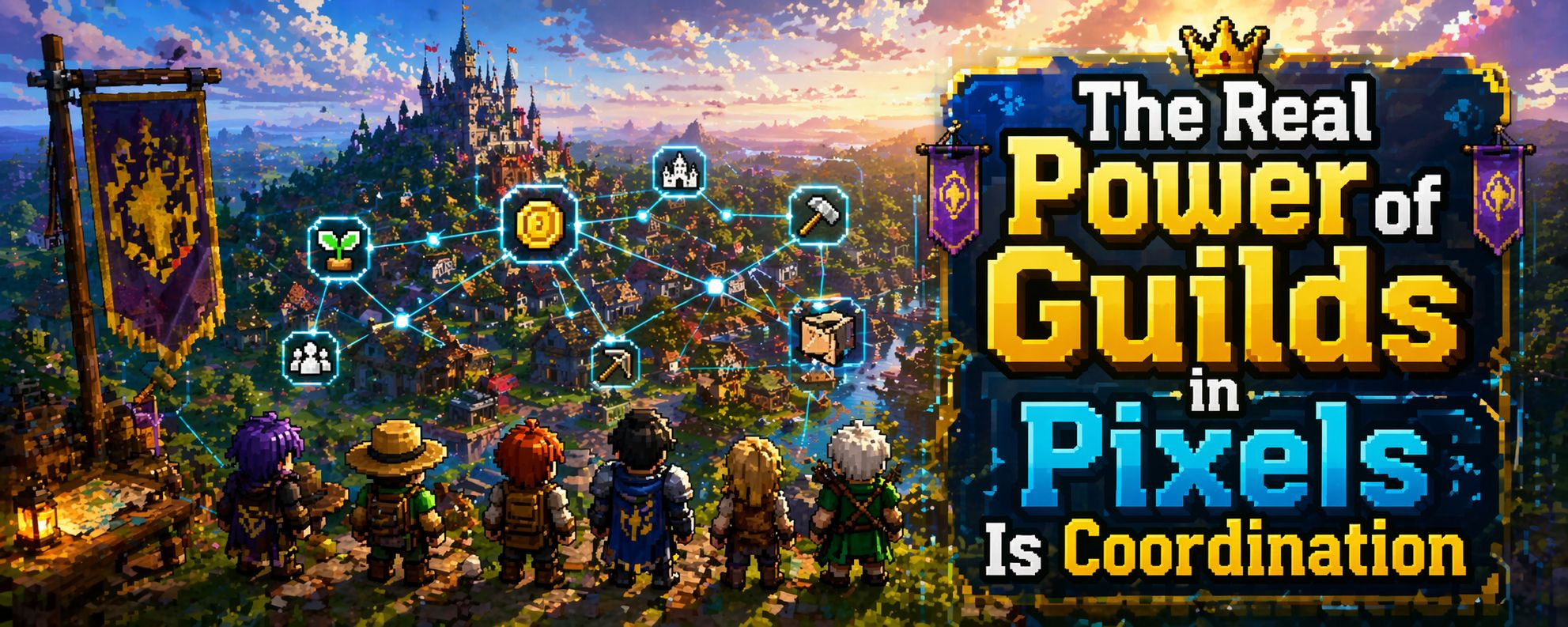
The more I watch Pixels, the less I think guilds are there to make the game feel social.
That sounds strange at first, because Pixels wears such a friendly face. It is bright, casual, and easy to read. The farming loop feels inviting. The world does not hit you with the usual hard-edged Web3 aggression. It feels like a place built for routine, not pressure. So the natural assumption is that guilds exist to deepen that softness. A place to belong. A place to chat. A place to make the game feel communal.
But honestly, I think that reading misses what is becoming most important.
To me, guilds in Pixels are starting to look less like communities and more like coordinators of economic behavior. Not in a cold or cynical way, but in a very practical one. The game keeps evolving in ways that make organization more valuable than simple participation. And once that happens, the guild stops being just a social layer. It becomes the structure that helps players turn scattered effort into usable output.
That is the shift I keep coming back to.
What makes Pixels interesting is that it does not present its economy like a machine, even though it increasingly behaves like one. On the surface, it is still a cozy world of crops, crafting, movement, and repetition. But underneath that softness, the systems are doing something much more disciplined. Land matters. Access matters. Reputation matters. Permissions matter. Productive space matters. Time matters. And when a game starts stacking those variables on top of each other, individual play begins to feel less important than coordinated play.
That is why I think guilds matter more than many people realize.
If a player owns land but cannot fully utilize it, that is idle capacity. If another player has time, energy, and willingness to grind but lacks infrastructure, that is underused labor. In a looser game, those two realities might never connect in a meaningful way. In Pixels, guilds increasingly look like the bridge between them. They help turn ownership into access and access into production.
That is a much bigger role than just giving people a tag over their name.
What fascinates me is that this does not feel like an accidental byproduct. The way Pixels has handled guild-linked participation, land access, task structures, and reputation-linked mechanics suggests a game that is gradually rewarding coordination itself. The more the economy is tuned, the more valuable organized groups become. Not necessarily the loudest groups. Not even the most culturally interesting groups. Just the ones that can reduce friction.
And reducing friction is an underrated form of power.
I think that is the part many people miss when they talk about Web3 games. They focus too much on assets and not enough on organization. They assume ownership is the whole story. Own the land, hold the item, get the upside. But ownership alone does not build an economy. It just creates the possibility of one. The real question is always who can make those assets productive, who can connect them to labor, and who can do that consistently. That is where guilds enter the picture.
In Pixels, a good guild can quietly answer the questions that an isolated player struggles to solve alone. Who gets access to what? Which members focus on which loops? How do you make better use of land, industries, or task opportunities? How do you turn a collection of players with uneven resources into something that actually functions as a system?
That is why I do not really see guilds in Pixels as social clubs anymore. I see them as coordination engines wearing the costume of a community feature.
And I do not mean that in a negative sense. In fact, I think it is one of the more mature things Pixels is doing.
A lot of earlier crypto games treated social structures as marketing extensions. Guilds were there to amplify narrative, recruit bodies, or organize extraction. They often felt like distribution channels for speculation. Pixels feels different to me because the guild is becoming useful at the level of operations. It is not just there to attract players. It is there to help them function better once they arrive.
That distinction matters.
A social club makes the experience warmer. An economic coordinator makes the system work. Pixels may still have both, but I think the second role is becoming the more consequential one. The guild that matters most in the long run may not be the one with the strongest identity or the most visible sense of culture. It may be the one that becomes best at managing access, trust, and labor across the game’s evolving economy.
In that sense, the most powerful guilds in Pixels may end up looking surprisingly boring from the outside. They may not seem glamorous. They may just be efficient. They may simply know how to place the right people in the right loops, make better use of productive infrastructure, and help members move through the game with less wasted motion. But that kind of quiet efficiency is exactly how influence forms inside a living economy.
That is why I think guilds in Pixels deserve to be viewed through a different lens.
They are not only about belonging. They are about economic translation. They translate ownership into opportunity. They translate individual effort into collective productivity. They translate a game full of uneven player positions into something more organized and more functional.
And maybe that is the deeper lesson here. Pixels is showing that the real power in a Web3 game may not sit only with the player who owns the asset. It may sit with the group that knows how to coordinate around that asset better than everyone else.
That is why I keep coming back to the same thought: the guild in Pixels is becoming important for reasons that have very little to do with friendship, even if friendship helps. Its real value is that it gives shape to an economy that would otherwise feel fragmented. It helps people do more with what they have. It makes infrastructure useful. It turns access into momentum.
To me, that is a far more interesting story than “guilds make the game more social.”
Guilds in Pixels may end up mattering most because they make the game more organized. And in an economy like this, organization is not a side feature. It is power.