
| @undefined | $PIXEL | #pixel | Automation has reshaped digital environments, but it has also exposed a critical flaw. Systems that rely on transparency in reward logic become vulnerable to exploitation.
When every rule is visible and every outcome is predictable, bots gain control.
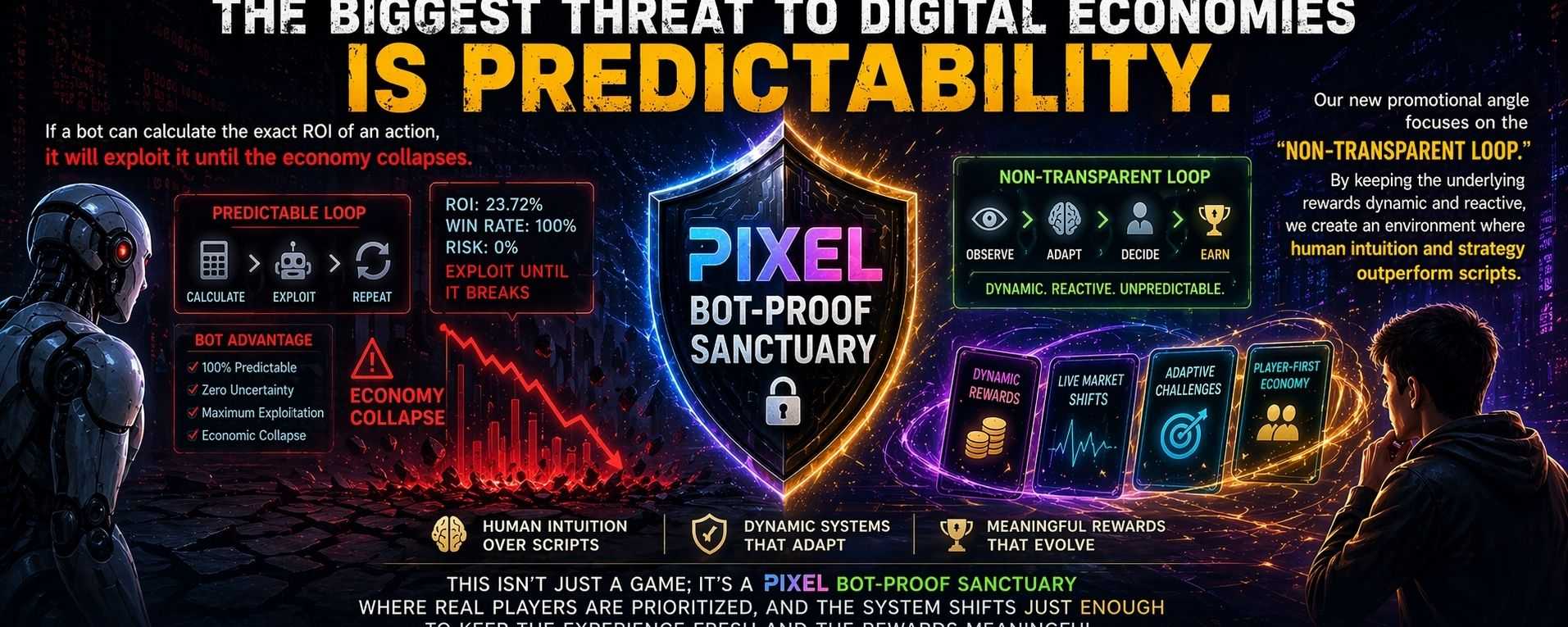
PIXEL introduces a non-transparent loop designed to counter this issue. It does not remove logic or fairness. Instead, it limits predictability. Outcomes are influenced by multiple variables that shift over time, making it impossible to calculate exact results in advance.

This creates a unique advantage for human players.
Humans are naturally adaptive. They can interpret incomplete information, take calculated risks, and adjust strategies based on experience. These qualities cannot be easily replicated by automated systems.
In a non-transparent environment, success comes from understanding patterns rather than solving equations. Timing, observation, and decision-making become more important than raw efficiency.
This also improves user experience. Instead of repetitive actions, players engage in a system that feels alive. Every interaction has potential, and every decision carries weight.
The goal is not to eliminate automation entirely but to ensure it does not dominate the system. By reducing predictability, PIXEL creates balance.

This balance leads to a healthier ecosystem. One where value is distributed more fairly, and participation is rewarded over exploitation.
In this model, the future belongs to those who can think, not just calculate.
This creates a more engaging experience for users. They are not just repeating actions but actively participating in an evolving environment.
PIXEL represents a shift toward smarter system design. It focuses on resilience, adaptability, and fairness.