
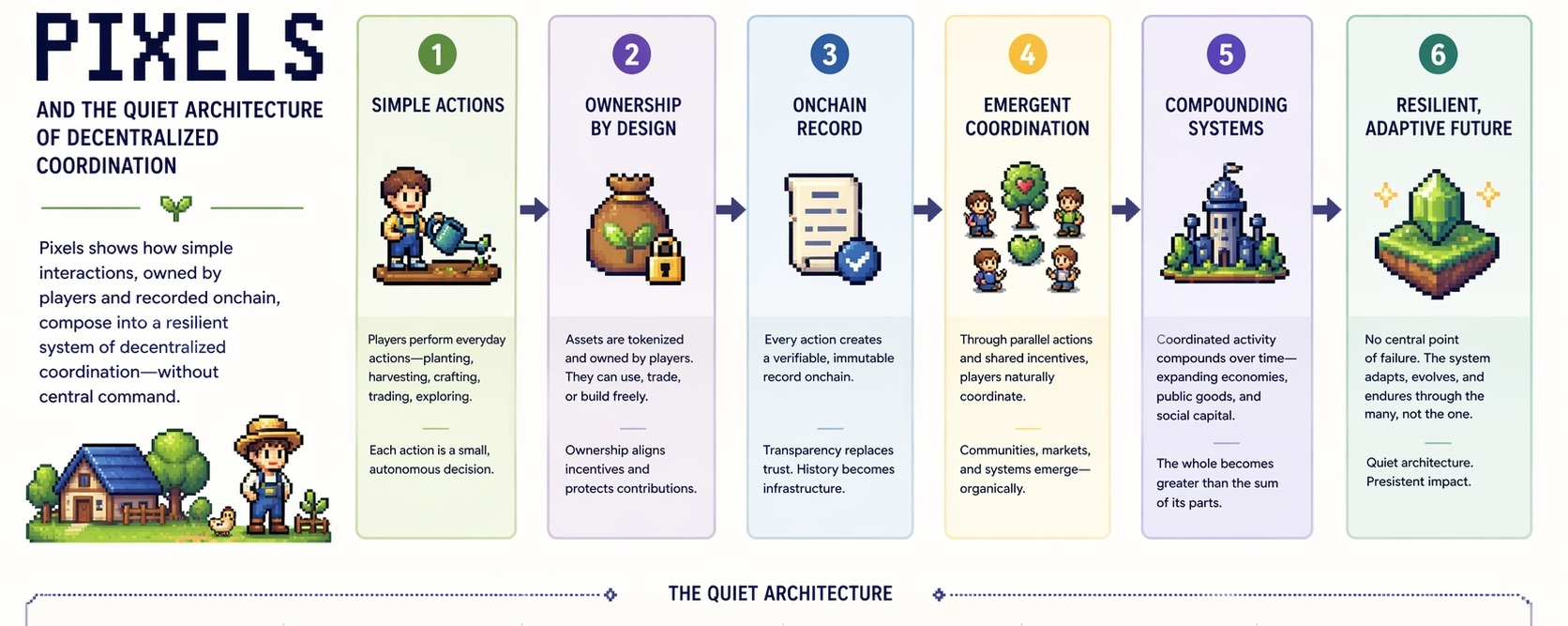
I’ve been watching Pixels for a while now, not as a game in the usual sense, but as a kind of living systemsomething that sits at the intersection of coordination, ownership, and quiet behavioral design. At first glance, it looks simple: farming, gathering, crafting, a loop we’ve seen countless times before. But the longer I observe it, the more it feels less like a game and more like an experiment in how loosely connected individuals can form structured economic behavior without central enforcement.
What caught my attention isn’t the farming itself, but the subtle way actions in Pixels become commitments. Planting a crop is trivial in isolation, but across thousands of players, these micro-decisions begin to resemble a distributed production network. No one assigns roles, no one enforces quotas, yet patterns emerge. Some players specialize, others explore, some hoard, some trade. It’s not designed as a rigid economy, but it behaves like one anyway.
I keep looking at how the system handles trust, because that’s where the underlying architecture reveals itself. Traditional games simulate economies, but they ultimately rely on centralized authority—the developer defines scarcity, validates transactions, and enforces fairness. In Pixels, that authority is partially externalized to the blockchain layer. Ownership is no longer just a database entry; it’s something that exists independently of the game client. That subtle shift changes the nature of participation. Players aren’t just interacting with a game—they’re interacting with a persistent system that remembers them in a different way.
What’s interesting is that this doesn’t make the system more complex from the user’s perspective. In fact, it often feels simpler. But beneath that simplicity, there’s a reconfiguration of responsibility. The network validates state, the player provides intent, and the game becomes more of an interface than a controller. It’s a quiet redistribution of power, not in a political sense, but in a structural one.
I’m noticing that the real innovation isn’t in the mechanics of farming or exploration, but in how those mechanics become signals within a broader network. Each action contributes to a shared state that no single participant fully controls. This starts to resemble something closer to an institution—not a formal one, but an emergent one. A place where rules are enforced not by authority, but by consensus and constraints embedded in code.
There’s also an interesting relationship forming between predictability and freedom. Because the system is open and verifiable, players can anticipate how it behaves. This predictability allows for planning, coordination, even strategy at a higher level. But at the same time, the lack of centralized direction means outcomes remain uncertain. It’s a balance that feels almost ecological—structured enough to sustain itself, but open enough to evolve.
As I spend more time observing, I start to see Pixels less as a standalone environment and more as a node in a larger network of machine-mediated interactions. The blockchain doesn’t just store assets; it acts as a coordination layer between participants who may never directly interact. It reduces the need for trust between individuals by shifting trust to the system itself. And that shift has implications beyond gaming.
What’s quietly unfolding here is a model for how digital spaces can host real coordination without relying on centralized oversight. Not perfect coordination, not frictionless, but something closer to organic order. Players don’t need to know each other, yet they still influence each other’s outcomes. They don’t need to trust each other, yet they still participate in shared systems of value and production.
I keep coming back to the idea that Pixels is less about play and more about rehearsal. A rehearsal for systems where humans and machines co-manage shared realities. Where actions are recorded, verified, and made meaningful not by authority, but by consistency and transparency. It’s not fully there yet, and maybe it doesn’t need to be. What matters is the direction it’s pointing in.
The longer I look at it, the more it feels like a quiet shift in how we think about digital environments. Not as isolated experiences, but as interconnected systems of coordination. And in that sense, Pixels isn’t just a game—it’s a small, evolving example of how decentralized systems might reshape the way we organize, interact, and trust in a world increasingly mediated by code.