
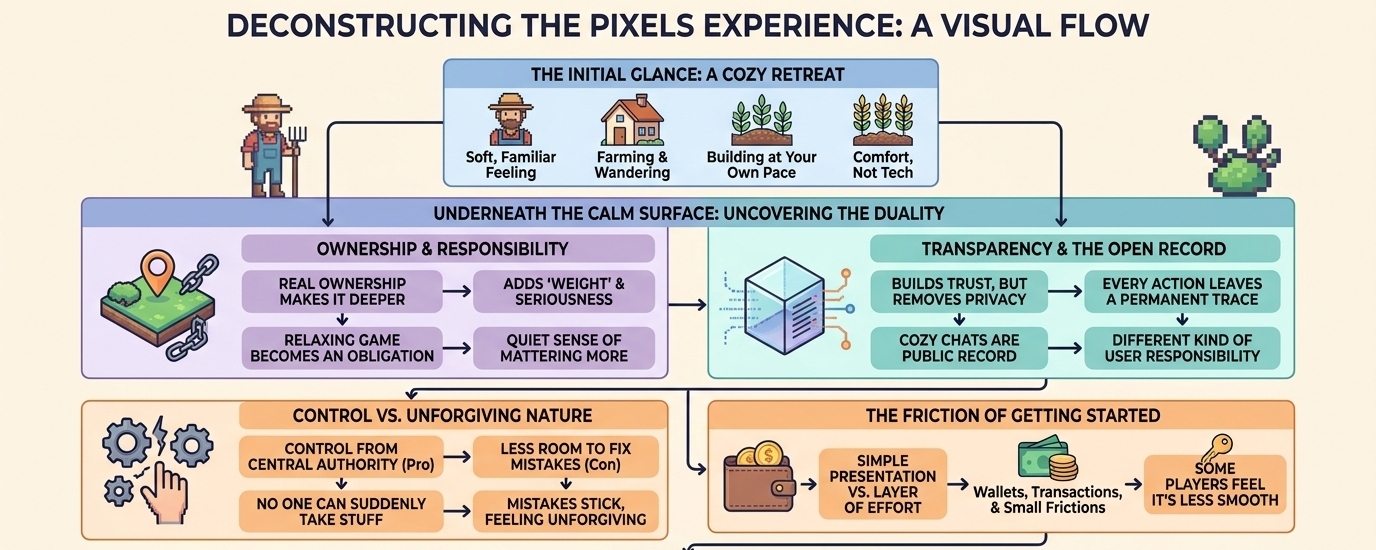

Pixels is easy to like at first glance. It has that soft, familiar feeling farming, wandering around, building something at your own pace. Nothing about it screams “complex system.” It feels closer to comfort than tech. But the longer you think about it, the more you realize there’s a lot going on underneath that calm surface.
The whole idea leans on this assumption that ownership makes things more meaningful. That if the land or items are actually yours, the experience somehow becomes deeper. Maybe it does, but it also adds a kind of weight. When something belongs to you in a real sense, even a small one, it’s harder to treat it lightly. A game that’s supposed to feel relaxing can start to feel like something you need to keep up with. Not in an obvious way just a quiet sense that it matters more than it used to.
There’s also something slightly uncomfortable about how open everything is. Transparency is supposed to build trust, and technically it does. But it also means nothing is really private. Every action leaves a trace somewhere. In a different kind of system, that might feel normal. Here, in a slow, cozy game, it feels a bit out of place. You can imagine someone just planting crops and chatting with others, not really thinking about the fact that their activity is part of a permanent record.
The idea of taking control away from a central authority sounds good too. No one can suddenly take your stuff or change the rules on you. But at the same time, it means there’s less room for things to be fixed if something goes wrong. Mistakes stick. And for people who aren’t deeply familiar with how these systems work, that can feel unforgiving. It’s a different kind of responsibility than most games ask for, especially one that presents itself as casual.
And even though everything is designed to feel simple, there’s still a layer of effort in just getting started. Wallets, transactions, small bits of friction that don’t fully disappear. Some players won’t mind. Others will feel it right away, even if they can’t quite explain why it feels less smooth than they expected.
What makes it more complicated is the mix of people it’s trying to appeal to. Some players just want a peaceful place to spend time, something low-pressure. Others are more focused on the systems behind it how to grow value, how to make the most of what they have. Those two ways of playing don’t always sit comfortably together. One is about slowing down, the other is about optimizing.
None of this makes Pixels a bad idea. If anything, it just shows how tricky it is to combine something meant to feel effortless with something that carries real structure underneath. It’s trying to make all of that invisible, or at least easy to ignore. The open question is whether that’s actually possible, or if players will always, at some point, notice the weight behind the calm.