
I didn’t notice it on day one.
Or even week one.
At first, Pixels felt like any other loop-based system — farm, craft, sell, repeat. You stay active, you assume you’re progressing. That’s the natural logic most of us carry into games.
So I did what everyone does.
I stayed consistent.
Same hours. Same loops. Same effort.
But then I started tracking something small…
Output vs effort.
And the numbers didn’t match.
After 10 days of playing, I compared my activity with a few others:
Same playtime (~3–4 hours daily)
Same task completion range
Same event participation
But when I looked deeper:
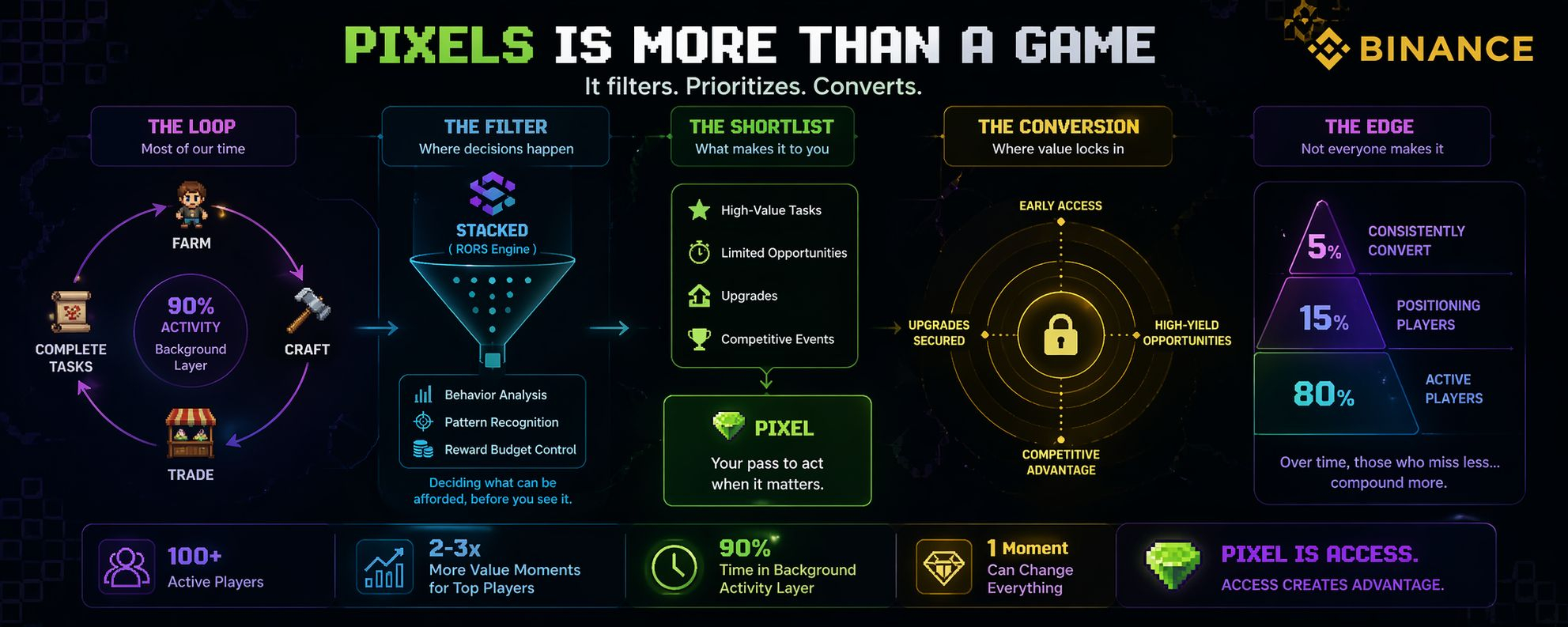
Some players converted 2–3x more value moments
They secured upgrades faster
They entered high-reward opportunities earlier
Not by grinding more.
But by being ready at the exact moment things mattered.
That’s when it clicked.
Pixels doesn’t reward activity evenly.
It rewards conversion timing.
Most of us spend ~90% of our time in what I’d call the background layer:
Farming
Crafting
Moving resources
Completing routine tasks
It feels productive.
But statistically, only a small portion of actions actually turn into finalized value events:
Limited upgrades
Time-sensitive drops
Competitive entries
High-tier conversions
And those moments?
They’re not evenly distributed.
That’s where $PIXEL changes the equation.
At first, I thought it was just a utility token.
Now it feels more like a priority switch.
Because when those high-value windows open:
If you have $PIXEL ready → you act instantly
If you don’t → you hesitate, or miss entirely
And hesitation, even for seconds, compounds over time.
I started observing patterns.
The same wallets kept appearing at critical points:
Early access moments
High-yield conversions
Competitive entries
Not louder. Not more visible.
Just consistently… present.
This reminded me of trading.
In markets, the difference isn’t who is active.
It’s who has liquidity at the exact second opportunity appears.
Pixels is starting to behave the same way.
So I ran a simple mental model:
If 100 players are active:
~80 are generating activity
~15 are positioning
~5 are consistently converting
And over time, that top layer compounds — not because they do more…
But because they miss less.
That’s when the idea of “fairness” started feeling incomplete.
Because the system is open:
Anyone can play
Anyone can earn
Anyone can participate
But not everyone gets the same economic visibility.
So now I don’t look at Pixels as a reward system.
I look at it as a filtering system.
Where:
Effort generates input
The system processes it
And $PIXEL decides what actually passes through
The uncomfortable part?
You can be active…
…but still invisible at the level where value locks in.
From a trader’s perspective, this changes everything.
Because demand for won’t come from:
“More players = more usage”
It will come from:
“More competition at conversion points = higher need to be ready”
So now I’m not just watching player count.
I’m watching something else:
How often do players pay to avoid missing the moment?
Because if that behavior repeats…
Then isn’t just a currency.
It’s access.
And in any system where access is limited…
That’s where real value starts forming.