
@Pixels I never made a decision to change how I play Pixels.
There was no moment where I said, “Okay, from now on I’ll play smarter.”
It didn’t happen like that.
It was quieter.
At the start, I played the way most people do. I stayed busy. That was the goal. As long as I was doing something, it felt like progress. I didn’t question whether an action was the right one I just focused on not wasting time.
And honestly, that felt good.
There’s a certain comfort in constant movement. You don’t have to think too much. The game gives you direction, and you follow it. One task leads to another, one reward leads to the next action. It’s smooth, predictable, and easy to stay inside that loop.
But over time, something started feeling… off.
Not wrong, just incomplete.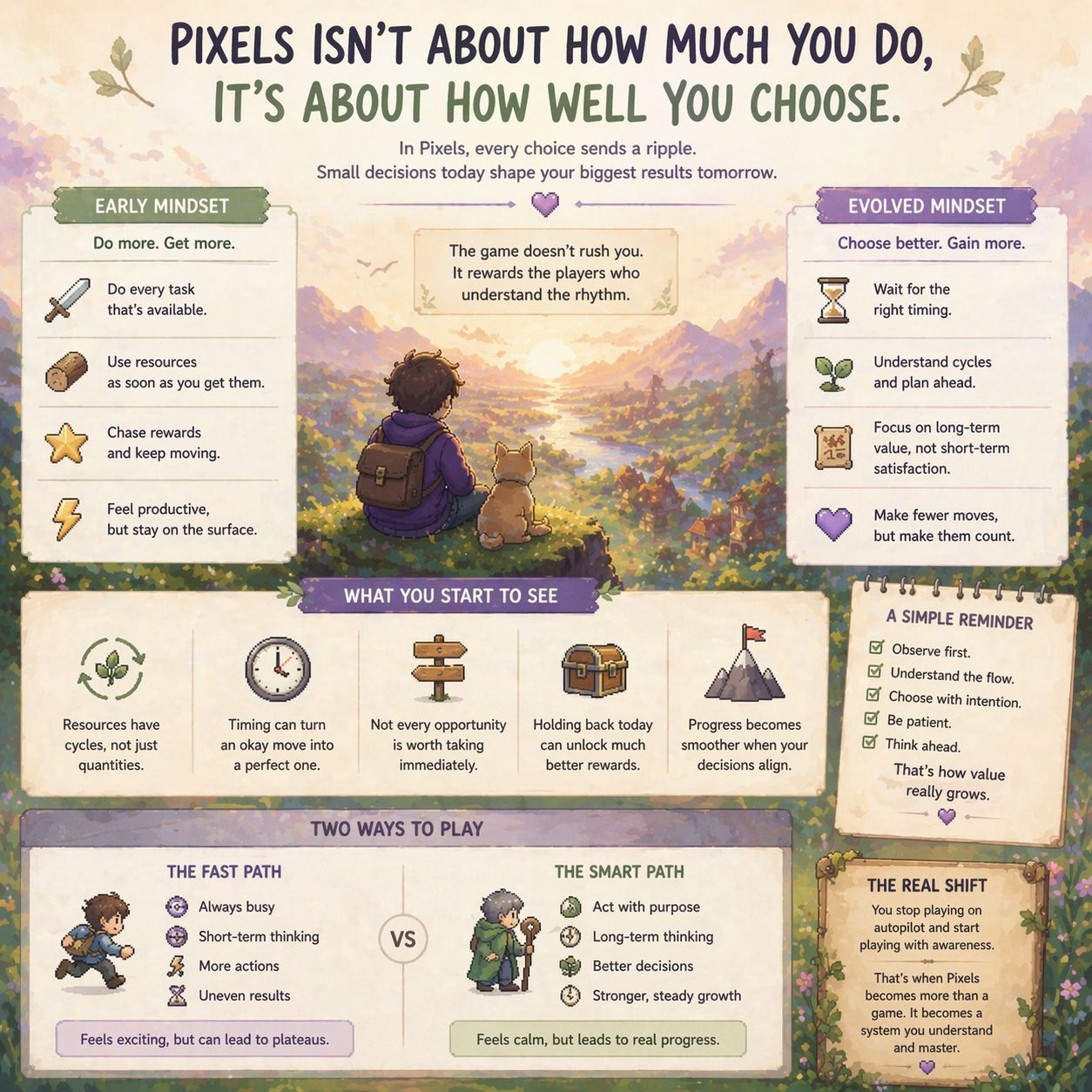
I would play the same way, do the same things, and still feel like I wasn’t getting the most out of it. Not in a dramatic way just small moments where I felt like there was a better way to handle what I had.
That feeling stayed.
And instead of trying to fix it immediately, I started paying attention.
That’s when I noticed something I hadn’t seen before.
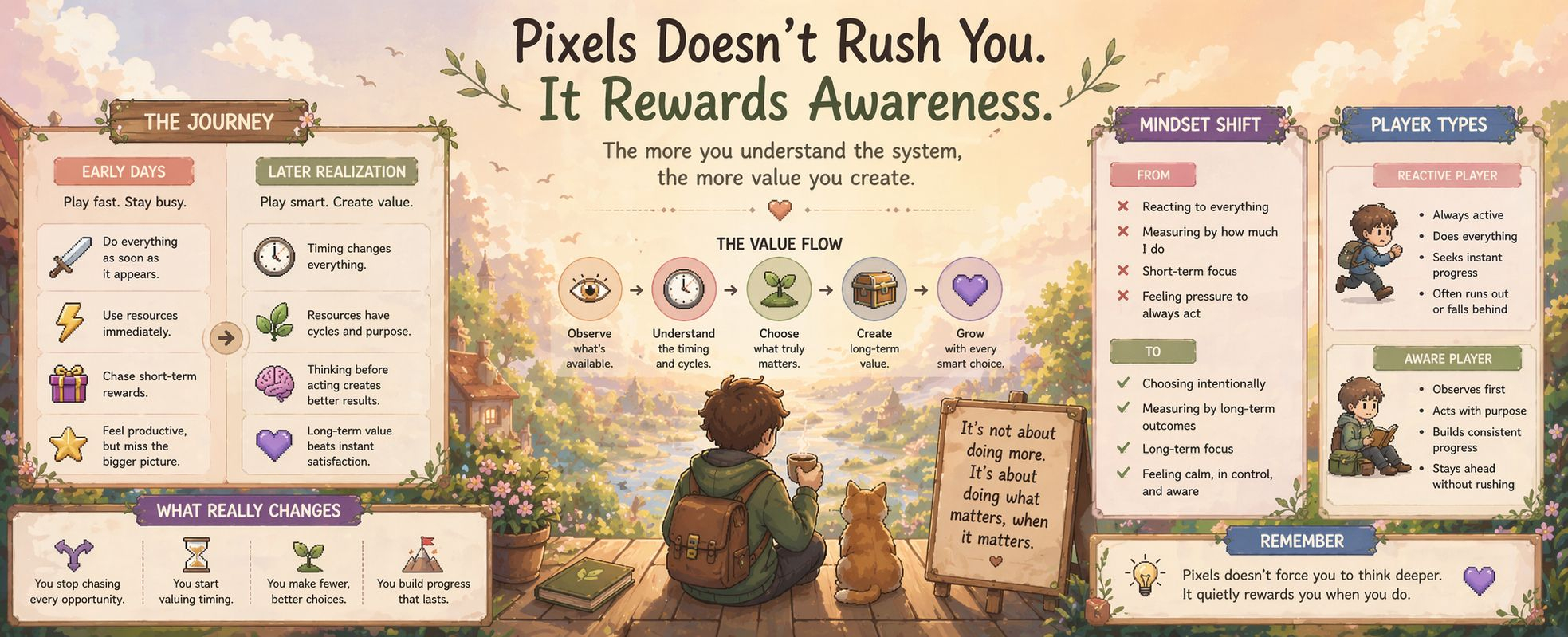
#Pixels doesn’t rush you.
It lets you rush but it doesn’t actually reward you for it in the long run.
That’s a very subtle difference.
Because most of the time, it feels like the game wants you to keep going. Everything is available, everything is clickable, everything is ready. It creates this sense that acting immediately is the correct move.
But if you step back, even slightly, you start to see cracks in that idea.
Not every action improves your position.
Not every reward is valuable in that moment.
Not every opportunity needs to be taken right away.
And once you realize that, you begin to hesitate.
At first, that hesitation feels uncomfortable.
You’re used to moving fast. You’re used to doing everything. So when you suddenly don’t act, it feels like you’re falling behind.
But slowly, that feeling changes.
That pause starts to feel intentional.
You begin to understand that waiting isn’t empty it’s part of the process. It gives space for better decisions. It keeps options open. It lets the system work in your favor instead of against you.
And that’s when the game starts feeling different.
You’re not chasing progress anymore.
You’re shaping it.
There’s a shift from reacting to choosing.
Before, I would log in and immediately start doing things. Now, I log in and observe first. I look at what’s available, what’s ready, what might change if I wait.
Sometimes I still act quickly.
But sometimes I don’t.
And that choice that ability to not act is what changed everything for me.
Because it made me realize something simple:
Pixels isn’t built around urgency.
It’s built around awareness.
The players who move the fastest aren’t always the ones who gain the most. The ones who understand the system the timing, the flow, the way resources interact end up making better decisions over time.
And those decisions don’t always look impressive on the surface.
Sometimes they look like doing less.
Sometimes they look like waiting.
Sometimes they look like ignoring things that seem important.
But underneath, they’re more efficient.
I also started noticing how this affects the way different players experience the game.
Some are still fully inside that fast loop constantly active, constantly engaged, constantly moving forward.
And there’s nothing wrong with that.
But others have stepped into a different rhythm.
Slower, but more controlled.
Less reactive, more deliberate.
They’re not trying to keep up with the game.
They’re trying to understand it.
And once you reach that point, something interesting happens.
The game doesn’t feel smaller it feels deeper.
Every action has weight.
Every delay has meaning.
Every choice connects to something ahead.
You’re no longer just playing what’s in front of you.
You’re thinking about what comes next.
And that’s when it hit me:
Pixels never told me to slow down.
It just created a system where slowing down started to make sense.
And once it makes sense, you don’t really go back.
Because now, it’s not about how much you can do in a session.
It’s about how well you understand what your actions actually lead to.
And that changes the entire experience.
It stops feeling like a race.
And starts feeling like something you’re learning to read.