
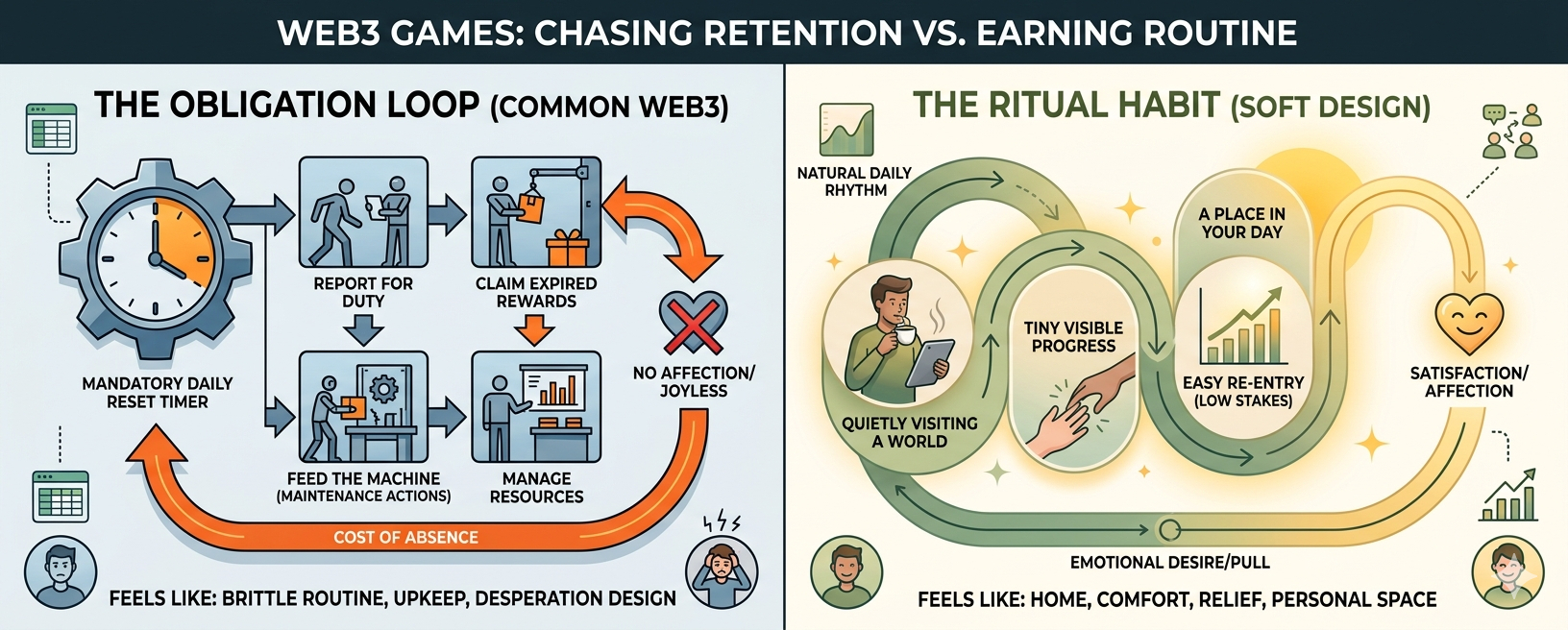
One thing that keeps bothering me about Web3 games is how badly they misunderstand habit. They talk about retention all the time. Daily active users. Returning wallets. engagement loops. sticky behavior. all the usual cold language. But a lot of them still do not understand what makes someone actually come back every day without feeling like they are being herded through a routine designed by a desperate product manager.
A real daily habit in a game is a fragile thing. It is not just a checklist. It is not a timer. It is not some cheap little reward stuck on top of basic repetition. It is a feeling. A rhythm. A small place the game makes for itself inside your normal life. That is why the best daily-loop games work so well. They stop feeling like events and start feeling like part of your day. You wake up, check something, do your rounds, make a little progress, waste a few extra minutes you did not plan to waste, and somehow that space becomes yours. Quietly. Naturally. That is the trick.
Web3 games keep trying to force that trick with incentives.
That is where the whole thing starts going wrong.
They confuse habit with obligation. They think if players have enough reasons to return, then they have built a healthy loop. But reasons are not the same as desire. Pressure is not the same as pull. A game can absolutely make you come back without ever becoming part of your life in a way that feels good. It can train behavior while still failing to earn affection. And that is exactly what a lot of Web3 projects end up doing. They create return patterns that look strong on paper but feel dead in the hands.
You log in because something expires. Because a reward resets. Because a claim window is closing. Because some resource needs managing. Because you do not want to fall behind. That is not a habit in the good sense. That is maintenance. That is the difference this space keeps missing. A real game habit feels like a small ritual. A bad one feels like feeding a machine before it starts complaining.
And honestly, players know the difference right away.
A good daily game gives you a reason to settle in. A bad one gives you a reason to report for duty.
That is why so many Web3 loops feel weirdly joyless even when the numbers look healthy for a while. The structure may be working, but the emotional tone is off. You are not returning because the game has built a place in your day that feels satisfying to revisit. You are returning because the system has made absence feel costly. That is much weaker than people think. It can generate activity, sure, but it creates a brittle relationship. The second the rewards weaken, the second a better loop appears somewhere else, the second life gets slightly busy, the whole routine collapses because it was never really rooted in pleasure to begin with.
And pleasure matters here more than the spreadsheets admit.
Daily habits in games are not built from rewards alone. They are built from comfort. Familiarity. Tiny progress that feels visible. A world that is easy to re-enter. A rhythm that does not punish you for being human. Maybe some light curiosity too. Maybe a little unpredictability. Just enough so the routine does not turn into wallpaper. It is a delicate balance. Too loose and people drift away. Too controlling and they start resenting the game even while they keep showing up.
Web3 games lean too hard toward control because the economy keeps demanding it.
That is the ugly part. The daily loop is not just there to make the player happy. It is there to stabilize activity, support the system, maintain certain behaviors, maybe protect token logic, maybe smooth out community sentiment, maybe keep the world looking active. So the loop gets loaded with extra jobs. Too many jobs. It stops being a player habit and starts being part of the project’s operational strategy. Once that happens, the design gets stiff. You can feel the weight in it. The loop is no longer just about what fits naturally into a person’s day. It is about what the machine needs from them.
That tension ruins a lot of potentially good games.
Because the funny thing is, some of these projects almost get it. They understand routine. They understand progression. They understand that people like low-stakes repetition when it has texture. But then the Web3 layer starts pushing everything toward efficiency and accountability. Suddenly the daily loop is not just a nice return point. It is a monitored system. A behavioral channel. A set of outputs. And the player starts feeling less like someone with a habit and more like someone maintaining eligibility.
That is such a bad feeling in a game.
The best daily habits are soft around the edges. They forgive you a little. They leave room for mood. Some days you stay longer. Some days you just do the basics. Some days you wander off and ignore the obvious efficient path because the world still has enough life in it to support that kind of wasted time. A healthy routine in a game should feel flexible. Personal. A little messy. That is how it becomes yours.
Web3 games often do not trust that kind of mess. They want cleaner behavior. More predictable return paths. More measurable outcomes. But a player is not a dashboard line. If the game starts feeling too aware of your behavior, too invested in controlling your pace, too eager to turn your day into a stable input, then the habit may survive for a while, but the warmth dies first.
And once the warmth dies, it is just a matter of time.
That is why I think this whole space still has a habit problem, not just a retention problem. It knows how to build systems people can return to. It still does not fully know how to build systems people want to live with. That is harder. Less flashy. Less easy to brag about. But it is the real challenge. A daily loop is not strong because it traps attention. It is strong because it slips into ordinary life without making the player feel owned by it.
That is the standard Web3 gaming still keeps missing. It keeps trying to secure behavior when it should be earning routine. It keeps building daily systems that feel like responsibility instead of relief. And nobody keeps those forever. Not really. A player will tolerate obligation for a while. They will make time for a ritual much longer.
That is the difference. One feels like upkeep. The other feels like home.
