
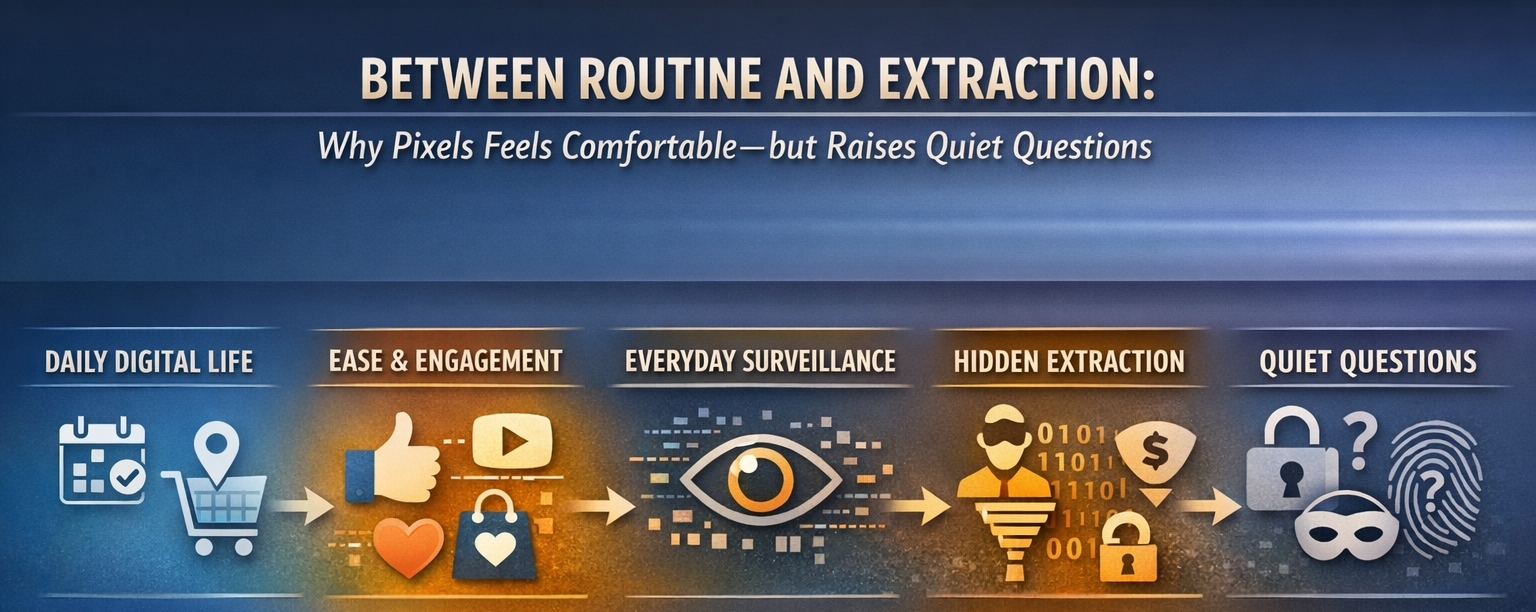
Some mornings feel almost identical to the ones before them. I wake up, reach for my phone, and go through the same quiet sequence—notifications, charts, a few familiar tabs. There’s no urgency in it anymore. Just repetition. And somewhere inside that repetition, a kind of comfort settles in. Not excitement, not curiosity—just something predictable.
That’s the feeling I keep coming back to when I think about Pixels.
On the surface, it presents itself simply: a farming world, soft pixel visuals, light interaction. Built on the Ronin Network, it leans into accessibility more than complexity. You plant, harvest, craft, socialize. It’s designed to feel easy, almost deliberately so. And I’ve seen versions of this before—projects that wrap economic systems in something that feels like a game, or games that slowly reveal themselves as systems.
But there’s something slightly different here. Not entirely new, just… more refined. The onboarding is smoother. The friction is lower. The world doesn’t immediately push you toward extraction. It lets you settle in first.
Still, that’s where the questions begin.
Because in this space, simplicity often hides pressure. The loop—farm, earn, upgrade—has existed across multiple cycles, and it rarely holds up the way people expect. Token economies stretch under their own weight. Inflation creeps in. Incentives shift from players to liquidity. Even now, I’m noticing how much of the conversation around Pixels drifts back to earnings, strategy, optimization—less about the world itself, more about what can be taken from it.
And the market reflects that tension. The token has moved through sharp bursts of attention—massive spikes in volume and price that feel less like organic growth and more like concentrated speculation. At one point, trading activity surged far beyond what the project’s size would normally sustain, a pattern that usually doesn’t resolve cleanly.
At the same time, the broader environment around it is shifting. The Ronin ecosystem itself is evolving—moving toward a more structured economic model and even transitioning into a full Ethereum layer-2 network. That kind of infrastructure change matters. It suggests the foundation is still being rebuilt while the game continues running on top of it.
And then there’s the current state of the token itself—far removed from its earlier peak, yet still active, still circulating, still drawing players in. That contrast is hard to ignore. It tells a familiar story: attention comes quickly, but retention is something else entirely.
What I find more interesting isn’t the price, though. It’s the behavior.
People stay in Pixels for reasons that don’t always show up on charts. The routine, the low effort, the sense of incremental progress—it creates a rhythm that’s easy to return to. Not because it’s deeply engaging, but because it’s consistent. And that consistency can blur the line between playing and participating in a system.
That’s where it starts to feel less like a world and more like a machine.
A world invites exploration, curiosity, unpredictability. A machine rewards repetition, efficiency, output. Pixels sits somewhere in between. And I’m not sure yet which direction it’s actually moving toward.
There are signs of adaptation—adjustments to token flow, updates to the ecosystem, attempts to stabilize what has historically been unstable in GameFi. But I’ve seen projects try to correct these things before. Sometimes they evolve. Sometimes they just slow down the inevitable.
So I keep coming back, not as a player, but as an observer.
I watch how the loop holds up over time. I watch whether the experience deepens or just becomes more optimized. I watch whether people talk about what they’re building—or just what they’re earning.
And the strange thing is, I still can’t quite place it.
It doesn’t feel like a failure. But it doesn’t fully feel like a breakthrough either.
Maybe it’s somewhere in between. Maybe it’s still deciding what it wants to be.
I’m still watching.
