
I keep seeing people talk about Web3 games like they are either the future of everything or a complete scam.
And honestly, both sides sound tired to me.
The truth is usually quieter than that. It sits somewhere in the middle, where people are not yelling, where things either work or they do not. Where a player logs in after a long day and does not care about big words like decentralization or ecosystem expansion. They just want the game to feel worth their time.
That is why Pixels keeps pulling my attention.
Not because it feels perfect. It does not. Nothing in this space does. But it feels strangely grounded for a Web3 game. Farming, exploring, creating, trading. These are not complicated ideas. They are old ideas. Human ideas. People understand land. They understand effort. They understand planting something and waiting for it to grow.
Maybe that is why it works.
A lot of crypto gaming forgot the game part. It became charts with characters. Wallets with background music. Communities built around price movement instead of shared experience. Everyone talks about ownership, but sometimes it feels like nobody is asking what people actually want to own.
Pixels feels different because it starts smaller.
You enter a world. You do things. You collect. You build. You interact. It is not trying to impress you every second. It lets the loop breathe. And that matters more than people think. Because real players do not stay for buzzwords. They stay for rhythm. For progress. For that small feeling of “I made something here.”
That feeling is powerful.
I think the contradiction in gaming is that players already give so much value away. Their time, their creativity, their loyalty, their social energy. Traditional games turn that into company value. Web3 at least asks a dangerous question. What if some of that value could move back toward the player?
Not in a magical way. Not in a guaranteed-profit fantasy. I hate that part of the conversation. It makes everything feel cheap.
But in a practical way.
A world where items, land, resources, and effort are not completely trapped inside someone else’s locked system. A game where the economy is not just decoration. A community where the player is not treated like a visitor with a rented identity.
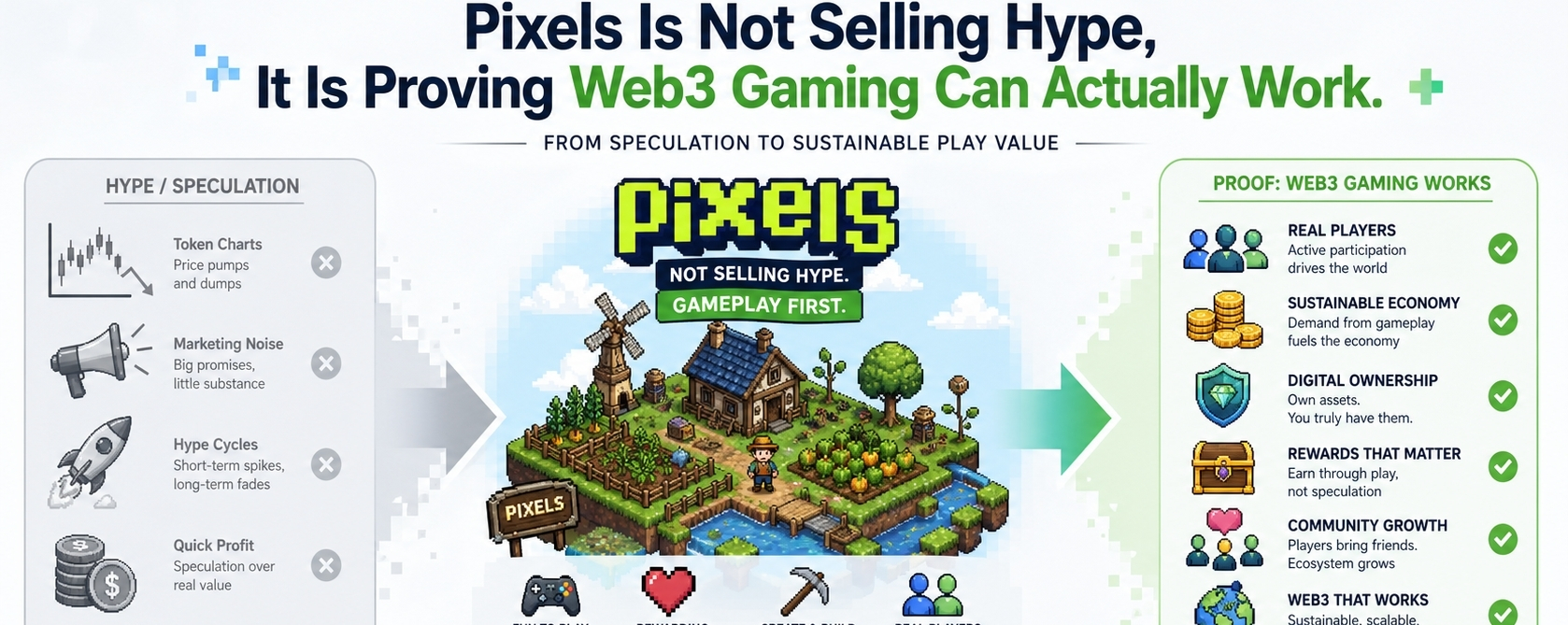
Pixels is not proof that every Web3 game will succeed.
But it is proof that the idea does not have to be fake.
And I think that is the part people keep missing. The future may not arrive as some loud revolution. It may look simple. A small farm. A daily task. A trade. A world people keep returning to because it feels useful, social, and alive.
That is where I stand with Pixels.
Still skeptical.
But paying attention.
