
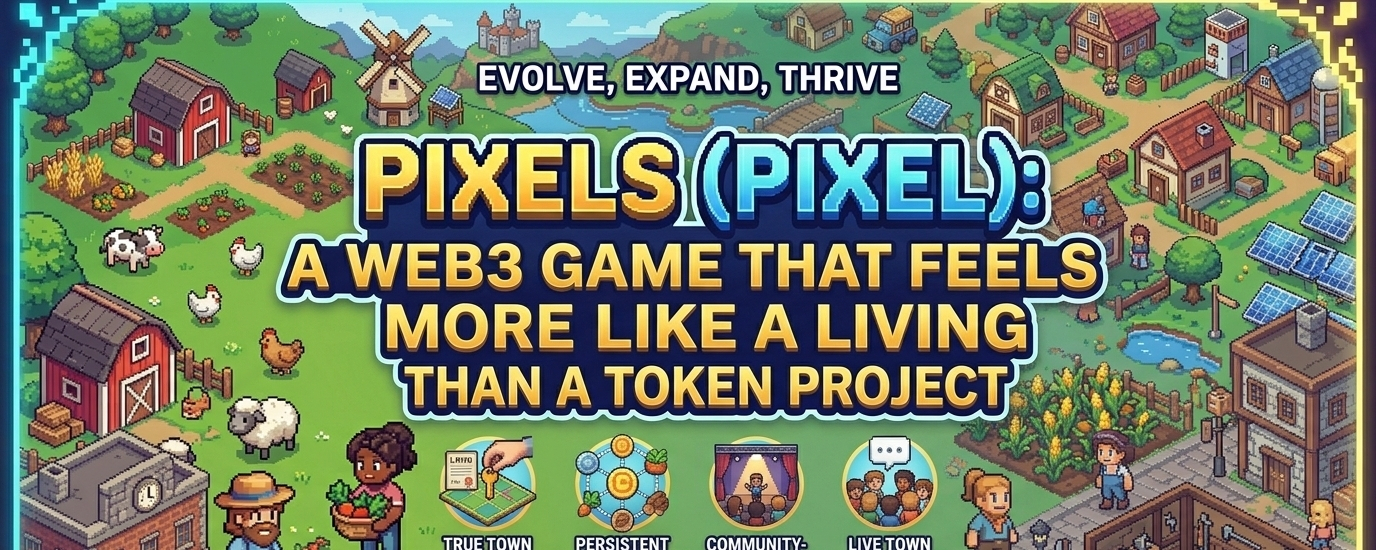
Pixels is one of those games that is easy to misunderstand if you only glance at the ticker. On paper, it is a social casual Web3 game built on Ronin. In practice, it tries to be something more interesting: a place where farming, exploration, creation, and community all feed into each other instead of sitting in separate corners like features written on a pitch deck. The official lite paper describes it as an open-ended world “built one pixel at a time,” where players gather resources, advance skills, build relationships, and move through story and quests while blockchain ownership sits quietly underneath the experience. That tone matters, because Pixels has always looked less like a flashy crypto product and more like a game that wants to feel inhabited
A game that starts with dirt, not hype
What gives Pixels its identity is the way it begins with ordinary game pleasures. You are not launched into a galaxy of abstract finance, impossible combat systems, or endless menus. You farm, you collect, you improve, you talk to people, you unlock new tools, and you slowly make your corner of the world feel less like borrowed space and more like yours. That is not just a poetic reading; it is baked into the project’s own description, which frames Pixels as a world of farming and exploration, with managing, creating, and exploring woven together into the same loop. Independent explainers have described it in similar terms, calling it a social, casual, open-world Web3 game and platform
That design choice is smarter than it first appears. A lot of Web3 games try to make the blockchain the headline. Pixels does the opposite: it makes the game the headline and lets ownership, trading, staking, and digital collectibles support the experience rather than overpower it. Even the official website frames the broader ambition as a platform where users can build games that integrate digital collectibles and where communities can “come to life.” That is a bigger idea than a single farming sim. It is a hint that Pixels wants to be infrastructure for playful worlds, not just one world
Why Ronin matters more than people think
Pixels would probably not feel the same on a generic chain. Ronin is an EVM-compatible blockchain built for gaming, and CoinGecko’s overview describes it as a gaming-focused network that powers two of Web3’s most prominent titles, Axie Infinity and Pixels. That matters because Pixels is not only using Ronin as a technical rail; it is borrowing the network’s whole identity: faster play, lighter friction, and a user base that already understands game-first blockchain design
The Ronin migration also tells a story about what the team values. When Pixels went live on Ronin, the Ronin blog said players could log in with a Ronin wallet and that the move would help push the game’s full migration forward. The same announcement made clear that gameplay on Ronin would be the same as on Polygon, but with Ronin wallet connectivity instead of an Ethereum wallet. That is the sort of detail that sounds small until you remember how many players quietly disappear when setup feels like homework. Less friction means more actual play
The real hook: progression that feels handmade
The best thing about Pixels is not that it has “progression.” Plenty of games have progression. The difference is that Pixels gives progression a handmade, social quality. The archived game updates show that the game has been steadily expanding its skill and industry systems: farming, cooking, woodworking, metalworking, stoneshaping, mines, and trees all sit inside a broader tiering structure, and even beginner spaces like specks were reworked so players could place industries, upgrade them, and see their little plots become more capable over time. That kind of design does something psychologically important: it makes growth visible. You do not just level up. You remodel your life inside the game
That is where Pixels starts to feel less like a “Web3 game” and more like a digital neighborhood. When a game lets you own land, decorate it, improve it, and use it as a base for production, the emotional effect is very different from a simple earn-and-exit loop. CoinGecko’s guide describes players farming crops, raising animals, trading goods, doing quests, owning farmland plots and pet NFTs, and building their own land. That combination turns everyday tasks into long-term identity. You are not only chasing rewards. You are shaping a place that reflects your decisions
An economy that keeps changing shape
One of the more revealing things about Pixels is that its economy has clearly evolved instead of staying frozen. During the Ronin migration era, the official announcement emphasized $BERRY as the in-game utility token and even gave simple examples of how players could earn it through gameplay. Later explainers describe the game using a free-to-play structure with off-chain Coins and on-chain PIXEL, which suggests the project has continued refining how value moves through the world. That evolution is important. It shows a team still tuning the balance between accessibility and ownership, between casual play and economic depth
Today, the help center makes the staking layer sound much more deliberate and ecosystem-oriented. In-game staking requires at least 100 $PIXEL and rewards are tied to activity in the past 30 days, while external staking through the dashboard has no minimum deposit and no in-game activity requirement. In both cases, the game is clearly trying to reward participation rather than passive holding alone. The system also includes a 72-hour lockup after unstaking, which adds a bit of gravity to the whole thing. Pixels is not pretending tokens are magic; it treats them like levers inside a live game economy
Lad, staking, and the quiet power of ownership
Land in Pixels is not just cosmetic. The staking FAQ says Farm Land NFTs give in-game $PIXEL staking power, with each land adding a 10% boost capped at 100,000 $PIXEL per land. That is a neat example of how the project ties ownership to utility without making ownership the whole story. The land is valuable because it does something, but it is also valuable because it sits inside a broader loop of play, production, and progression
That matters because it creates a more interesting social hierarchy than simple “rich versus poor” mechanics. A landholder is not just a speculator; ideally, they are someone whose ownership changes how they participate in the world. Pixels also notes that if land is rented out, the benefit follows the wallet currently holding or delegated to the land, which is exactly the kind of practical rule that reveals how seriously the game takes its internal economy. It is trying to make land feel like a working asset, not a decorative receipt
What Pixels gets right that many Web3 games miss
Pixels understands that players do not fall in love with “yield.” They fall in love with rhythm. They like routines that feel satisfying, spaces that get familiar, goals that stack on top of one another, and communities that remember them. The game’s own documentation leans into that rhythm: gather resources, advance skills, build relationships, complete quests, and keep moving through a world where the pace is relaxed enough to be welcoming but layered enough to stay interesting. Even the official site’s broader pitch about building games around digital collectibles suggests a long-term vision: not just one entertaining loop, but a framework for many communities to form around play
That is also why Pixels feels different from the cold stereotype people often attach to Web3 gaming. It is not selling the fantasy of instant riches. At its best, it sells a slower and stranger promise: that digital ownership can be meaningful when it is attached to a place, a skill tree, a neighbor, a task board, a pet, or a patch of land you keep returning to. That is a much harder thing to build than a speculative token loop, but it is also the reason Pixels has remained relevant while so many louder projects have faded into noise
The radeoff: depth comes with patience
Of course, Pixels is not effortless, and that is part of its charm and its problem. Games like this ask for patience. They ask you to learn systems, manage resources, understand timing, and care about small gains that do not look dramatic on a screenshot. That can be deeply rewarding for players who like slow-burn progression, but it can also feel demanding if someone wants instant spectacle. Even the official staking and gameplay systems suggest a philosophy built around activity, planning, and long-term involvement rather than quick extraction
That tension is probably the heart of Pixels. It wants to be casual, but it is not shallow. It wants to be social, but it is not just chat with a skin on top. It wants blockchain ownership, but it refuses to let ownership replace the game itself. That balancing act is difficult, and sometimes messy, but it is also what gives Pixels a real personality. It feels like a project still trying to earn its shape in public, which is often where the most interesting games are born
Conclusion: why Pixels sticks in the mind
Pixels works because it understands a simple truth: people do not remember systems first. They remember places. They remember routines that became rituals, tools that felt useful, land that felt personal, and communities that made the world feel inhabited. By centering farming, exploration, creation, skills, land, and social play on Ronin, Pixels has built a Web3 game that aims for something sturdier than speculation. It tries to make ownership feel lived-in. It tries to make progress feel handmade. And most importantly, it tries to make the player feel like they are growing inside a world, not just farming inside an economy.
If you read Pixels only as a token story, you miss the point. The more interesting story is that it is trying to become a place people want to return to for reasons that have nothing to do with charts. That is a much harder promise to keep. It is also the one that gives Pixels its staying power