

@Pixels i still remember watching early P2E games and feeling like everyone was pretending not to see the obvious. People weren’t playing because the game was good. They were playing because the token faucet was open. The moment rewards slowed down, the “community” started looking like mercenary liquidity. That’s why Pixels’ 2024 play-to-airdrop run caught my attention. It didn’t magically fix GameFi, but it changed the first question from “how fast can I earn?” to “what behavior does the game want before it pays me?”
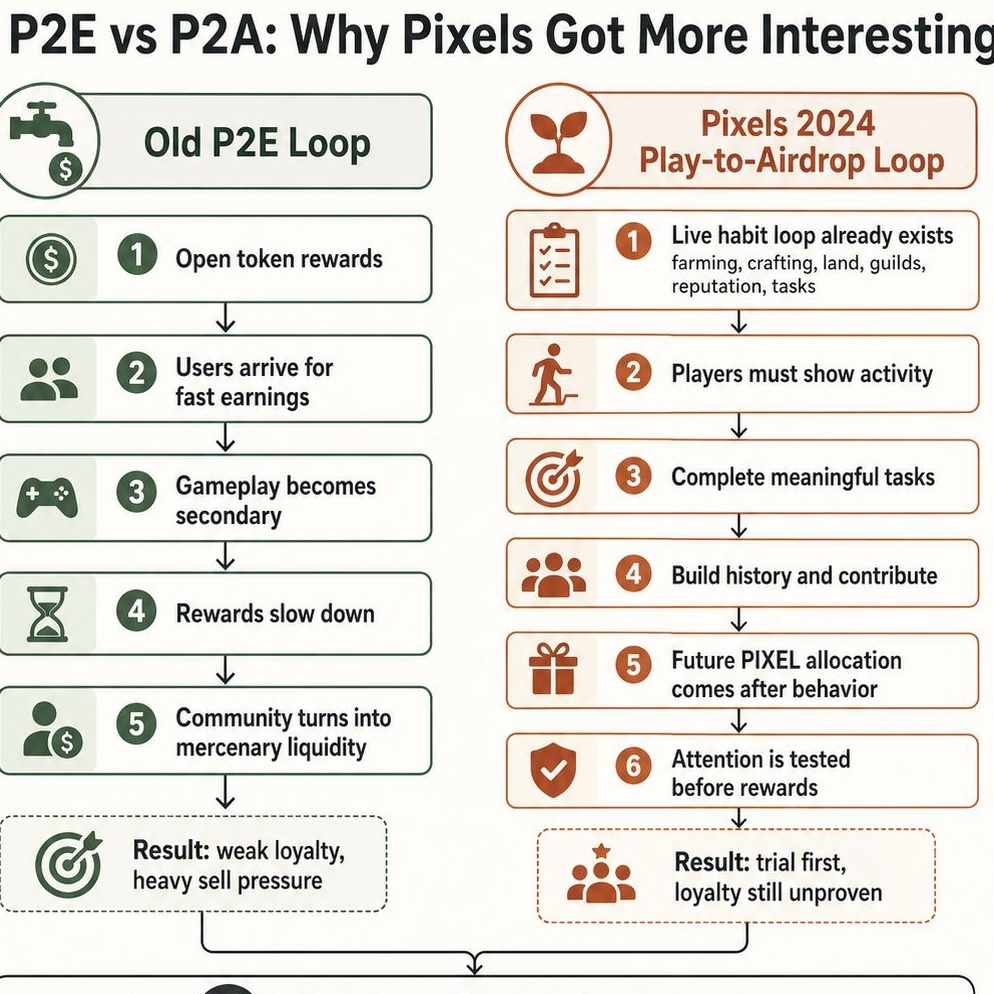
That difference matters for traders. Play-to-earn failed because it often paid users before it proved they were valuable. Play-to-airdrop, at least in Pixels’ case, tried to reverse that order. Players had to show activity, complete tasks, build history, and contribute before the token became the reward. Pixels’ January 2024 campaign was built around earning future PIXEL allocation through gameplay, and reports at the time said players had to actually play and complete meaningful tasks rather than just appear with a wallet. That was smarter than the old model because it treated attention as something that had to be tested first.
Now here’s the thing. Airdrops still attract farmers. Anyone who’s been around long enough knows that. But Pixels had one advantage the older P2E crowd didn’t always have: the token came after a live habit loop already existed. Farming, crafting, land, guilds, reputation, tasks, and Ronin’s low-friction environment gave people something to repeat daily. Was every player there for fun? No. But not every player needed to be. The real test was whether enough reward-seekers could convert into retained users after the airdrop glow faded.
That’s the Retention Problem, and for PIXEL it’s the whole trade. If people came only for the 2024 airdrop and left, then the token becomes another post-launch liquidity exit. If a meaningful slice stayed, used the economy, joined guilds, staked, built land routines, and kept interacting, then play-to-airdrop worked better than P2E because it bought trial instead of pretending it had loyalty.
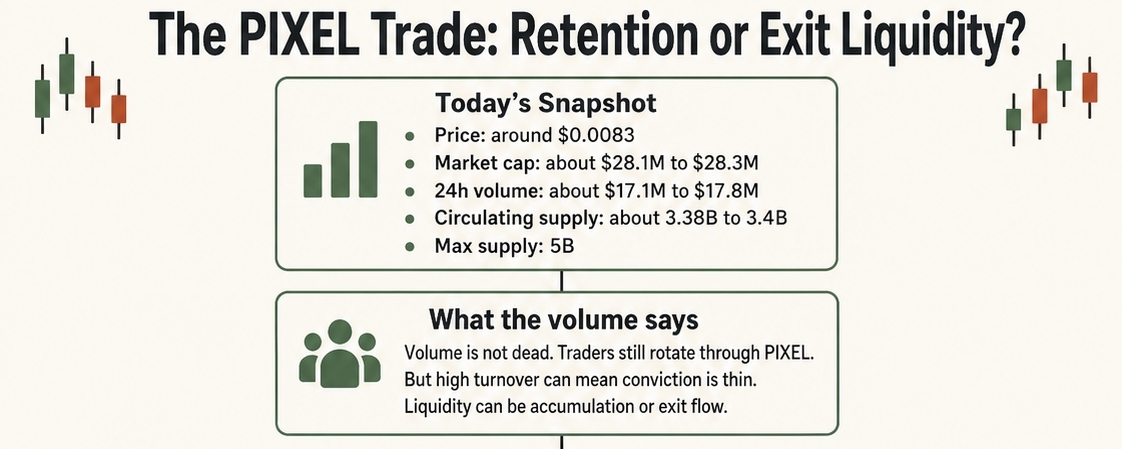
Today’s numbers show both sides of that argument. Binance shows PIXEL around $0.0083, with roughly $28.1 million market cap, about $17.8 million in 24-hour volume, and 3.4 billion tokens circulating. CoinMarketCap is in the same zone, showing about $28.3 million market cap, $17.1 million in 24-hour volume, 5 billion max supply, and 3.38 billion circulating supply. That volume is not dead. For a small cap gaming token, daily turnover above half of market cap means traders are still actively rotating through it. But it also means conviction can be thin. Liquidity is there, yes, but liquidity can be exit flow just as easily as accumulation.
The bull case is realistic, not romantic. PIXEL has already survived the first big hype decay. The token is far below its early highs, but the project still has active infrastructure, Ronin distribution, staking language, land utility, and a game that is not just a whitepaper promise. Binance Research describes PIXEL as the native utility and governance token for a Ronin based social Web3 game, with uses around NFT minting, VIP features, guild-related functions, and governance. That matters because a token with actual sinks has a better chance than a token that only exists to reward clicking.
But I’m still cautious. CoinGecko currently shows a much smaller market cap figure because it tracks only about 770 million tradable PIXEL, while Binance and CoinMarketCap show around 3.38 to 3.4 billion circulating. That kind of data mismatch is exactly the kind of thing that makes me slow down before getting too confident. When trackers disagree that much, traders need to understand which supply number their venue and market participants are actually pricing.
The bear case is simple. Play to airdrop worked in 2024 because it created anticipation, but anticipation is not retention. If users keep treating Pixels like a campaign machine, then every new incentive becomes a future sell event. If gameplay starts feeling too managed, too gated, or too optimized around reward timing, normal players may lose interest while farmers keep studying the system. That’s the frustration I can’t shake. A game economy can become so good at filtering abuse that it starts feeling less like play and more like a job interview.
So my call to action is this: don’t judge PIXEL only by the candle. Watch whether the game keeps people after the reward, whether volume turns into deeper conviction, whether staking and guild activity create real repeat behavior, and whether supply pressure stays manageable. The trade isn’t “P2A beat P2E.” The trade is whether Pixels can turn paid attention into unpaid habit. That’s where the truth is hiding.