
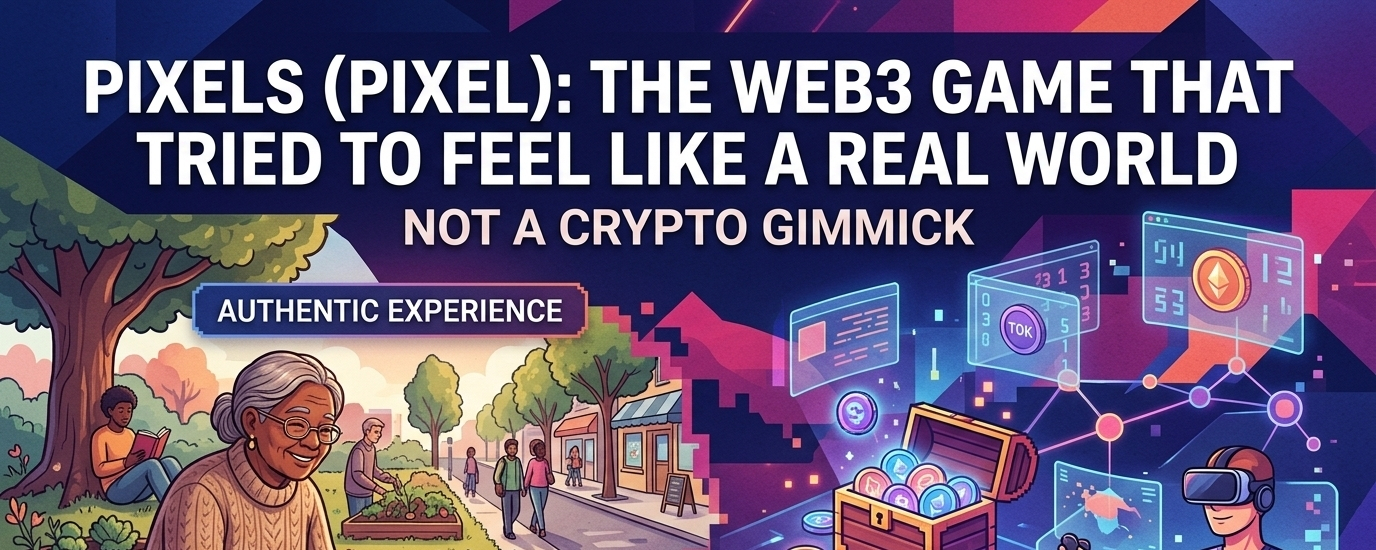
Pixels is one of those games that is easier to understand once you stop looking at it like a “Web3 project” and start looking at it like a place. The official docs describe it as an open-ended world built around farming and exploration, where you gather resources, advance skills, build relationships, and move through quests in a universe that ties blockchain ownership to your progress. The current site leans into the same idea: make a home, master skills, play with friends, and build new communities. That combination matters, because it tells you exactly what Pixels is trying to be: social first, casual in feel, and economically layered underneath
A cozy game with an economy hiding in plain sight
At its surface, Pixels speaks the language of relaxing games. You farm crops, raise animals, harvest energy, and use that energy to expand what you can do. You personalize land, play with friends, and collaborate or compete in a world that is clearly meant to feel alive rather than transactional. The documentation also shows that the core gameplay grew beyond simple farming: quests, cooking, land ownership, map building, and social features sit alongside the basics, which is part of why the game has always felt broader than a single loop
That broader design is not accidental. Pixels’ whitepaper says the project was never meant to stop at one game; instead, it was built to address the problems of play-to-earn by using better incentive design, targeted rewards, and data-driven token mechanics. In plain English, that means the team is trying to make the economy serve the game, not the other way around. That distinction is easy to miss in Web3, where many projects begin with token hype and never really become games. Pixels seems to be trying to reverse that order
Why Ronin became the obvious home
Pixels’ migration to Ronin is one of the most important parts of its story. Ronin announced in September 2023 that Pixels would move to its network, noting that the game already had strong traction, was still fully playable at the time, and would transition from Polygon to Ronin with Ronin’s support. Later, Ronin confirmed that Pixels was live on Ronin and that players could create a Pixels account using a Ronin wallet, earn $BERRY, buy Pets on Mavis Market, and continue playing with the same basic gameplay loop
That move mattered because Ronin is built specifically for games and player-owned economies. Its own site describes it as an EVM blockchain crafted for developers building games with player-owned economies, and it emphasizes features like frictionless onboarding and wallet integration. In a game like Pixels, that kind of infrastructure is not just convenient; it shapes the whole experience. A farm game can survive a clunky wallet flow for a while, but if you want players to return every day, swap items, own land, and participate socially without friction, the chain has to disappear into the background. Ronin was designed to do exactly that
The token is not the whole point, but it does matter
$PIXEL is the premium in-game currency at the center of the economy. The official docs say it is used for items, upgrades, and cosmetic enhancements outside the core gameplay loop, and they also describe uses such as minting new land, speeding up build times, temporarily boosting energy, unlocking skins, unlocking XP and skill enhancers, unlocking crafting recipes, and even purchasing merchandise. Ronin’s own launch post for the RON/PIXEL pool says PIXEL fuels the farming simulation game and can be used for in-game items, upgrades, and cosmetic enhancements
The same Ronin post also gives the token’s supply details: a total supply of 5 billion PIXEL and an initial circulating supply of 771,041,667, or 15.42% of total supply. It also points to the token’s contract on Ronin. That matters because it shows PIXEL was never pitched as an infinite farm-fodder token; it was structured as a controlled asset meant to support the game’s economy rather than simply inflate alongside player activity
By early 2024, the token had moved from idea to reality. Ronin reported that PIXEL was available and tradeable on Binance Launchpool, and that the RON/PIXEL pool on Katana gave Ronin users a direct swap route. In other words, PIXEL became part of a live market, but one still anchored tightly to the game itself. That balance is one of Pixels’ central experiments: make the token useful enough to matter, but not so dominant that the whole experience turns into a spreadsheet
Chapter 2 made the game feel much bigger
Pixels did not stay stuck in its original farming identity. The game’s own archived update log shows a major Chapter 2 shift in June 2024, when Pixels added or reorganized skills, industries, specks, avatar creation, land systems, and a much more structured task board and progression model. It also notes that existing items were migrated, industries were tiered, and Terra Villa was reorganized. That is the kind of update that changes a game’s rhythm, not just its balance numbers
The same update log shows just how much the game started to resemble a living MMO economy rather than a simple farming sim. Skills such as stoneshaping and metalworking were added, production chains became more elaborate, and landowners got more meaningful progression paths. Later updates in 2024 and 2025 added reputation changes, seasonal events, task-board adjustments, and new industry limits. The pattern is clear: Pixels is not static. It is being constantly tuned into a world with longer-term loops, more specialization, and more reasons to return
That evolution also lines up with what the homepage now emphasizes. Pixels says “Chapter 2 Is Here,” highlights pets, staking, communities, and updates every two weeks, and frames the game as a place where users can build games that integrate digital collectibles. That is a much bigger ambition than “farm, sell, repeat.” It suggests a platform layer sitting underneath the game layer, which is where Pixels becomes more interesting than the average blockchain title
What makes the social layer work
A lot of Web3 games talk about ownership. Fewer make ownership feel social. Pixels has always pushed in that direction. Ronin’s migration announcement said the game already included mini-games, peer-to-peer resource trading, and no-code tooling that lets players create their own in-game items. The homepage adds guilds, avatars, and the idea of building communities around shared play. That is important because social games survive on habits, not just incentives. People come back when they feel seen, needed, or mildly competitive in a way that does not feel exhausting
The task board, reputation systems, events, and creator codes all reinforce that same idea. Pixels’ help center says staking $PIXEL is tied to different game projects and can provide future benefits, while other support pages show creator codes, reputation-based fee logic, and live events that reward participation. The result is an economy that is not only about extracting value; it is also about signaling affiliation, supporting guilds, and turning regular players into part of the ecosystem’s social machinery
Why Pixels stands out in a crowded Web3 field
The biggest reason Pixels stands out is that it understands how little most players care about blockchain when the game is fun. Its own whitepaper says the team is trying to solve the hard parts of play-to-earn by using targeted rewards and better incentive alignment, while the homepage keeps returning to friendly language: play with friends, build communities, own your world, earn rewards. That framing feels less like a pitch deck and more like a promise that the game should be enjoyable even before the token logic kicks in
That is also why the Ronin connection makes sense. Ronin is pushing itself as a purpose-built gaming chain, and Pixels is exactly the kind of title that can benefit from that setup: a social world with land, resources, items, wallets, and a token economy that needs fast, low-friction transactions. The fit is not just technical. It is philosophical. Both are betting that Web3 will work better when the game is already compelling without needing the blockchain to explain itself at every turn
The real reason people keep returning
Pixels works because it has a familiar emotional shape. You plant something, wait, harvest, improve, decorate, trade, and come back tomorrow to see what changed. That loop is ancient game design, and it still works because it taps into patience, ownership, and small visible progress. Pixels adds a modern layer on top of that with NFTs, token rewards, guild structures, and staking, but the core feeling is still recognizably human: make a place, make it better, share it with others
There is also a practical reason the game has endured. The project keeps updating. The archived changelog shows regular balance changes, seasonal events, new recipes, updated industries, and adjustments to the economy and land systems. That kind of ongoing maintenance is not flashy, but it is the difference between a game that briefly trends and one that keeps breathing. Pixels looks like a world that is still being actively negotiated between developers, players, and an economy that has to stay believable
Conclusion
Pixels is interesting because it never fully chooses between comfort and ambition. On one hand, it is a farming-and-friends game with crops, animals, land, pets, and cozy progression. On the other hand, it is a Web3 experiment with a token, staking, player-owned assets, and a chain designed to keep the whole machine moving smoothly. That tension is exactly what makes it worth watching. Pixels is not just trying to be another blockchain game. It is trying to be the kind of place players remember for the routine itself. And in a market crowded with loud promises, that is a much stronger idea than it first sounds
If you want, I can , turn this into a more polished blog-style article with a stronger headline, and SEO-friendly subheadings
