
There’s a particular kind of silence that settles over financial markets right before people realize the system they trusted isn’t nearly as solid as they thought. You could feel it in 2008. Banks collapsing. Governments scrambling. Executives walking away rich while ordinary people watched retirement accounts evaporate in real time. And somewhere inside that chaos, almost quietly at first, Bitcoin appeared on the internet like a challenge nobody fully understood yet.
The funny part is, hardly anyone took it seriously in the beginning.
Back then Bitcoin looked less like a financial revolution and more like an obscure experiment built by programmers who spent too much time arguing on forums. A digital currency with no government backing, no physical form, no CEO, no customer service line, and a mysterious creator nobody could identify? To most people, it sounded ridiculous. Honestly, even people inside tech dismissed it for years.
And yet here we are.
Wall Street firms now package Bitcoin into investment products for institutional clients. Governments debate national crypto regulations almost monthly. Major corporations hold Bitcoin on balance sheets. Presidential candidates talk about crypto policy publicly because they know millions of voters care about it now. Somewhere along the way, the thing people mocked as “internet monopoly money” became impossible to ignore.
That matters more than people realize.
Because Bitcoin’s rise was never only about technology. It was about trust. Or more accurately, the slow erosion of trust in traditional systems people once assumed were permanent.
Look, I’ve seen this movie before. Every major technological shift begins the same way. First it gets laughed at. Then it gets attacked. Then suddenly the institutions that dismissed it start trying to absorb it before they lose control of the narrative entirely. The internet followed that trajectory. Social media did too. Artificial intelligence is going through it right now. Bitcoin fits the pattern almost perfectly, except money carries a deeper emotional charge than most technologies ever will.
People don’t just use money. They build their lives around it. Their security. Their future. Their identity, sometimes.
That’s why Bitcoin triggers such visceral reactions. Some people see liberation in it. Others see financial nihilism dressed up as innovation. And if we’re being honest, both sides occasionally sound a little unhinged.
Spend enough time around hardcore Bitcoin evangelists and you’ll hear declarations that traditional banking is already dead, governments are doomed, and decentralized money will replace everything within a decade. Then spend five minutes with Bitcoin critics and you’d think the entire industry exists solely for scams and speculation. Reality sits somewhere in the middle, which is usually where the truth lives in emerging technologies.
Still, something undeniably shifted after Bitcoin arrived.
Before Bitcoin, most people never questioned the architecture behind money itself. Currency was issued by governments. Banks processed transactions. Inflation existed because economists said it was necessary. The average person wasn’t sitting around wondering whether monetary systems could operate differently. Why would they? The machinery was invisible.
Bitcoin dragged that machinery into public view.
Suddenly people started asking uncomfortable questions. Why can central banks print effectively unlimited currency during crises? Why do cross-border payments still move like it’s 1997? Why does sending money internationally cost so much in certain regions? Why do billions of people remain underbanked while smartphones become nearly universal?
Bitcoin didn’t invent those problems. It exposed them.
And here’s where things get interesting. Even people who hate Bitcoin are now participating in conversations Bitcoin forced into the mainstream. Digital ownership. Decentralization. Monetary sovereignty. Scarcity in digital environments. These were once fringe concepts discussed mostly by cryptographers and libertarians online. Now central banks, hedge funds, regulators, and Fortune 500 executives debate them openly.
That alone makes Bitcoin historically important, regardless of where its price goes next year.
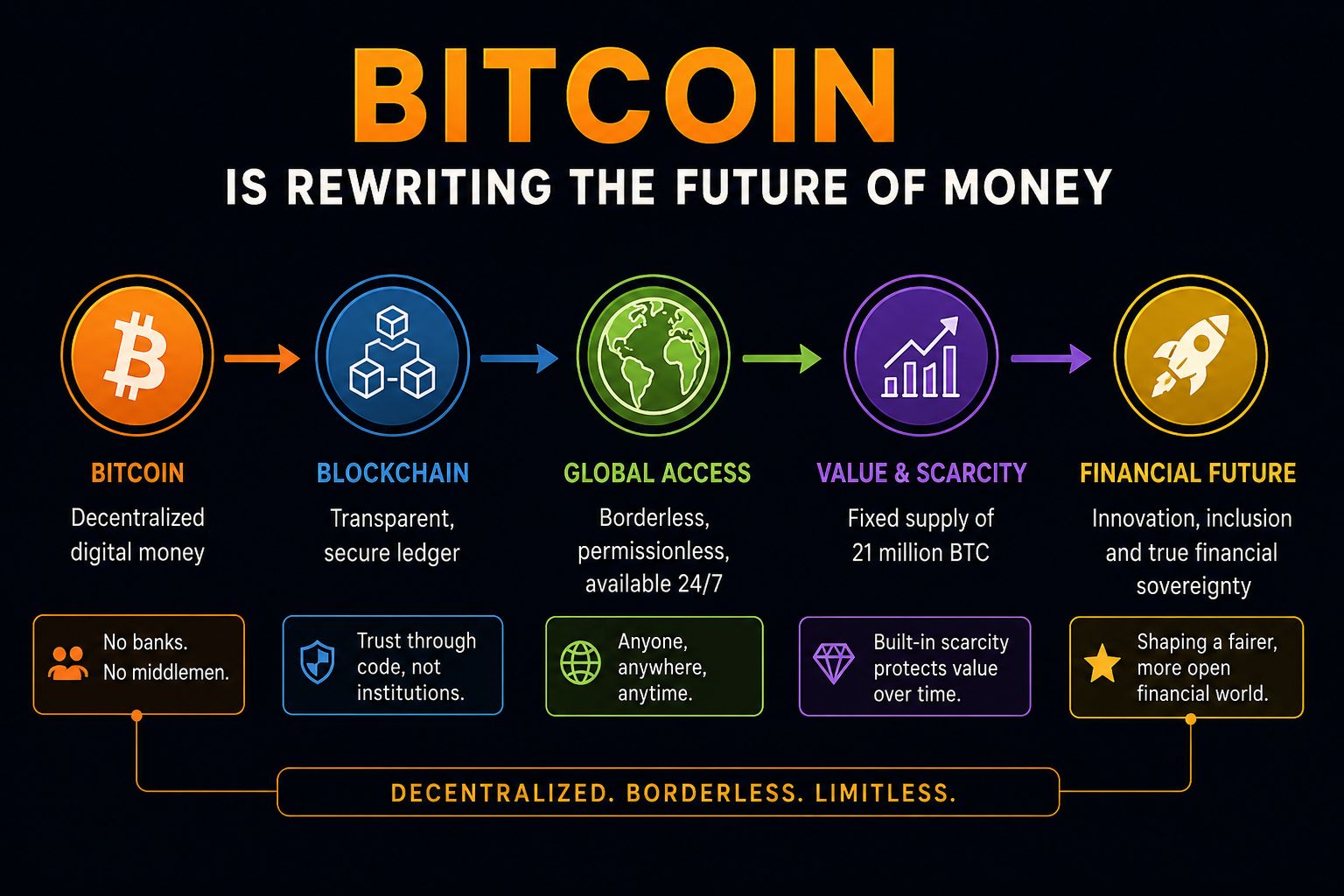
The core design still feels almost confrontational when you step back and look at it properly. Only 21 million Bitcoin will ever exist. No central authority can change that supply cap casually. No government controls issuance. The network operates globally, continuously, without office buildings or banking hours. That structure was intentional from day one.
And it arrived at exactly the right moment psychologically.
After the financial crisis, public faith in institutional competence took a real hit. People watched governments bail out banks while ordinary citizens absorbed the consequences. Bitcoin emerged offering an alternative model built around code instead of centralized trust. Whether or not someone believes that model is sustainable long-term, the emotional appeal was obvious.
Be real for a second. A lot of Bitcoin’s momentum came from disillusionment.
Not just greed. Not just speculation. Frustration.
Especially outside wealthy Western economies.
In countries dealing with inflation crises or unstable banking infrastructure, Bitcoin looks very different than it does to someone trading crypto casually from a Manhattan apartment. For people living under capital controls or rapidly devaluing currencies, decentralized assets can feel less like speculative tech and more like financial survival tools. Western crypto discourse sometimes forgets that because it gets distracted by meme coins and billionaire tweets.
The actual utility stories are usually quieter.
Freelancers getting paid across borders without payment restrictions. Families sending remittances without losing huge percentages to fees. Citizens preserving purchasing power when local currencies collapse. Those stories rarely dominate headlines because they don’t generate the same social media frenzy as overnight millionaires posting screenshots.
But they matter more long term.
At the same time, Bitcoin absolutely became a speculative asset. Pretending otherwise would be dishonest. Entire waves of investors entered crypto markets chasing life-changing wealth, not monetary philosophy. Some made fortunes. Others got wrecked chasing hype cycles they barely understood. We’ve watched this play out before in nearly every emerging market driven by equal parts innovation and greed.
Railroads. Dot-com stocks. Housing. AI startups now, frankly.
Human beings consistently overestimate short-term revolutions while underestimating long-term structural change.
Bitcoin experienced both extremes simultaneously.
That tension still defines the industry today. Is Bitcoin primarily a decentralized monetary breakthrough or a speculative financial instrument? Depends who you ask — and probably when you ask them. During bull markets, people talk about liberation and transformation. During crashes, suddenly everyone rediscovers the word “bubble.”
The volatility remains one of Bitcoin’s biggest image problems. Traditional investors can tolerate risk. What they struggle with is chaos. Ten percent swings in a single day still happen often enough to make mainstream adoption psychologically difficult. You can’t realistically function as stable everyday currency while behaving like a hypergrowth tech stock during earnings season.
Bitcoin supporters usually counter by comparing its current volatility to early internet companies. Their argument is that monetizing a new global asset network naturally creates violent price discovery phases before maturity. There’s some truth there. But let’s be honest, crypto culture also developed a bad habit of treating skepticism as ignorance, which damaged credibility badly over the years.
And credibility matters in finance more than almost anything else.
Especially after the collapse of several major crypto firms that marketed themselves as trustworthy institutions right before imploding spectacularly. Those failures exposed a contradiction sitting at the heart of modern crypto culture: an industry built around distrust of centralized intermediaries somehow recreated centralized intermediaries almost immediately.
Humans are funny like that.
Still, Bitcoin itself kept operating through every scandal, crash, regulatory attack, and market collapse. That resilience became part of the story too. Critics predicted Bitcoin’s death repeatedly over the years. The network just kept processing blocks.
That persistence changed perceptions slowly.
The institutional shift was probably the clearest turning point. When companies like BlackRock started moving seriously into Bitcoin products, the conversation evolved overnight. Wall Street didn’t suddenly become ideologically pro-Bitcoin. That’s not what happened. Demand became too large to ignore profitably.
There’s an important distinction there.
Traditional finance realized Bitcoin could no longer be dismissed as a temporary internet phenomenon. Once pension funds, asset managers, and publicly traded corporations entered the ecosystem meaningfully, Bitcoin crossed into another phase entirely. It stopped looking fringe.
Ironically, that institutional acceptance created internal conflict inside crypto communities themselves. Early Bitcoin culture often positioned itself as anti-establishment, almost rebellious by design. Now many of the same institutions Bitcoin originally challenged are integrating it into traditional financial products.
That’s where things get messy philosophically.
Can something remain financially revolutionary after Wall Street absorbs it? Maybe. Maybe not completely. But history suggests disruptive technologies rarely stay outside institutional systems forever. The internet eventually became dominated by giant corporations too. That didn’t erase its transformative impact.
Bitcoin mining created another layer of controversy that never fully went away. Critics point to enormous energy consumption as proof the system is fundamentally unsustainable. Supporters argue the energy debate gets oversimplified constantly, especially compared against the environmental costs of existing financial infrastructure or unused energy resources powering many mining operations.
The truth is, both sides selectively frame the conversation.
Bitcoin mining absolutely consumes significant energy. That criticism is legitimate. But the discussion often ignores nuances around renewable energy adoption, stranded energy utilization, and how energy markets actually function regionally. It’s not as clean-cut as either side usually presents online.
Then again, almost nothing in crypto ever is.
What fascinates me most about Bitcoin at this point isn’t even the technology anymore. It’s the psychology surrounding it. Few assets in modern history have become such powerful cultural projection screens. People see what they want to see in Bitcoin. Freedom. Greed. Hope. Collapse. Innovation. Delusion. Rebellion. Financial evolution.
Sometimes all at once.
And despite everything — the crashes, scams, regulation fights, environmental debates, institutional hypocrisy, speculative mania — Bitcoin continues forcing the world to rethink assumptions that once felt untouchable.
That’s the real story here.
Not whether Bitcoin reaches another all-time high next cycle. Not whether some influencer predicts a million-dollar price target on a podcast. Most of that noise fades eventually.
What remains is the larger shift in perception.
Before Bitcoin, digital scarcity sounded impossible. Decentralized global money sounded unrealistic. Financial systems operating outside state infrastructure sounded fringe. Now governments actively strategize around digital assets because ignoring them entirely stopped being viable years ago.
That’s an extraordinary change for a technology barely old enough to drive.
Maybe Bitcoin eventually becomes digital gold integrated permanently into institutional finance. Maybe it stabilizes as a niche reserve asset. Maybe future technologies eventually surpass it technically while preserving the ideas it introduced. All plausible outcomes.
But the deeper transformation already happened.
Bitcoin forced people to realize money is not some immutable law of nature handed down permanently by governments and banks. It’s infrastructure. Designed infrastructure. And once people understand infrastructure can be redesigned, they start questioning everything connected to it.
That realization doesn’t disappear.
Not after this many people have seen behind the curtain.
