
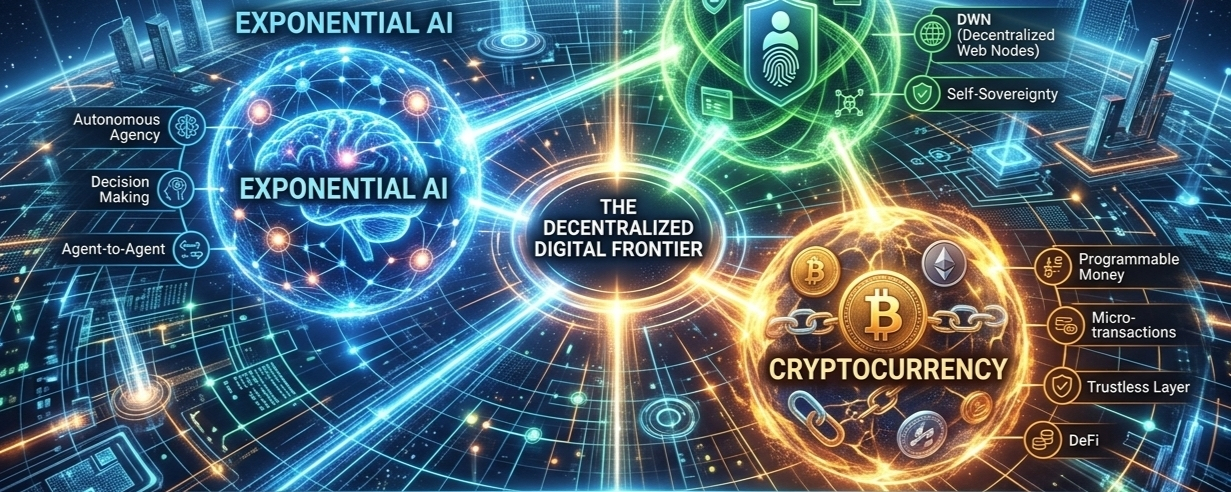
The technological landscape is undergoing a massive paradigm shift. We are no longer moving in a linear fashion; instead, we are witnessing an exponential explosion in Artificial Intelligence (AI). As AI transitions from basic chatbots to highly autonomous agents capable of reasoning and executing complex tasks, a critical question arises:
What kind of digital infrastructure do these hyper-intelligent entities need to operate safely, freely, and efficiently?
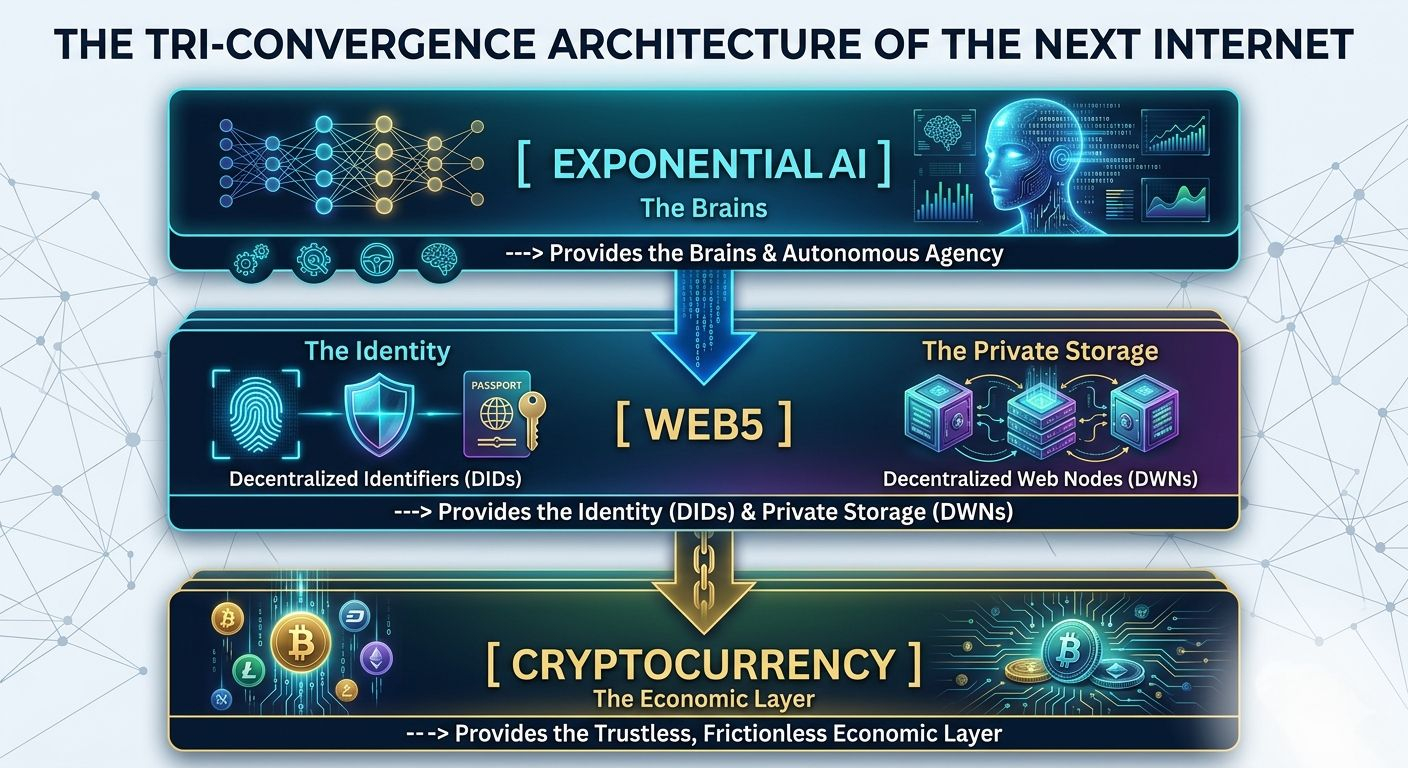
The answer lies at the intersection of Web5 and Cryptocurrency. Together, these three pillars are building a decentralized ecosystem where intelligence, identity, and value converge.
1. The Fuel: Exponential AI and Autonomous Agents
The exponential growth of AI means that tomorrow’s internet will not just be populated by human users, but by billions of Autonomous AI Agents. These agents will analyze data, optimize processes, and make real-time decisions. However, for an AI agent to be truly autonomous, it cannot remain trapped inside the centralized servers of Big Tech. It needs to have its own agency, its own data privacy, and the ability to interact with the world independently.
2. The Skeleton: Web5 for Identity and Data Sovereignty
This is where Web5 (the decentralized web platform built on Bitcoin and open protocols) enters the equation. Web5 provides the ultimate architectural framework for AI autonomy through two main components:
Decentralized Identifiers DIDs: Instead of an AI agent being tied to a corporate Google or Microsoft account, Web5 allows the agent to possess its own cryptographic, self-sovereign identity.
Decentralized Web Nodes DWNs: AI thrives on data, but centralized data collection violates user privacy. With Web5, users store their personal data in secure, encrypted DWNs. An AI can temporarily access a user's DWN to provide highly personalized automation without ever "owning" or stealing that data to train corporate models.
3. The Bloodline: Cryptocurrency as the Native Economic Layer
An autonomous agent with an identity (Web5) still needs a way to transact. It cannot open a traditional bank account or hold a Visa card. Cryptocurrency is the native economic layer of this new era.
Programmable Money: Crypto, smart contracts, and micro-transaction protocols (like the Bitcoin Lightning Network or stablecoins) allow AI agents to pay each other fractions of a cent for API calls, data retrieval, or computational power.
Trustless Ecosystem: Crypto eliminates the middleman. An AI agent can independently audit a blockchain transaction, verify liquidity, trade assets, or fund its own operations seamlessly and instantly, 24/7.
The Synthesized Vision: A Day in the Tri-Convergence Future
Imagine building an autonomous AI agent designed to hunt for market inefficiencies or manage your digital life.
Under this tripartite architecture, your agent boots up with a unique Web5 DID, giving it an independent, un-bannable digital identity. It connects to your personal DWN to understand your preferences, financial goals, and risk tolerance securely. To execute its strategy, the agent navigates the web peer-to-peer and uses Cryptocurrency to pay for its own cloud hosting, purchase premium data feeds, and execute on-chain trades on decentralized networks.
Conclusion
The exponential growth of AI is an unstoppable force, but without the right framework, it risks creating ultimate centralization. Web5 provides the necessary boundaries for privacy and identity, while Cryptocurrency provides the economic freedom required for machine-to-machine economies.
For the builders and architects of the modern web, the future is not about developing these technologies in isolation. The true breakthrough lies in synthesizing them into a single, cohesive ecosystem: an intelligent, self-sovereign, and decentralized digital frontier.