
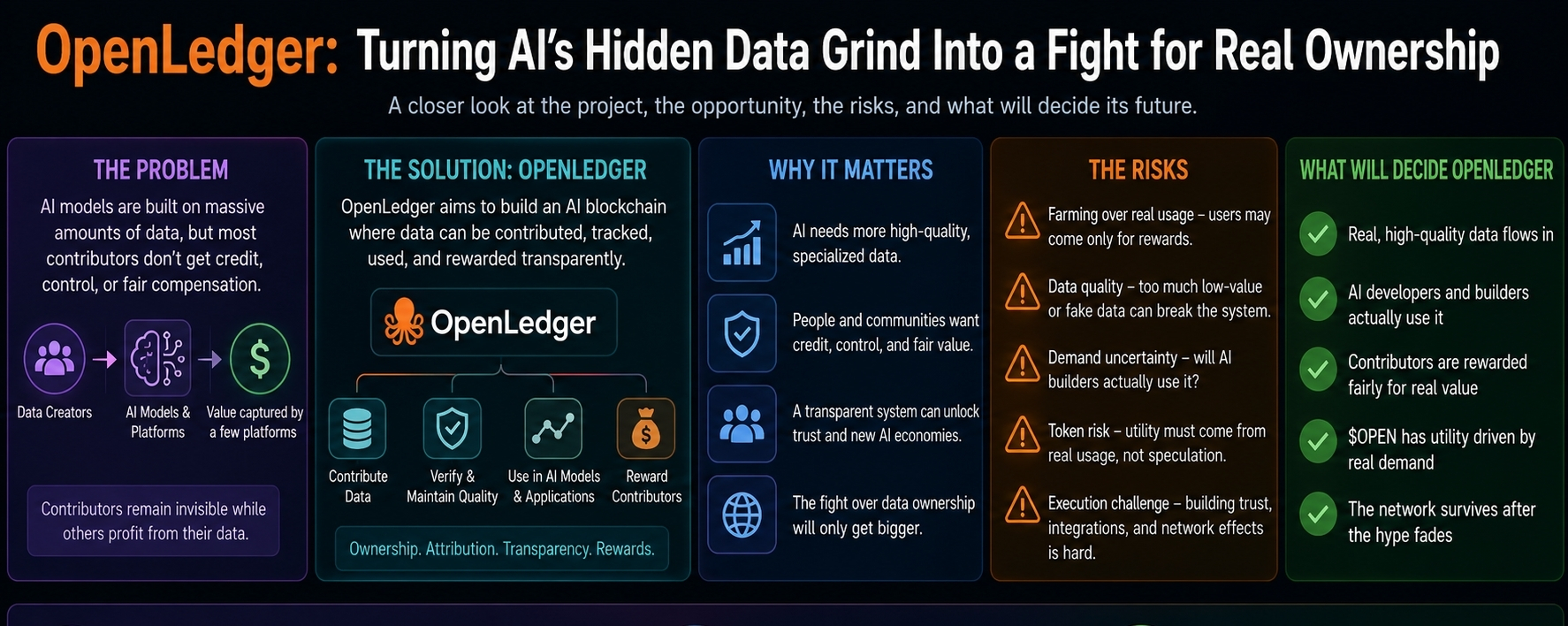

I’m watching OpenLedger closely, not because it is another AI-crypto name making noise, but because it is trying to touch one of the messiest problems in the AI market: who actually owns the data, who gets paid for it, and who disappears into the background while bigger systems make money from it.
That is the part that interests me.
OpenLedger is not just trying to sell the usual “AI plus blockchain” story. At least, that is not the part I care about. The more serious idea is that AI runs on data, and most of that data comes from people, communities, developers, creators, and businesses that rarely get proper credit or reward. OpenLedger wants to build a system where data can be contributed, tracked, used, and rewarded in a more open way.
That sounds simple, but it is not.
AI has made data more valuable than ever, but it has also made ownership harder to see. Once data is used to train or improve a model, it becomes difficult to know who created the value. Was it the person who uploaded the data? The community that collected it? The developer who cleaned it? The model builder who used it? Or the platform that turned everything into a product?
OpenLedger is trying to bring structure to that problem.
The project’s main idea is that data should not just be taken, used, and forgotten. If data helps AI become better, then the people behind that data should have a clearer role in the value chain. That is a fair idea. It is also the kind of idea crypto keeps coming back to: ownership, transparency, rewards, and removing invisible middlemen.
But I’ve been around crypto long enough to know that a good idea is only the beginning.
OpenLedger still has to prove the hard part. Can it attract useful data, not just random uploads? Can it bring in real builders who actually need that data? Can it create demand from AI developers, not just attention from token hunters? Can it reward contributors without turning the whole thing into another farming game?
That is where the project becomes interesting, and also risky.
Because if there are rewards, people will come. That is normal in crypto. But people coming for rewards does not always mean the product is working. It can make a project look active before it has real demand. Dashboards can look good. Communities can look busy. Social media can look excited. But after the incentives slow down, the real question appears: is anyone still using it?
For OpenLedger, that question matters a lot.
The project needs more than hype around AI. It needs real usage. It needs developers who use its network because the data is valuable. It needs contributors who provide data because the system rewards quality, not spam. It needs buyers or builders who can clearly say, “This helps me build something better.”
That is the difference between a real protocol and a temporary narrative.
I like that OpenLedger is focused on a real issue. AI companies need more specialized data. General internet data is not enough forever. The next wave of AI may depend on cleaner, more specific, more useful datasets. Finance data. Legal data. coding data. local language data. agent data. research data. community knowledge. These kinds of datasets can be valuable if they are organized properly.
OpenLedger could matter if it becomes a place where this kind of useful data is created, verified, and used.
But that is a big “if.”
Data quality is not easy. Anyone can say they are building a data network. The difficult part is making sure the data is actually useful. Bad data can hurt models. Duplicate data wastes time. Fake data creates problems. Stolen data creates legal risk. Low-quality data attracts short-term farmers but pushes away serious users.
So OpenLedger has to be strict about quality. It cannot only focus on growth. It has to focus on trust.
That may be the hardest part.
In crypto, projects often want fast numbers. More users. More transactions. More contributors. More community activity. But for a project like OpenLedger, more is not always better. Better is better. One strong dataset that real AI builders use is more important than thousands of weak contributions that only exist for rewards.
This is why I’m watching the project’s execution more than its announcements.
The idea behind OpenLedger could become important if it works. It gives people a way to think about AI data ownership differently. Instead of data being silently absorbed into large systems, contributors could have a visible role. Instead of value flowing only to big platforms, some of it could move back to the people and communities who helped create it.
That is a powerful direction.
But OpenLedger also has to prove that blockchain is necessary here. That is another uncomfortable question. Does the project need a token because it improves the system, or because every crypto project needs a token to get attention? Does decentralization make the data economy fairer, or does it add complexity? Will AI builders care about the token, or will they only care about cheaper, cleaner, better data?
These questions matter because real users are not loyal to narratives. They are loyal to tools that save time, reduce cost, or create value.
If OpenLedger can do that, it has a real chance.
The token side is also important. Token utility has to be more than a line in a document. If the token is used to reward contributors, access data, support network activity, or align incentives, then it needs real demand behind it. Not just speculative demand. Not just people holding because they expect listings or price movement. Real demand means the token is connected to actual usage inside the ecosystem.
That is difficult to build.
Many projects fail here. They launch with a strong story, build a large early community, attract farmers, create excitement, and then struggle to show why the token matters after the first wave. OpenLedger has to avoid that path. It has to make sure the token supports the product, instead of becoming the product.
Because once the market only cares about the token, the project can lose focus.
The better version of OpenLedger is clear. It becomes a serious data layer for AI. Contributors bring valuable information. Developers use that information to improve models and applications. Rewards go to the people creating real value. The ecosystem grows because the product works, not because the market is chasing another AI narrative.
That version is worth watching.
The weaker version is also easy to imagine. People show up to farm rewards. The data quality is average. Developers do not stay. Token activity becomes louder than product usage. The AI narrative cools down, and the project has to face the market without the hype around it.
That version would not be surprising either.
This is why I’m not treating OpenLedger like a guaranteed winner. I’m treating it like a project with a serious idea that still needs proof.
And honestly, that is fair. Every project should be judged that way.
OpenLedger is trying to solve a real problem in the AI economy. That gives it a reason to exist. But now it has to show that the system can work in practice. It has to show real adoption, real data demand, real contributors, real builders, and real product-market fit.
The market does not need another project that only sounds important.
It needs projects that keep working after people stop talking about them.
So yes, OpenLedger is worth watching. The idea is strong, the problem is real, and the timing makes sense. But it is not worth blindly believing yet. Until OpenLedger proves real usage and real demand, I’m staying interested, but careful.