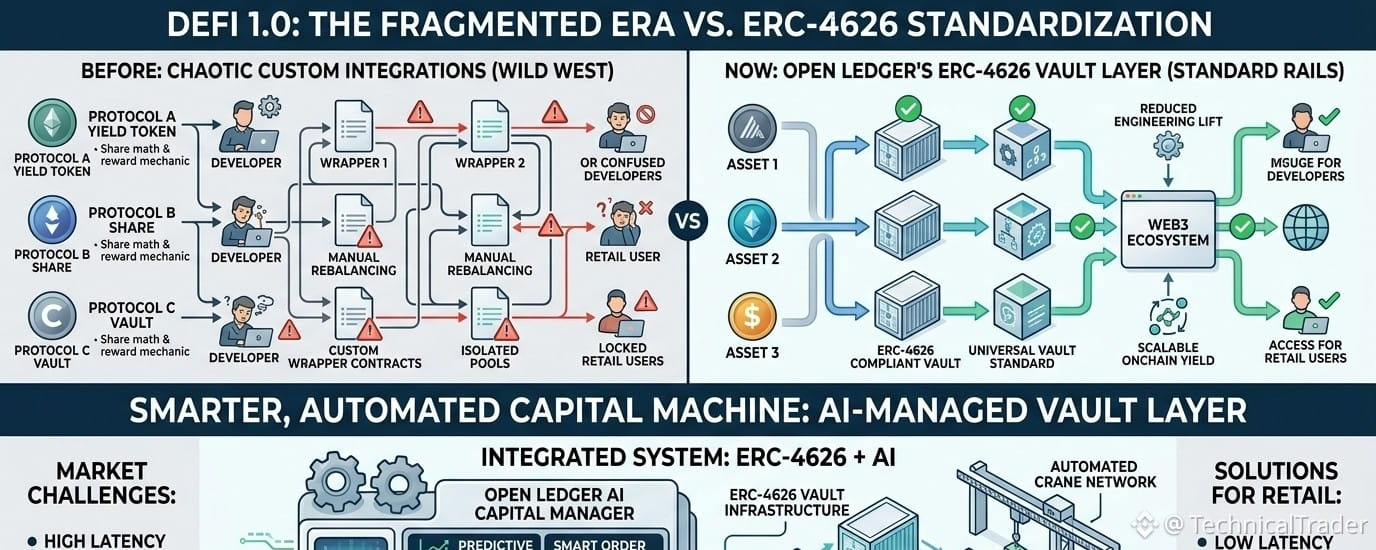
I remember the first time I tried to integrate a custom yield bearing token into a decentralized application back in the early days of DeFi. It felt less like software engineering and more like trying to force a square peg into a round hole while blindfolded. Every single protocol had its own bespoke architecture, its own quirky implementation of share math, and its own special way of handling rewards. You spent eighty percent of your dev cycle writing wrapper contracts just to make sure two different protocols could talk to each other without draining the liquidity pool. It was a fragmented, fragile mess that kept retail users locked out and left developers constantly putting out smart contract fires.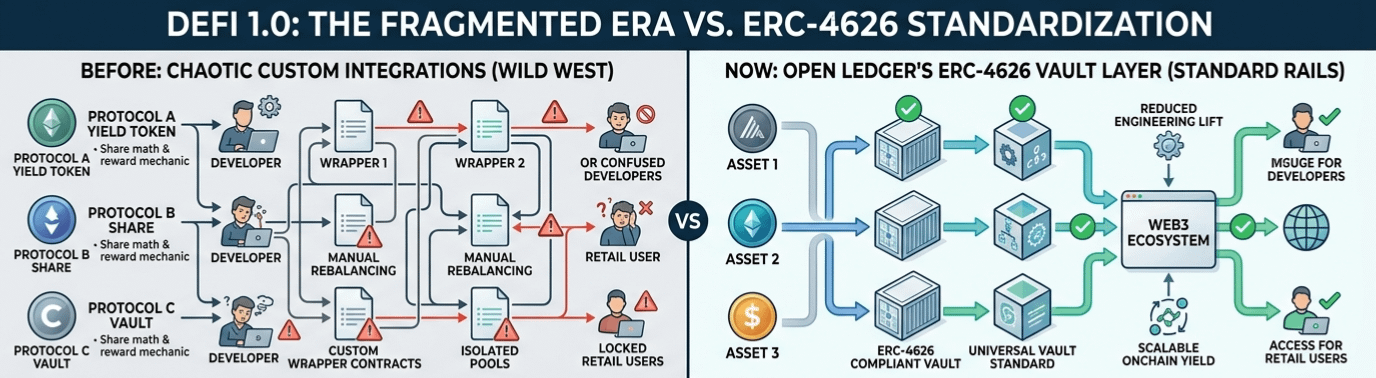
Then came the ERC 4626 vault standard, and the entire conversation changed. We are finally moving away from that Wild West era of chaotic, custom yield mechanics and shifting toward automated capital management on standard rails. Open Ledger is jumping straight into this transition by adopting ERC 4626 for its vault layer, which is honestly the only way forward if we want onchain yield to scale. The old way of doing things relied on manual rebalancing and blind trust in static pools that quickly rotted under shifting market conditions. By introducing standardized vault rails, Open Ledger can plug directly into the broader Web3 ecosystem, allowing assets to move smoothly across different protocols without requiring a massive engineering lift every time.
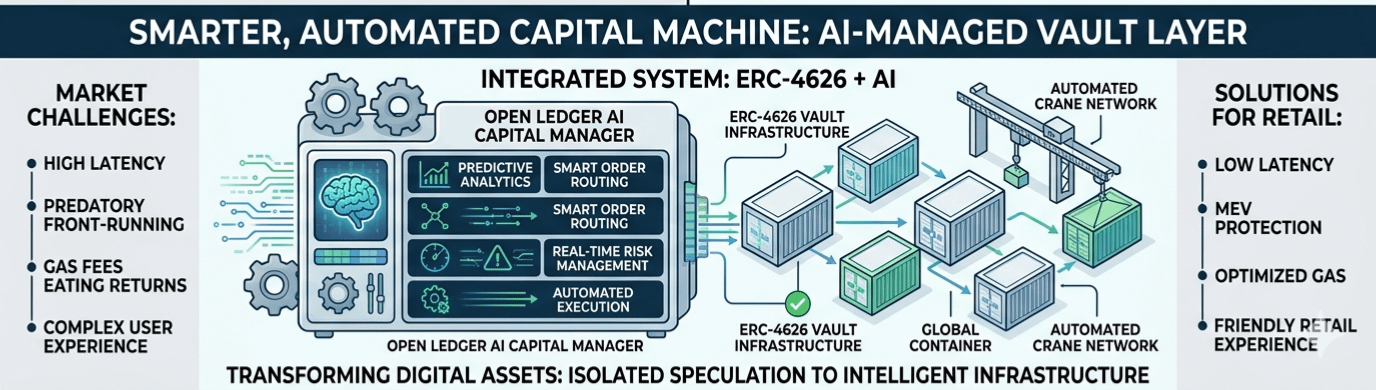
But let us be realistic about the current state of Web3 and artificial intelligence before we get too swept up in the hype. The industry loves to throw the words AI and vault together as if they magically solve the liquidity problem, but the bone deep reality is that most automated yield products are still plagued by high latency, predatory front running, and prohibitive gas fees that chew up retail returns. Existing DeFi giants have built massive moats, yet their user experiences remain incredibly hostile to the average person. Open Ledger wants to power a smarter onchain experience by marrying this new ERC 4626 structure with an AI managed vault layer, aiming to build yield products that actually work for retail instead of just enriching sophisticated high frequency trading bots.
If they can actually pull off this integration, it transforms how we perceive digital assets. We are no longer just staring at a collection of isolated digital gold coins sitting idly in speculative wallets. Instead, this standardized, intelligent infrastructure turns the blockchain into a global container terminal. The ERC 4626 standard acts as the universal shipping container, ensuring every asset fits perfectly onto the ships, while the AI layer operates as the automated crane network routing capital to the most efficient docks in real time.