
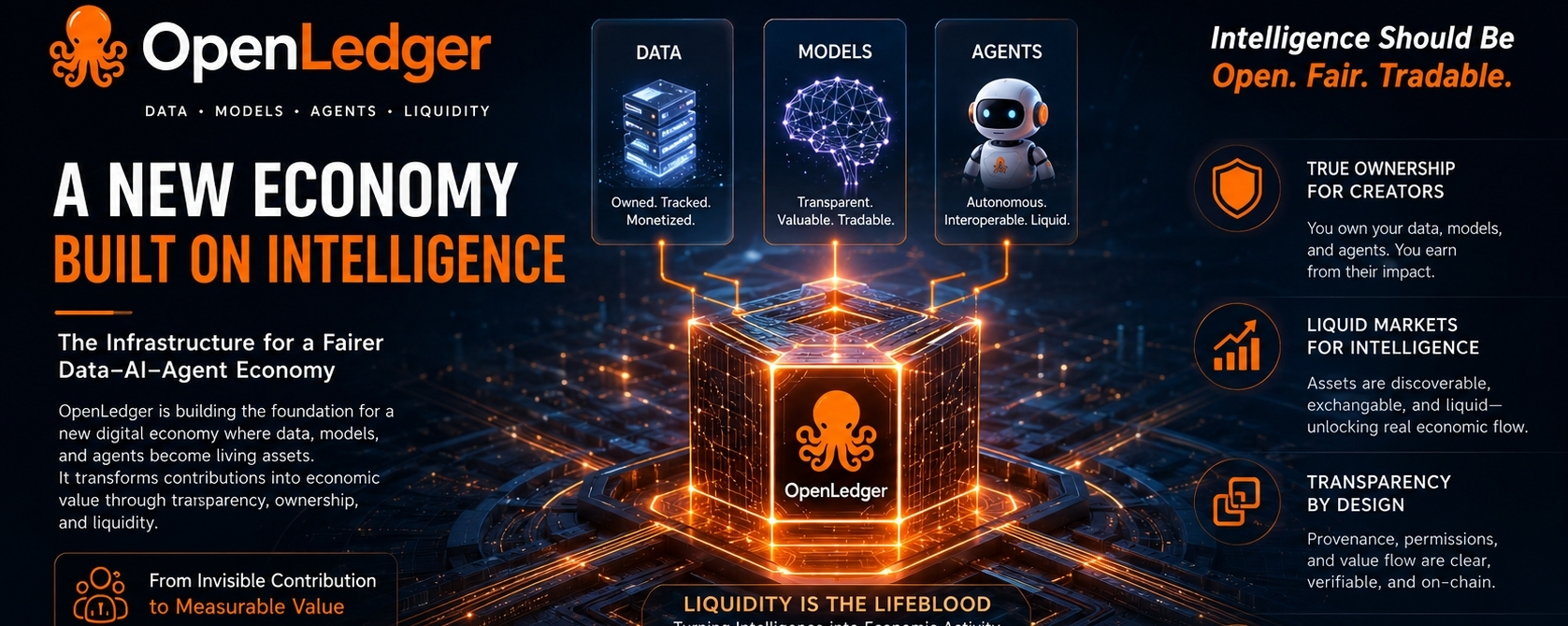
I find something quietly transformative in the idea behind OpenLedger. In a market that often chases speed, noise, and speculation, this kind of project speaks to me in a calmer register. It suggests that the next chapter of crypto may not be built only on tokens moving from one wallet to another, but on value flowing from information itself. Data, models, and agents are no longer just technical components in a digital system. In the world I see OpenLedger imagining, they become living assets, capable of producing liquidity, utility, and lasting economic meaning.
That vision matters to me because the internet has spent years generating value without fairly returning it. I have watched data be collected, trained on, analyzed, and repackaged countless times, often without clear ownership or transparent compensation. Models have grown more powerful while the people and systems behind the underlying inputs have remained invisible. When I look at OpenLedger, I see a different tone. It feels like a quiet insistence that the age of passive contribution may be ending, and that a more open, trackable, and monetizable structure can emerge in its place.
What draws me in is not just the technology, but the philosophy beneath it. OpenLedger feels like a response to a growing frustration I sense across digital economies: the feeling that value is created everywhere, yet captured in only a few places. By building infrastructure around data, models, and agents, it points toward a future where ownership is clearer and participation is more direct. In that future, contributing a dataset, refining a model, or deploying an intelligent agent is not merely a technical act to me. It becomes an economic one. It creates an opportunity for liquidity, for reward, and for a more balanced relationship between creators and systems.
This is where I begin to see OpenLedger standing apart from a great deal of crypto narrative. It does not feel like it is trying to be a passing trend. Instead, I see it attempting to solve a deeper structural problem. The question it raises stays with me because it is simple, but powerful: what if intelligence itself could be made more open, more accountable, and more tradable? That question reaches far beyond speculation. It touches the future of AI infrastructure, decentralized ownership, and the way I think digital work should be valued.
The appeal of such a system, at least from my perspective, lies in its blend of practicality and imagination. On one hand, I can see the concept grounded in real economic pressure. Businesses, developers, and communities all want better ways to exchange value around AI. On the other hand, I feel there is something almost poetic in it. It imagines a network where knowledge is not locked away, but transformed into active capital. It imagines a world in which data is not a silent residue of online behavior, but a resource that can be priced, shared, and mobilized with greater fairness.
In crypto, I have noticed that many projects promise disruption. Fewer seem to promise a redesign of incentives at the level where digital value is actually born. OpenLedger appears, to me, to belong to that smaller group. Its focus on liquidity suggests an awareness that usefulness alone is not enough. For an ecosystem to grow, I believe it must make participation feel real, immediate, and economically alive. Liquidity, in this sense, becomes more than a financial term. I see it as the difference between an idea that remains abstract and an ecosystem that can breathe, circulate, and sustain itself.
There is also a deeper emotional layer that I cannot ignore. I increasingly sense that the future will be shaped not only by AI, but by who controls it, who benefits from it, and who gets left behind by it. OpenLedger, at least in how I interpret it, speaks to that tension with a constructive answer. It does not reject AI. Instead, I see it trying to make AI more open, more interoperable, and more economically inclusive. That balance matters to me. The strongest technologies are rarely the ones that shout the loudest. They are the ones that create a new sense of possibility without abandoning realism.
In this sense, I feel OpenLedger reflects a broader shift happening across the crypto landscape. The market, from what I observe, is slowly maturing beyond pure narratives of scarcity and speculation. Attention seems to be moving toward infrastructure, utility, and meaningful application. Projects that connect blockchain with AI catch my interest because they sit at the intersection of two of the most important technological forces of our time. One is redefining trust and ownership. The other is redefining intelligence and productivity. OpenLedger brings them together in a way that feels both timely and strategically important to me.
Still, I know the real test for any project like this is not the elegance of its framing. It is whether it can convert vision into durable systems. The promise of monetizing data, models, and agents is powerful, but I also recognize that it demands execution, clarity, and trust. Users need to understand how value moves. Builders need confidence that the ecosystem rewards contribution fairly. Investors need evidence that the model can scale beyond early interest. These are not small challenges, and I do not see them lightly.
What gives OpenLedger an edge in narrative terms, from my perspective, is that it addresses a pain point I already feel, even if it is not always easy to articulate. The digital economy is crowded with invisible extraction. I see people contributing to systems constantly, yet rarely participating in the upside. A platform that attempts to make those contributions measurable and monetizable speaks directly to that imbalance. It offers not just a new market, but a more legible one. And in a space as complex as crypto, I believe legibility itself becomes a form of strength.
There is something quietly hopeful in that realization. The best blockchain ideas, in my view, do not merely accelerate finance. They reorganize relationships. They make ownership more transparent, exchange more direct, and collaboration more meaningful. OpenLedger seems to lean into that tradition while extending it into the AI era. Its ambition does not feel small to me. It imagines a framework where the building blocks of intelligence can move with the same fluidity that assets do in mature markets.
That is why I find the project relevant beyond its own branding. It speaks to a future in which the line between data infrastructure and economic infrastructure becomes thinner. I begin to imagine a world where models are not isolated black boxes, but assets with provenance, exchange value, and shared incentives. I picture agents not as mere tools, but as participants in a larger marketplace of intelligence. Whether every part of that vision arrives exactly as imagined, I cannot say. But the direction itself feels compelling.
In a sector that often prizes loud narratives, I experience OpenLedger as a more composed kind of ambition. It does not ask only for attention. It invites reflection. It nudges me to consider that the next major wave in crypto may come not from another speculative cycle, but from the infrastructure that allows data and intelligence to become economically active in a fairer way. That idea stays with me. It feels modern, necessary, and quietly bold.
I find myself thinking that OpenLedger may ultimately be remembered not just as another AI blockchain project, but as part of a larger turning point. A moment when the crypto industry begins to move from trading attention to organizing intelligence, from chasing momentum to building ownership, from abstract hype to usable value. If that transition continues, I can imagine projects like this coming to represent something much bigger than a ticker symbol. They may represent the beginning of a more honest digital economy, one where the sources of value are finally allowed to share in what they create.
@OpenLedger #openleadger $OPEN
