
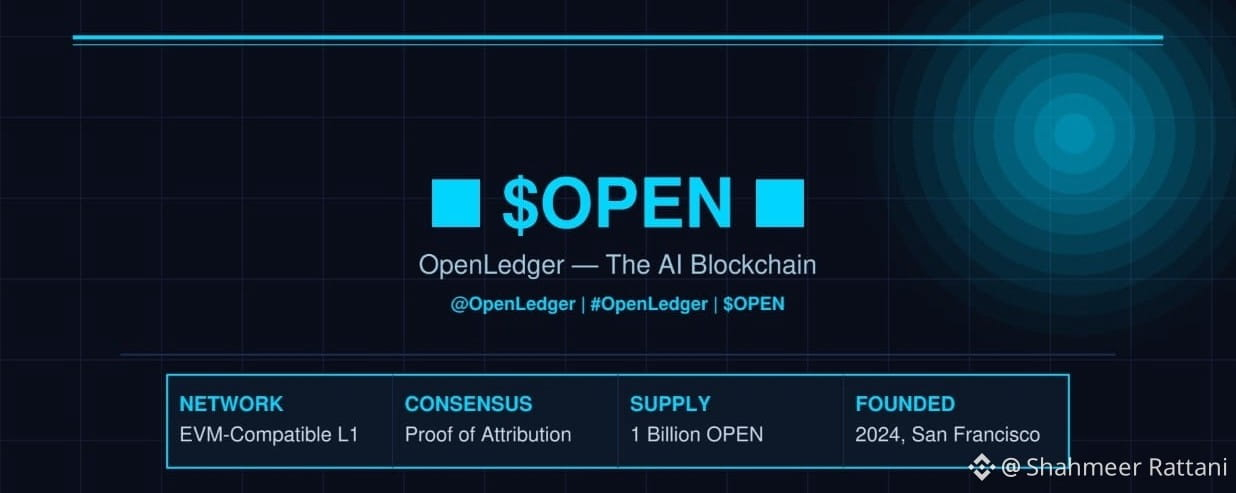
Most blockchains were built to move money. OpenLedger was built to move minds.
In a space crowded with layer-2s, meme coins, and DeFi forks, OpenLedger stands alone as something genuinely alien — a blockchain purpose-engineered not for transactions, but for intelligence itself. If you've been sleeping on $OPEN, this is your wake-up call.
The $500 Billion Problem Nobody Talks About
Here's the uncomfortable truth about modern AI: the datasets that train the most powerful models in the world are almost entirely uncompensated. Thousands of data creators, researchers, and curators feed the machine — and receive nothing. OpenLedger was built to end that.
Founded in 2024 by Ashtyn Bell and Pryce Adade-Yebesi in San Francisco, OpenLedger introduces Proof of Attribution — a cryptographic mechanism embedded at the protocol level that traces every piece of training data back to its source. Every inference a model makes, every output it generates, is cryptographically linked to the data that shaped it. Contributors get rewarded in $OPEN, proportional to their real influence. This isn't a whitepaper promise. It's live.
OctoClaw: When AI Agents Get a Brain and a Wallet
The most jaw-dropping development in the OpenLedger ecosystem right now is OctoClaw — and if you haven't heard of it, you're not paying attention. OctoClaw is OpenLedger's live AI agent execution environment, allowing developers to build, automate, configure via cloud, and deploy autonomous trading agents and intelligent workflows — all executed and settled on-chain in real time.
Think about what that means. An AI agent that can read market data, make decisions, execute trades, and log every action to an immutable ledger — without a human in the loop. Cloud-configurable, composable, and already running. OctoClaw isn't a beta product. It's production-grade AI autonomy on a blockchain.
A Tech Stack That Would Make Any Engineer Jealous
Under the hood, OpenLedger's architecture is a masterpiece of forward-thinking design:
EVM Compatibility — The base blockchain is fully EVM-compatible, meaning every Ethereum tool, every Solidity contract, every developer already familiar with the Ethereum ecosystem can plug straight in. No learning curve. Maximum composability.
ERC-4626 Integration — OpenLedger has integrated the tokenized vault standard, layering DeFi-grade yield mechanics and programmable incentives directly on top of its AI infrastructure. This bridges the gap between decentralized finance and decentralized intelligence in a way no other chain has attempted.
EVM Bridge — Cross-chain isn't an afterthought here. OpenLedger's bridge enables seamless asset transfers between Ethereum, Binance Smart Chain, and the OpenLedger network — giving $OPEN holders maximum liquidity and access across the broadest DeFi surface area.
Vibecoding Support — In one of the most creative developer moves of the year, OpenLedger supports natural-language-driven development workflows on its chain. Build AI-powered apps by describing what you want. The barrier to entry just collapsed.
Model Factory & Datanets — A structured, on-chain pipeline for proposing, fine-tuning, scoring, and hosting specialized AI models — connected through curated data marketplaces called Datanets. It's an entire AI R&D ecosystem baked into the protocol.
The $OPEN Token: More Than Gas
$OPEN is the economic engine of the entire system — and its design is elegant. It pays for gas and platform fees, yes, but that's the least interesting part. $OPEN flows as rewards to data contributors, funds the lifecycle of AI model creation and hosting, settles inference payments split among developers and stakers, and governs the protocol through stake-weighted voting.
What this creates is a self-reinforcing economic flywheel: more model usage generates more transactions and validator activity, which strengthens the network, which attracts more builders and data contributors, which improves model quality, which drives even more usage. It's an AI economy that feeds itself.
The Bigger Picture
The convergence of AI and blockchain has been discussed for years. Most attempts have been shallow — AI-themed tokens without real infrastructure, or blockchain tools bolted awkwardly onto existing AI products. OpenLedger is neither. It's infrastructure-first, attribution-first, and agent-first. It treats AI not as a marketing keyword but as the primary design constraint.
With OctoClaw live, bridges operational, ERC-4626 integrated, and a vibrant developer ecosystem growing around vibecoding and agent tooling, OpenLedger is executing at a pace that should concern every other AI-focused project.
The question is no longer whether AI will be on-chain. The question is who builds the rails first — and OpenLedger already has tracks laid.
Follow @OpenLedger er. Accumulate $OPEN. Watch closely. 👁️
#OpenLedger #OPEN #AIBlockchain #OctoClaw #Web3AI #BİNANCESQUARE