
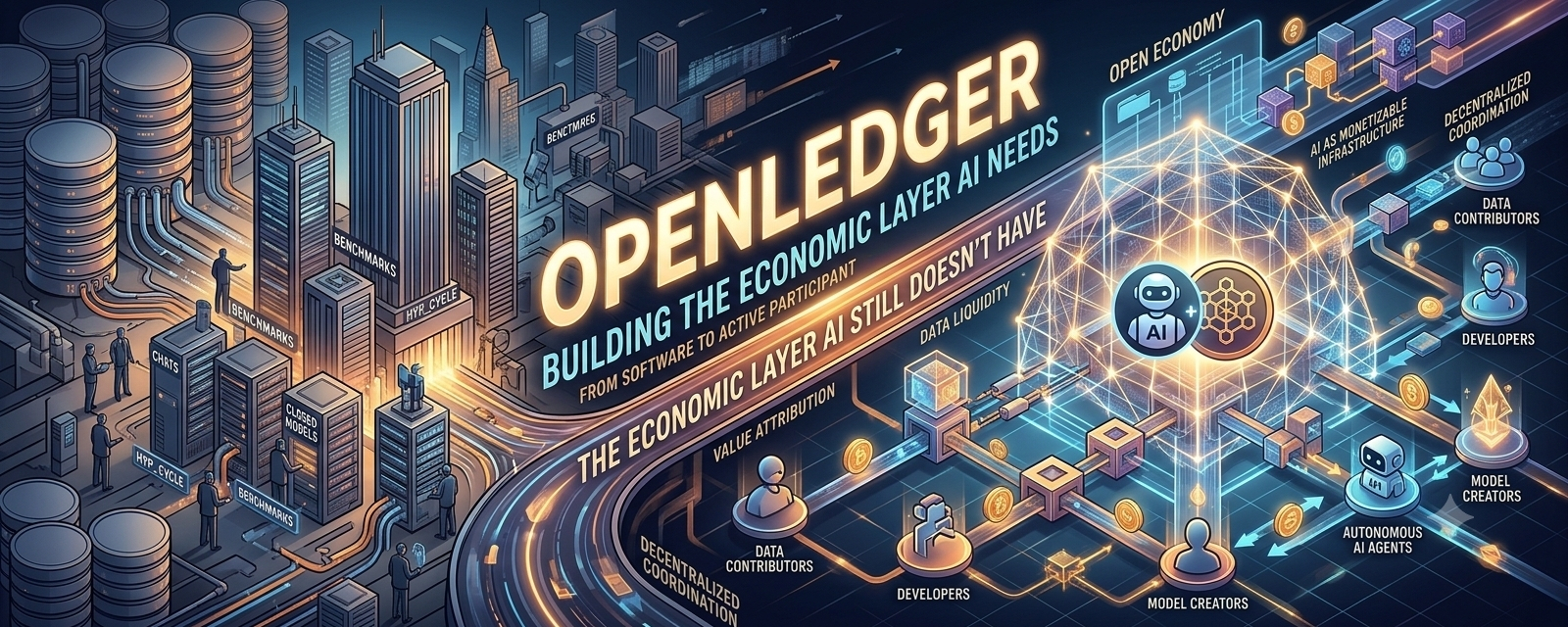
Most people are still looking at artificial intelligence from the surface level. The conversation usually revolves around which company has the smartest model, the fastest responses, or the most powerful AI tools. Every new release becomes a competition of benchmarks, features, and hype cycles. But underneath all that noise, a much more important question is starting to emerge — who actually owns the value being created by AI?
That’s the part that makes OpenLedger feel different.
Instead of treating AI like a closed product controlled by a handful of companies, OpenLedger seems to be approaching it like an open economic network. A system where data contributors, developers, model creators, and even autonomous AI agents can participate in the value they help generate. And honestly, that idea feels far bigger than most people currently realize.
Right now, the AI industry is expanding at an incredible pace, but the economics around it remain heavily centralized. The largest companies own the infrastructure, the datasets, the computing power, and often the monetization layer as well. Most users simply interact with AI without ever having ownership in the ecosystem itself. OpenLedger appears to be challenging that structure by building an environment where AI can function inside a more open and decentralized economy.
What makes this interesting is that the focus is not just on tokens or speculation. The bigger vision seems to revolve around creating liquidity around AI itself — AI data, AI models, AI outputs, and AI agents. That changes the entire conversation. Because once AI becomes monetizable infrastructure instead of just software people use, entirely new economic behaviors begin to appear.
The average user still sees AI as a tool. More experienced builders are beginning to see AI as something capable of participating economically on its own. That difference matters. An AI agent that can access information, perform tasks, interact with protocols, and generate value is no longer just software running in the background. It starts becoming an active participant inside a digital economy. And economies require coordination, incentives, ownership, and systems that allow value to move efficiently.
That’s the gap OpenLedger seems to be targeting.
Lately, something interesting has been happening across both AI and crypto markets. The next major opportunity probably will not come from “AI hype” alone. It will likely come from infrastructure capable of solving the monetization and coordination problem around AI participation. Because eventually, the world may reach a point where millions of AI agents exist simultaneously, interacting with applications, users, and each other in real time. At that stage, the bigger question becomes how those agents transact, verify contributions, exchange resources, and operate economically at scale.
Traditional infrastructure doesn’t fully solve that problem.
Open systems may end up becoming far more important than people currently expect. That’s why projects like OpenLedger are starting to attract attention. Not simply because they are connected to blockchain technology, but because they sit at the intersection of two massive industries that are rapidly evolving together — artificial intelligence and decentralized coordination.
Historically, some of the biggest opportunities emerge exactly where industries collide.
Another reason this narrative feels important is timing. AI development is accelerating faster than regulations, ownership frameworks, and economic structures can adapt. Questions around data attribution, model rights, revenue distribution, and autonomous AI participation are still largely unresolved. That creates uncertainty, but uncertainty is often where entirely new infrastructure layers are born.
OpenLedger seems to be positioning itself around the belief that future AI ecosystems will not remain completely centralized forever. As AI agents become more capable and economically active, open coordination layers may become necessary rather than optional. That thesis may still need time to prove itself, and execution will ultimately decide everything, but the direction itself feels important.
Because the long-term opportunity may not be about which chatbot dominates headlines today.
The bigger opportunity could belong to whoever builds the underlying system where AI can actually function as an economy.
And if AI eventually evolves from being simple software into an entirely new economic layer of the internet, then the infrastructure supporting that shift could become extremely valuable in ways most people still are not fully seeing yet.
