
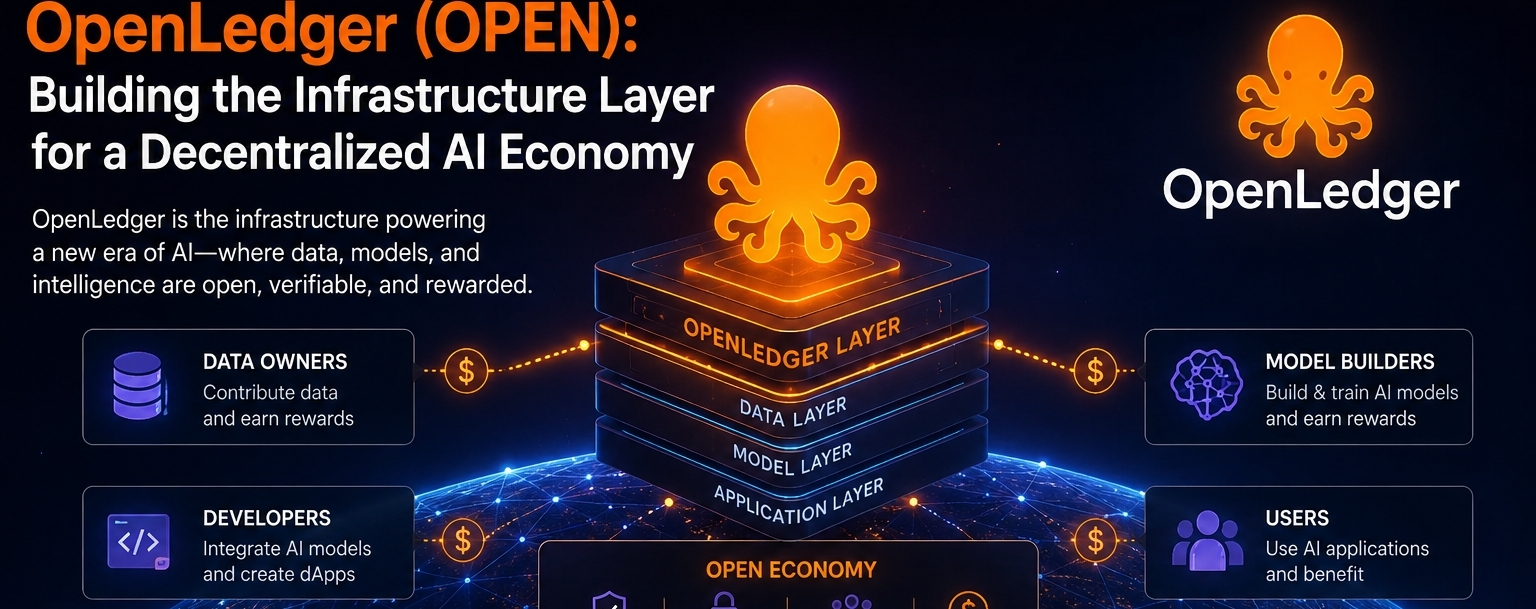
Artificial intelligence is rewriting the rules of every industry but behind the scenes a quiet crisis has been unfolding. The data powering the world's most powerful AI models was largely built on contributions from millions of people who received nothing in return. Developers researchers and data providers watched as trillion-dollar corporations extracted immense value from their work with no attribution no compensation and no transparency.
OpenLedger was built to change that equation entirely.
Since its mainnet launch in November 2025 OpenLedger has positioned itself as one of the most substantive projects at the crossroads of blockchain and artificial intelligence not through marketing promises but through a technically grounded approach to a very real problem: making AI development open, fair, and verifiable on chain.
The Vision: Putting Intelligence on the Blockchain
The core thesis behind OpenLedger is straightforward but powerful. AI development today is a centralized, opaque process. Data is harvested without clear attribution. Models are trained behind closed doors. Contributors have no visibility into how their work is used or what value it creates.
$OPEN introduces a transparent decentralized alternative. The project describes itself as the "AI Blockchain" an infrastructure layer designed to unlock the liquidity of data AI models and intelligent agents while ensuring that ownership and attribution remain traceable and verifiable on-chain. Every dataset uploaded every model trained every inference run all recorded on an immutable ledger with provable credit to its contributors.
This isn't a philosophical exercise. It addresses a market scale problem. The global data economy is estimated at over $500 billion yet the individuals and communities generating that data sit almost entirely outside the value chain. OpenLedger's ambition is to close that gap.
Technology: A Purposefully Built Layer 2
OpenLedger is an Ethereum-compatible Layer 2 network built on the OP Stack with EigenDA providing data availability. The OP Stack delivers scalability low transaction fees and high throughput while EigenDA reduces on-chain storage costs and ensures data integrity. Full EVM compatibility means developers can build using familiar tools without friction.
At the heart of the protocol sits the Proof-of-Attribution mechanism the technical core that separates OpenLedger from generic AI platforms. When a developer accesses a dataset to train an AI model the system traces the exact contributions used and automatically triggers compensation to the relevant contributors.
The platform runs on three pillars:
Datanets community owned domain specific datasets
Specialized Models AI models deployable by agents chatbots and enterprise apps
Payable AI the economic layer that rewards contributors automatically
Ecosystem and Partnerships
OpenLedger raised $8 million in seed funding backed by Polychain Capital and Borderless Capital. In June 2025 it launched OpenCircle with $25 million committed to fund AI and Web3 developers.
Key partnerships include:
Ether.fi — AI model development and security ($6.5B TVL)
Spheron GPU infrastructure for on-chain AI compute
Trust Wallet AI-powered commands for 200M+ users
Story Protocol legal AI training standards and automatic rights payments
LayerZero cross-chain integration across 130+ blockchains
The OPEN Token
$OPEN is a working currency not just a speculative asset. It powers every interaction: transaction fees, staking for model proposals governance voting and direct rewards for data contributors Over 61% of total supply is allocated to community and ecosystem structuring incentives toward long-term participation.
The token launched on September 8, 2025 via Binance's HODLer Airdrop program debuting with a 200% surge and $182 million in trading volume on day one.
Adoption Metrics
Before mainnet launch, the testnet already showed serious traction:
6 million registered nodes
28 million transactions processed
23,000 AI models deployed
Mainnet went live November 2025. Enterprise revenue has since funded a buyback program a meaningful signal that real commercial activity exists beyond token speculation.
Future Outlook
The 2026 roadmap focuses on OpenFin (AI model monetization layer) and the AI Marketplace enabling enterprises to discover license and deploy models built on the network. These two catalysts represent the shift from infrastructure builder to utility driven platform.
Risks exist: token unlock schedules will create supply pressure, competition is intense, and enterprise adoption at scale remains unproven. But the thesis is sound the world is increasingly uncomfortable with how AI is built and OpenLedger is one of the few projects with a real technical answer.
Conclusion
OpenLedger isn't chasing a narrative it didn't help create. It's a bet that the next frontier of blockchain utility lies in the fundamental infrastructure of how intelligence gets built, distributed, and compensated.
The groundwork technically institutionally and narratively has been laid with more care than most projects at this stage. For those who believe AI development must eventually become more transparent and equitable OPEN is worth watching closely.
The question is no longer whether the problem is real. The question is whether OpenLedger is the team that solves it.