
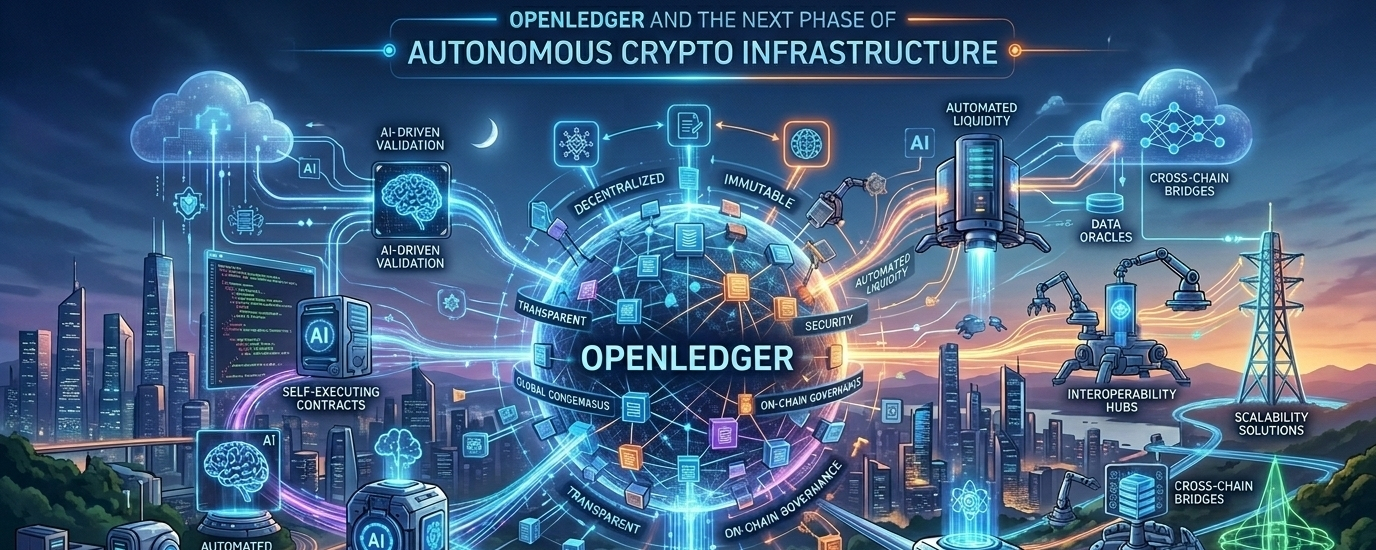
A lot of people still do not understand where Artificial Intelligence in crypto is going.
The market is focused on products because they are easy to sell.
We see Artificial Intelligence trading bots and Artificial Intelligence signal channels and Artificial Intelligence-generated market summaries and Artificial Intelligence assistants explaining tokenomics.
Every project is trying to use the term Artificial Intelligence with existing products without changing how crypto actually works.
The next phase is not about information.
It is about execution.
This difference is more important than most people think.
Some projects are becoming interesting because they are using Artificial Intelligence to build the underlying infrastructure than just creating content.
Of building another chatbot for traders these projects are creating systems where agents can work together in real time across decentralized environments.
This will change the future of Web3.
Now crypto users still have to do things manually inside systems that are too complex for humans to manage.
A normal active trader today may use ten chains and multiple bridges and several wallets and perpetual exchanges and staking protocols and liquidity pools and governance systems and Artificial Intelligence-based analytics platforms within a single week.
The ecosystem is growing faster than humans can keep up with.
This is where autonomous agent infrastructure becomes important.
The future that most people are not thinking about yet is a world where users do not interact directly with protocols of the time.
Instead intelligent agents will handle execution and optimization and coordination automatically according to user-defined rules.
Imagine a trader in 2027 using an OpenLedger-powered execution layer.
The trader does not have to move assets between chains
The agent continuously monitors liquidity conditions and bridge fees and slippage and network congestion and arbitrage opportunities.
The agent moves capital when better yield conditions appear elsewhere.
The agent adjusts risk exposure based on volatility.
The system can pause activity during market conditions without needing manual help.
The user does not have to spend twelve hours looking at charts.
The role of the user changes from operator to strategist.
This change is one of the changes that crypto has ever seen.
For years the best traders have been the ones who're fast and can pay attention and control their emotions.
Autonomous systems remove that advantage.
Once Artificial Intelligence agents can monitor every chain and execute transactions instantly and adapt strategies in time human reaction speed does not matter.
The new advantage is the quality of the framework that controls the agent.
The best traders of the cycle may not even look like traditional traders.
They may look like system architects.
This is why infrastructure projects are more important than short-term trends over the run.
The market still does not understand how hard it is to coordinate systems.
Most current blockchain systems are environments.
Liquidity is fragmented.
User identity is fragmented.
Smart contract logic is fragmented.
Security assumptions differ between chains.
Data availability varies widely.
Transaction finality differs from network to network.
Coordinating all of this safely is one of the problems in crypto.
That is why autonomous execution layers could become infrastructure if they succeed.
The opportunity is huge because every sector will eventually connect to this model.
Decentralized finance will become portfolio management.
NFT ecosystems will become Artificial Intelligence-managed licensing and royalty systems.
Gaming economies will become self-balancing markets.
Prediction markets will become machine-coordinated information systems.
Supply chain systems will become automated verification networks.
DAO governance will become partially autonomous with Artificial Intelligence-assisted proposal execution and treasury management.
Even social media may evolve into agent-driven ecosystems where digital identities negotiate and transact and interact continuously without needing direct user help every minute.
OpenLedgers long-term importance depends on whether it can position itself as the coordination layer underneath these systems than just another application competing for attention.
That distinction determines whether a project becomes infrastructure or becomes replaceable.
Infrastructure grows in value differently.
Applications. Fall quickly because users switch platforms.
Infrastructure survives longer because entire ecosystems depend on it.
Most people never think about the infrastructure that powers the internet every day.
They just use applications built on top of it.
The same pattern may eventually happen in decentralized Artificial Intelligence systems.
If autonomous agents become normal across crypto, the protocols that coordinate trust and permissions and execution and verification may become some of the valuable layers in the industry.
The road to that future is not easy.
There are risks that cannot be ignored.
Security is still the concern.
An autonomous agent that manages assets across chains introduces huge security risks.
A vulnerability in execution logic or oracle systems or bridge infrastructure or permission management could create big failures.
Trust is also a problem.
Most users are not comfortable letting software control decisions autonomously.
The industry still lacks standards for agent accountability and rollback systems and decentralized dispute resolution during execution failures.
Regulation is another variable.
Governments are already struggling to understand finance.
Autonomous Artificial Intelligence-driven financial execution creates a category that regulators may try to control in the future.
There is also the problem of strategy commoditization.
When everyone gains access to execution systems many current trading advantages disappear.
Market inefficiencies shrink faster.
Arbitrage windows get smaller.
Emotional mistakes decrease.
Retail participation becomes more sophisticated.
The entire market structure changes.
That is why the future value may not come from having Artificial Intelligence itself.
The value may come from owning the infrastructure that coordinates Artificial Intelligence activity securely across systems.
That is the idea around projects like OpenLedger.
The market sees Artificial Intelligence narratives as hype cycles.
Underneath the noise a deeper change may already be starting.
Crypto began with money.
Then it evolved into applications.
The next phase may become autonomous coordination.
Not humans interacting with protocols every second.
Intelligent systems negotiating and executing and optimizing and adapting continuously on behalf of users, across interconnected networks.
If that future develops most people will stop thinking about chains.
They will just define goals.
The infrastructure will handle everything automatically.
That is the direction watching over the next few years.
Not because it guarantees success.
Because it changes the definition of participation itself.
If OpenLedger manages to position itself at the center of that transition the project may eventually matter far more than current market attention suggests.
