
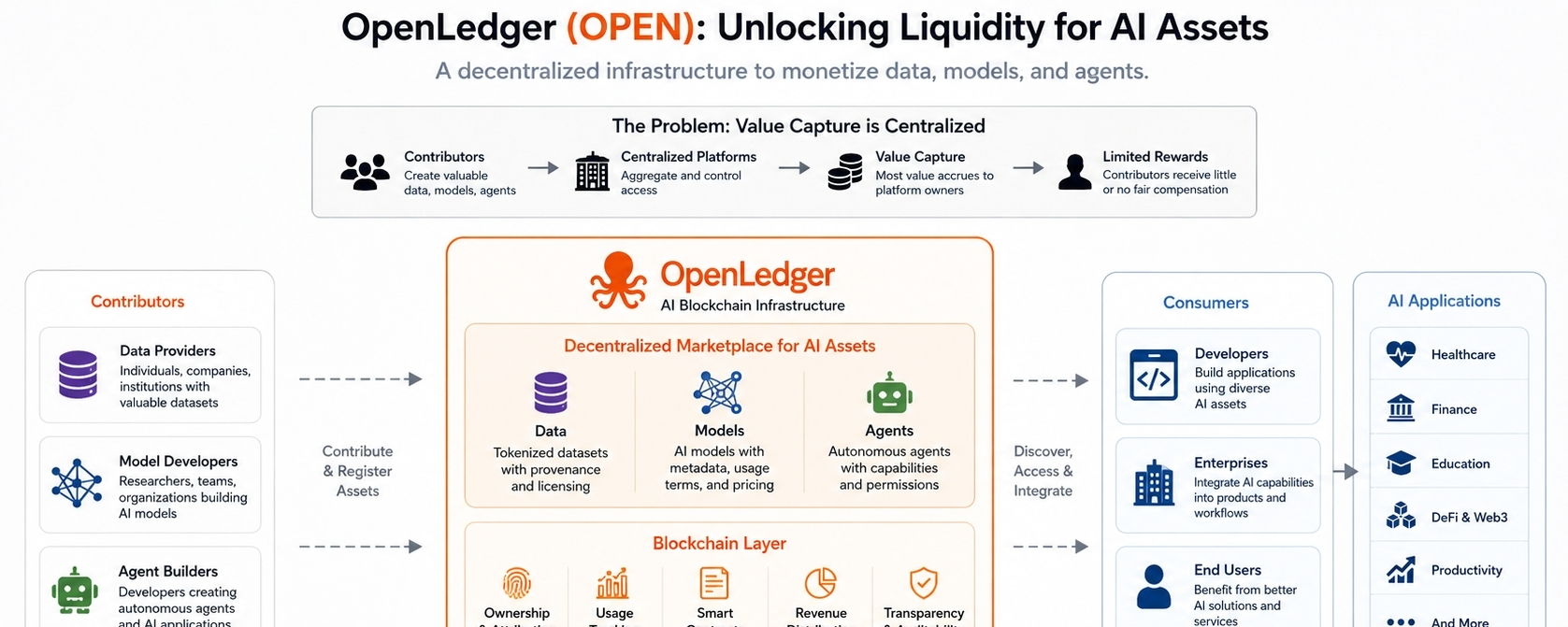
OpenLedger sits at the intersection of two industries that have become remarkably good at promising revolutions while avoiding the more difficult question of who actually captures the value being created. After watching both crypto and artificial intelligence evolve over the last several years, I’ve become increasingly skeptical of projects that rely on familiar slogans decentralization, democratization, ownership, intelligence.without confronting the structural imbalance underneath them. What makes OpenLedger interesting to me is not that it combines AI and blockchain, a phrase that has already been stretched thin by countless speculative tokens, but that it focuses on a much more concrete issue: the fact that the people and organizations supplying the raw ingredients of AI are rarely compensated in proportion to the value they generate.
The current AI economy is built on a quiet asymmetry. Data providers, model developers, and application builders all contribute pieces to a much larger machine, yet the majority of the financial rewards tend to accumulate at the platform layer. This is not unique to AI; the internet has always concentrated value in the hands of those who control distribution and infrastructure. But with AI, the imbalance feels sharper. A researcher may create a highly specialized model, a company may possess proprietary datasets, and an independent developer may build a useful agent, but monetization remains fragmented and opaque. Most participants either license their work privately or give it away and hope to benefit indirectly.
That is the problem OpenLedger appears to be addressing. Its central premise is that data, models, and agents should be treated as productive digital assets rather than static intellectual property. In theory, blockchain infrastructure can provide the accounting layer needed to track contributions, usage, and rewards. The idea is less about speculative token trading and more about establishing a system where value flows back to the sources that make AI possible.
I find this framing more grounded than many crypto-AI narratives because it starts with an actual market inefficiency. AI has become incredibly good at generating outputs, but the economics behind those outputs remain surprisingly primitive. If a medical dataset improves a diagnostic model, or a niche language model powers thousands of interactions, there should be a transparent way to measure and distribute the resulting value. Today, that process is often handled through private contracts, closed APIs, and centralized billing systems. OpenLedger is proposing a more open marketplace where these contributions can be priced and monetized directly.
The concept reminds me of how mineral rights work in the physical economy. The visible product—a building, a battery, a semiconductor—depends on resources extracted elsewhere, often by actors far removed from the final customer. In AI, the equivalent resources are datasets, training architectures, and autonomous agents. They are the underlying deposits that others build upon. OpenLedger’s thesis is that these resources need a clearer ownership and revenue structure if the AI ecosystem is to become more sustainable.
This strikes me as a more serious ambition than launching another token attached to a vague “AI ecosystem.” Too many projects in this sector seem assembled from interchangeable parts: a token with unclear utility, a dashboard, a handful of partnerships, and a narrative that borrows whatever themes are currently attracting capital. Last year it was decentralized GPU networks. Before that, metaverse infrastructure. Today it is AI agents. The pattern is familiar enough that experienced observers instinctively discount most announcements.
OpenLedger at least appears to begin from a legitimate question rather than a trend-driven slogan. If AI becomes one of the defining economic systems of this decade, who gets paid when intelligence is produced? Will value continue to concentrate around a few dominant model providers, or can smaller contributors participate in a more open marketplace? Those are meaningful questions, and they are worth exploring whether or not any specific project succeeds.
That said, the difficulty of execution should not be underestimated. Designing a blockchain protocol is challenging enough; building a functioning market for AI assets is even harder. Accurate attribution is notoriously complex. Determining how much a particular dataset or model contributed to a final output involves both technical and economic judgment. Incentives can also be gamed. Low-quality or duplicated assets may flood the system if the reward mechanism is not carefully designed. And even if the infrastructure works, adoption remains the ultimate test. Developers and enterprises will only participate if the platform is simpler and more profitable than existing alternatives.
There is also the broader question of whether blockchain is truly necessary. In many cases, centralized marketplaces can operate more efficiently than decentralized systems. OpenLedger’s success will depend on proving that transparency, composability, and permissionless access create tangible benefits rather than additional complexity. Without that proof, the protocol risks becoming another technically elegant solution in search of a sufficiently urgent problem.
Still, I think the project deserves attention because it addresses a fundamental tension in the AI economy. Intelligence is often discussed as though it emerges magically from a single model provider, when in reality it is assembled from countless contributions distributed across researchers, institutions, and developers. The challenge is not merely building better models; it is constructing fairer economic systems around them.
Whether OpenLedger can turn this idea into a durable network is uncertain. Most ambitious infrastructure projects fail, and skepticism is justified. But in a market crowded with recycled narratives, I find it refreshing when a project focuses on ownership, attribution, and monetization rather than spectacle. If AI is going to reshape how value is created, the question of who receives that value matters as much as the technology itself. That is the part of the story that makes OpenLedger worth watching
