Most people still think AI is just about smarter chatbots. I think they are missing the bigger shift entirely. the real transFormation is economic. every AI response already carries invisible value data, feedback, human behavior, model tuning, compute, validation but almost nobody partIcipating in that process actually owns a piece of it. that is the first time OpenLedger genuinely caught my attention not because it is another AI blockchain, but because it is trying to turn AI inference itself into an economy.
the deeper I looked into the project, the more I realized OpenLedger is not really trying to build another Layer-1 chain with AI attached to it. it is attempting to build an entirely new economic layer around intelligence itself.
that is the part most people are missing.
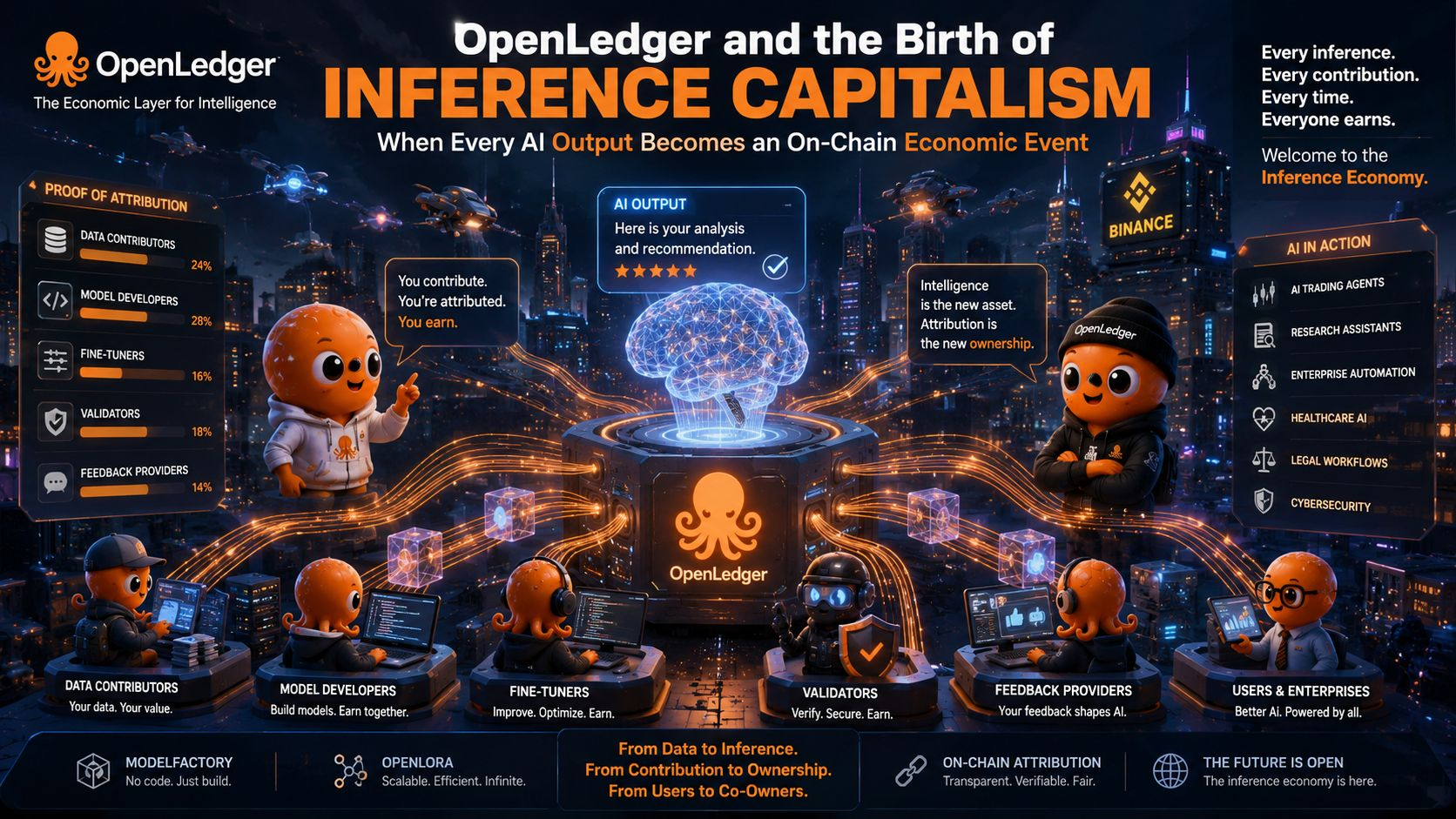
the core idea behind OpenLedger is surprIsingly powerful: every AI output should have traceable economic value attached to the people who helped create it. not just model developers, but also data contributors, validators, fine tuners, and even feedback providers.
Today, AI feels incredIbly one sided. Big models scrape value from users, conversations, datasets, and human feedback, while almost nobody outside the centralized companies earns from it. OpenLedger is Proof of Attribution system tries to change that dynamic completely. if your data meaningfully influences an AI response, the protocol can theoretically reward you when that inference happens.
that is why I started thinking of it as Inference Capitalism.
The more AI gets integrated Into daily life, the more valuable inference Itself becomes. every chatbot response, research output, trading assistant suggestion, or enTerprise automation task becomes an economic event. You can already imagine how this could evolve if AI trading agents become deeply integrated into large crypto ecosystems lIke Binance. Instead of value flowing only to platforms, attribution based systems could eventually reward the datasets, strategy builders, and model contributors behind those AI driven decisions.
and honestly, that idea stayed in my head longer than I expected.
what also stood out to me is who this ecosystem is actually built for. it is not only targeting hardcore blockchain users. The infrastructure seems desIgned for AI developers, enterprises, researchers, domain experts, data contrIbutors, and even smaller teams that can not afford massive AI infrastructure.
their ModelFactory platform especially caught my attention because it removes a lot of technical friction around fine tuning models. Instead of needing complicated command line workflows, the system focuses on GUI based model training with LoRA and QLoRA support. that is important because the next wave of AI adoption probably won't come from giant labs alone it will come from smaller specialized builders creating niche intelligence systems.
And OpenLedger seems heavily optimized for that future.
rather than competing directly with giant foundation models, the project focuses on specialized AI. Finance, healthcare, legal workflows, cybersecurity, enterprise automation these are areas where smaller focused models can outperform massive general purpose systems. personally, I think this direction makes far more sense long term.
another underrated piece is OpenLoRA. Most people will probably skip over that section, but scalable LoRA infrastructure could become extremely important once thousands of specialized AI agents start running simultaneously. OpenLedger is approach to dynamic adapter loading and multi-tenant GPU systems shows they are thinking beyond hype and actually focusing on deployment scalability.
of course, execution is the hard part. Real-time attribution at scale is insanely difficult, and that’s probably the biggest risk here. but at least the project is tackling a real infrastructure problem instead of recycling meme level AI narratives.
what stayed in my mind after finishing the paper was this:
OpenLedger is not simply trying to decentralize AI models. it is trying to financialize intelligence itself where every inference becomes a transparent economic interaction tied to contributors, datasets, validators, and builders.
if that system actually works, we may eventually look at projects lIke OpenLedger as the early foundations of a completely different internet economy.
not the attention economy.
Not even the creator economy.
An inference economy.