

Let’s drop you into this wild, shining city. Lights bounce off glass, networks thrum underfoot, and—if you know where to look—a global uprising is happening. Not the angry, megaphone kind. This one runs under the skin of the digital world.
The era of lonely creators staring up at unreachable corporate towers is over. Now, the streets overflow with data scientists, open-source hackers, curious researchers, and everyday folks, all huddled together around glowing, decentralized hubs. They’re building something new—a community powered by collaboration, not by surrendering what they’ve built to faceless giants.
Used to be, if you made something valuable, you had to hand it over. Share a brilliant new dataset with a big tech firm? Kiss it goodbye. They’d stash it away, use it to build something worth billions, and you’d get—maybe—a polite email. That world is collapsing.
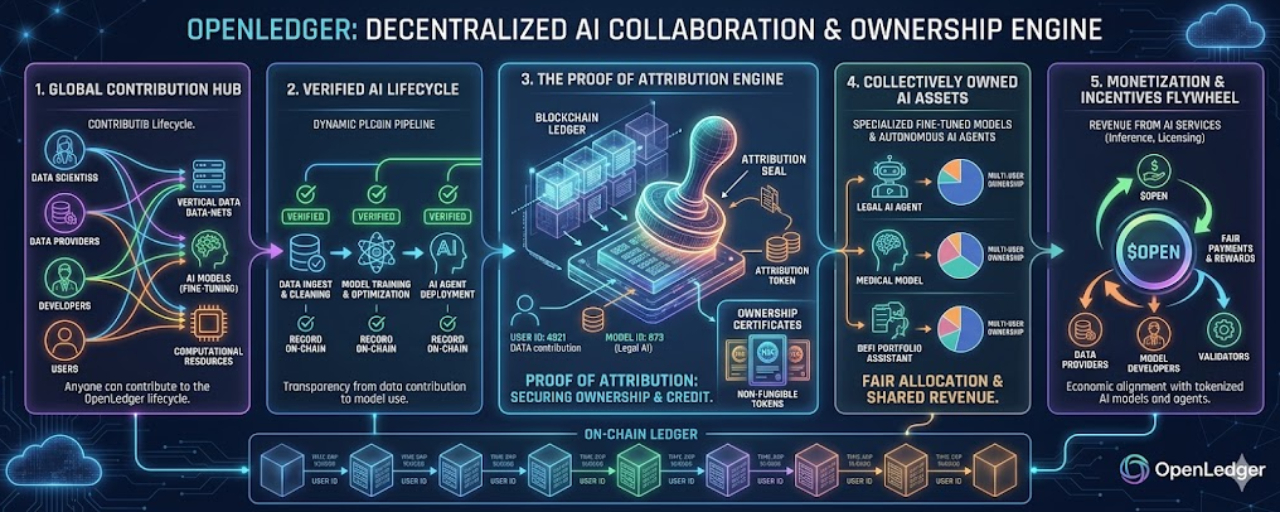
OpenLedger flips it all upside down. It’s like a public square—a council, but nobody has to show their face or beg for permission. Everyone can chip in their data, models, or algorithms, knowing the system keeps things fair. No one siphons your work into a black hole.
Here’s how it works. Everything you create—whether it’s a line of text, a killer image, or a tuned AI model—becomes a token on the blockchain. Basically, it’s a digital fingerprint that proves what you made is yours. Every contribution earns recognition and a real share of the value, not just empty thanks.
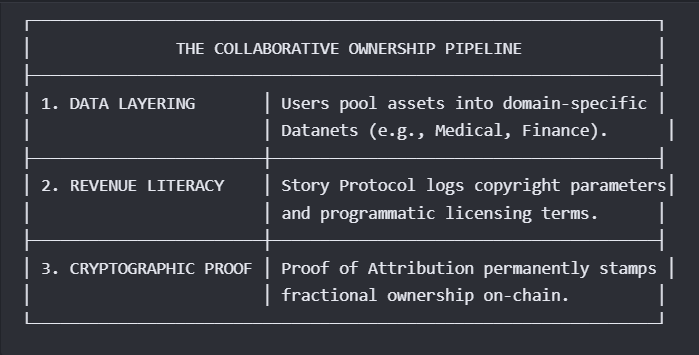
Let me break down the pipeline:
First, there’s “data layering.” Contributors toss their files into focused pools called Datanets—like a “Medical Datanet” for hospital scans, or a “Market Trends Datanet” for trading info. You keep ownership over your files, stamped and tracked on-chain.
Second, Story Protocol steps in. It records exactly how you want your work used—who can share it, remix it, even make money from it. These terms are locked in directly on the network.
Third, cryptographic proof glues the whole thing together. Proof of Attribution marks every contribution, so your stake is never lost, no matter how many hands the data passes through.
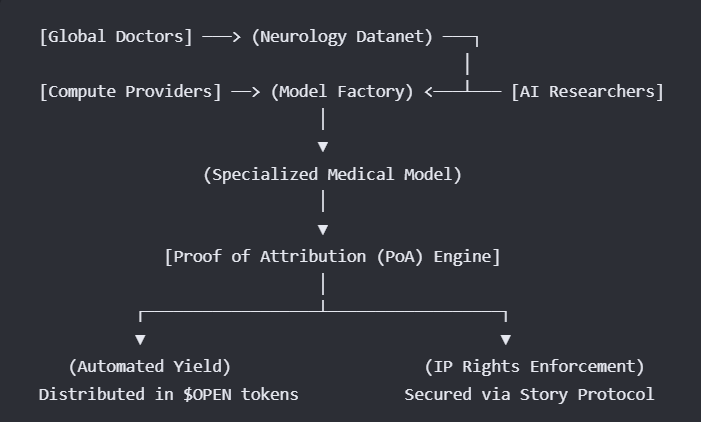
Let’s see it in action. Suppose you’re helping train a medical AI to spot rare brain conditions. In the old world, one mega-corporation would buy out clinics, gobble up all their data, and call it a day. On OpenLedger? Neurologists from Tokyo, Madrid, and Chicago upload research scans into a Neurology Datanet. Open-source engineers jump in, fine-tune the AI using those scans, and everyone involved keeps a tracked, fractional ownership stake.
Say a hospital in Tokyo uses this AI and pays a fee in OPEN tokens. The system pinpoints exactly which doctor or engineer contributed what. Payment splits automatically—Madrid’s clinic gets a cut, so does the Berlin developer who wrote the crucial software layer, plus a share kicks back to the infrastructure validators. No invoices. No chasing payments. No middlemen.
OpenLedger doesn’t exist in a bubble, either. It links arms with other big networks. Bittensor’s TAO pulls in high-quality OpenLedger datasets to train smarter models. The Render Network supplies compute muscle. Agents on the Artificial Superintelligence Alliance grab and lease valuable data and models—all tracked, all paid out fairly.
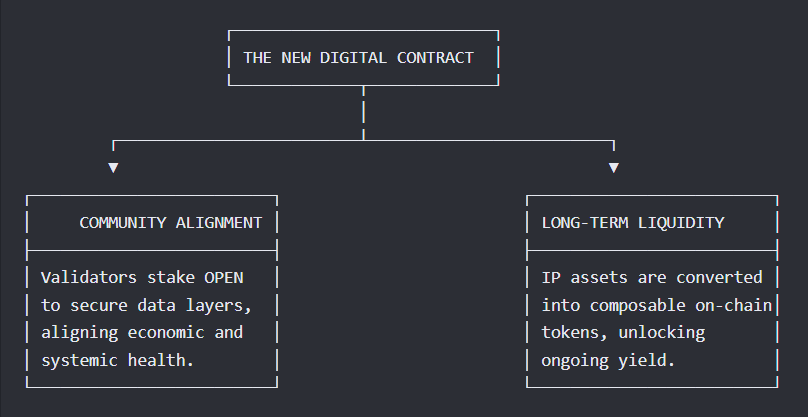
This changes everything. Now, if you put in work, you become an owner. Stake OPEN tokens to secure the system and you’re rewarded for keeping things clean—no spam, no junk data. Your piece of a dataset, or a model you’ve helped build, isn’t just sitting idle. It can flow through the whole Web3 economy, generating earnings as long as it gets used.
So this—finally—is the new digital social contract. The wall between “user” and “owner” is gone. If you help build the network, the rewards flow right back to you. No black boxes. No gatekeepers hoarding power. Just a living, breathing ecosystem where credit—and profit—goes back to the people doing the work. The age of silent exploitation is fading out, replaced by an era of open ownership and ongoing rewards for everyone who chips in.