
Why OpenLedger Could Become a Major Player in Decentralized AI
Artificial intelligence is evolving at an incredible pace, but one major issue continues to grow alongside it: centralization. Today, most AI infrastructure is controlled by a small number of large companies that own the models, datasets, and computing resources powering the industry. Contributors provide data, feedback, and development support, yet very few people receive transparent attribution or meaningful rewards for their role in building these systems.
This is where @OpenLedger introduces a much more interesting approach.
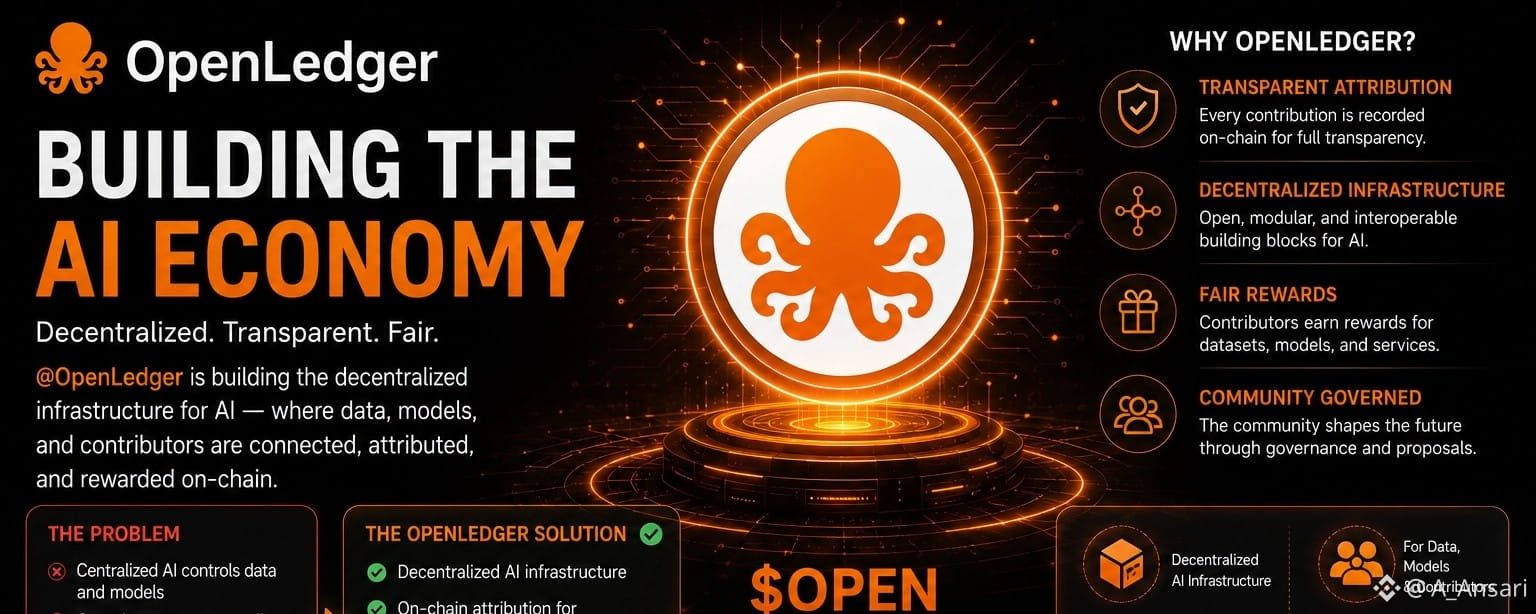
OpenLedger is building decentralized infrastructure for AI that focuses on transparency, attribution, and fair incentives for contributors across the ecosystem. Instead of relying on closed systems controlled by corporations, OpenLedger creates an environment where datasets, models, developers, and communities can interact through verifiable on-chain mechanisms. That has the potential to reshape how value is distributed within the AI economy.
One of the strongest aspects of the project is the utility behind $OPEN . Rather than existing purely as a speculative asset, the token is designed to support governance, staking, ecosystem participation, and access to AI-related services within the network. As decentralized AI continues gaining attention across both Web3 and traditional tech sectors, infrastructure-focused projects with real functionality may become increasingly important.
Transparency is another key advantage. Questions about data ownership, contributor rights, and accountability are becoming impossible to ignore in the broader AI conversation. OpenLedger’s model attempts to address these concerns by combining blockchain verification with decentralized coordination. That could help create more open and sustainable AI systems over the long term.
The idea that AI development should benefit communities instead of only giant corporations is becoming a stronger narrative every year. Projects like @OpenLedger are exploring how blockchain technology can help build that future in a more transparent and contributor-driven way.
