
I keep coming back to a strange contradiction in the AI economy.
The internet has slowly turned ordinary human behavior into raw material. Every search, correction, conversation, image upload, and online interaction feeds systems that grow more intelligent over time. Yet most people contributing to these systems never really participate in the value being created. They generate the fuel, but someone else owns the engine.
For years, this imbalance was treated as normal. Big technology platforms collected enormous amounts of behavioral data because storage was cheap, users were disconnected from ownership, and AI models needed scale above all else. The result was an ecosystem where data moved upward into centralized systems, while financial rewards stayed concentrated around infrastructure owners.
The uncomfortable part is that many people barely noticed it happening.
Developers building AI tools faced another version of the same problem. Even when someone created a useful model or intelligent agent, distribution remained difficult. Access to quality datasets was fragmented, monetization depended on gatekeepers, and smaller builders often lacked the infrastructure to compete with companies operating closed ecosystems. Open-source communities improved collaboration, but sustainable incentives remained unclear.
This is the broader environment where projects like begin to attract attention.
I do not think OpenLedger arrives as a perfect solution, and I am skeptical of any crypto project claiming it can “fix” AI ownership entirely. But I do think it reflects a growing realization that the current AI economy may be structurally incomplete.
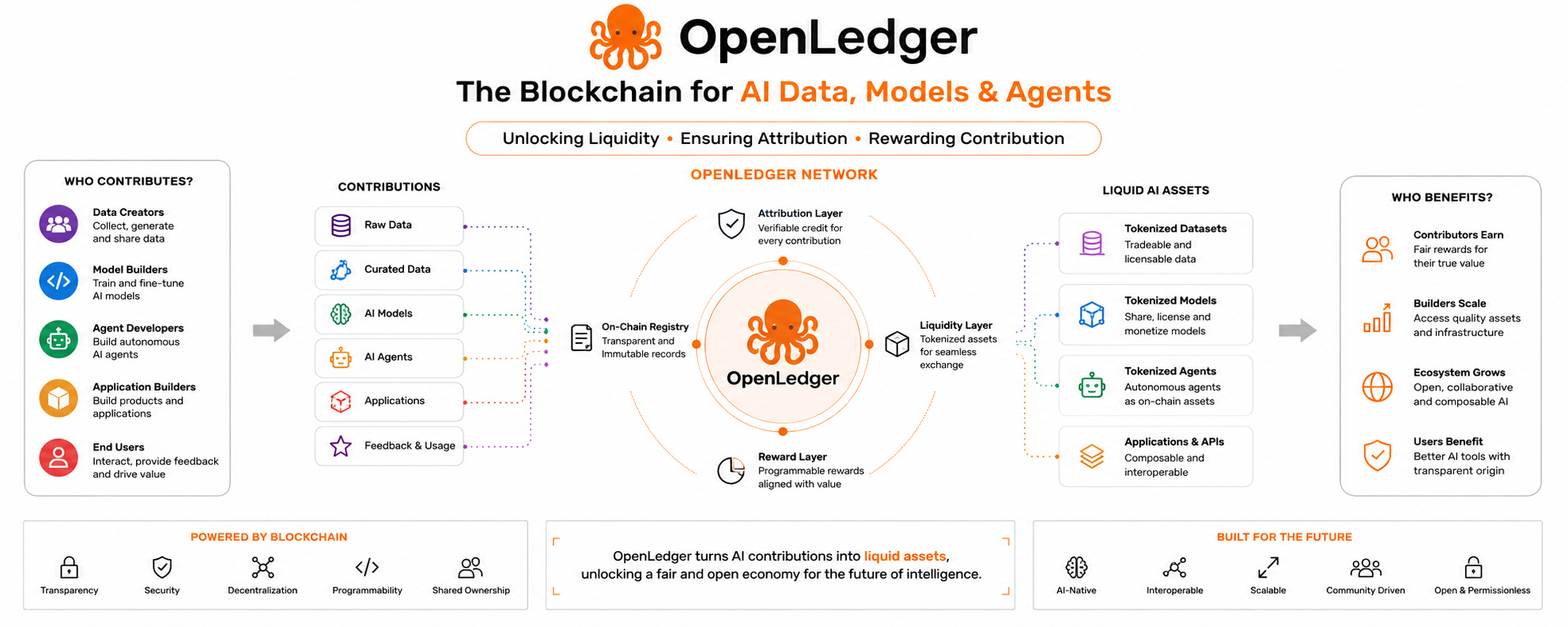
At its core, OpenLedger is attempting to build a blockchain-based system where data, AI models, and autonomous agents can become liquid digital assets. In simpler terms, the project is exploring whether contributors inside AI networks can be tracked, attributed, and rewarded more directly rather than disappearing into opaque platforms.
That idea sounds simple on paper, but the underlying problem is extremely difficult.
Most AI systems today are built on layered contributions. One person creates data. Another cleans it. Another trains a model. Another fine-tunes the outputs. Another builds an application on top. Once value begins flowing through several layers of contributors, determining who deserves compensation becomes messy very quickly.
Traditional internet platforms solved this by centralizing ownership. One company controlled the ecosystem, defined the rules, and captured most of the economic value. Efficient, yes. Fair, perhaps not.
OpenLedger appears to be exploring a different direction: using blockchain infrastructure to record contributions across AI systems in a more transparent way. The logic is that if contributions can be measured on-chain, rewards can potentially become programmable rather than dependent on platform discretion.
In theory, this creates a marketplace where datasets, models, and even AI agents behave more like independent economic participants instead of invisible background infrastructure.
I find the idea intellectually interesting because it tries to address a question many AI discussions avoid: what happens when human knowledge itself becomes monetized infrastructure?
The project also reflects a larger shift happening inside crypto. Earlier blockchain narratives focused heavily on finance. Then attention moved toward gaming, creator economies, and tokenized communities. AI now appears to be the next layer where blockchains are searching for practical relevance beyond speculation.
Still, there are serious reasons to remain cautious.
One issue is measurement itself. AI contributions are rarely clean or isolated. High-quality outputs often emerge from collective inputs accumulated over long periods. Even if blockchain systems improve attribution, determining proportional value may still become subjective. A dataset contributor, model architect, and inference provider may all claim they are the primary source of value creation.
Another concern is accessibility.
Projects built around tokenized AI infrastructure often assume participants already understand crypto wallets, decentralized systems, and on-chain interactions. That immediately excludes large parts of the global population who may contribute valuable data or knowledge but lack technical literacy. Ironically, systems designed to democratize ownership can still become dominated by highly technical insiders.
There is also the question of whether monetizing every contribution changes human behavior in unhealthy ways.
Not every online interaction was originally designed to function as financial labor. Once people begin optimizing conversations, creativity, or knowledge-sharing for economic extraction, digital environments can start feeling transactional rather than social. The internet already struggles with engagement farming and algorithmic manipulation. Financializing AI contribution layers may intensify those behaviors instead of reducing them.
I also think many blockchain-AI projects underestimate the power of centralized incumbents.
Large technology companies possess enormous advantages in computing resources, proprietary datasets, and distribution networks. Even if decentralized alternatives become philosophically appealing, users often prioritize convenience over ownership. History repeatedly shows that people tolerate opaque systems when those systems are faster and easier to use.
That creates a difficult challenge for projects like OpenLedger. Building fairer infrastructure is one thing. Convincing ordinary people to change habits is another entirely.
Still, I do not think these experiments should be dismissed too quickly.
The emergence of AI forces society to revisit old assumptions about labor, ownership, and participation in digital economies. If human-generated data becomes one of the most valuable economic resources of this decade, then questions around attribution and compensation will likely become harder to ignore.
Perhaps the real importance of projects like OpenLedger is not whether they fully succeed, but whether they push the conversation forward. They expose tensions that already existed beneath the surface of AI development: who owns intelligence, who profits from contribution, and whether digital participation should eventually resemble economic participation.
What I still cannot fully answer is this: if future AI systems are trained on the collective knowledge and behavior of millions of people, is it realistic to build an economy where those contributors are meaningfully included — or will ownership inevitably concentrate again around whoever controls the largest infrastructure?
