
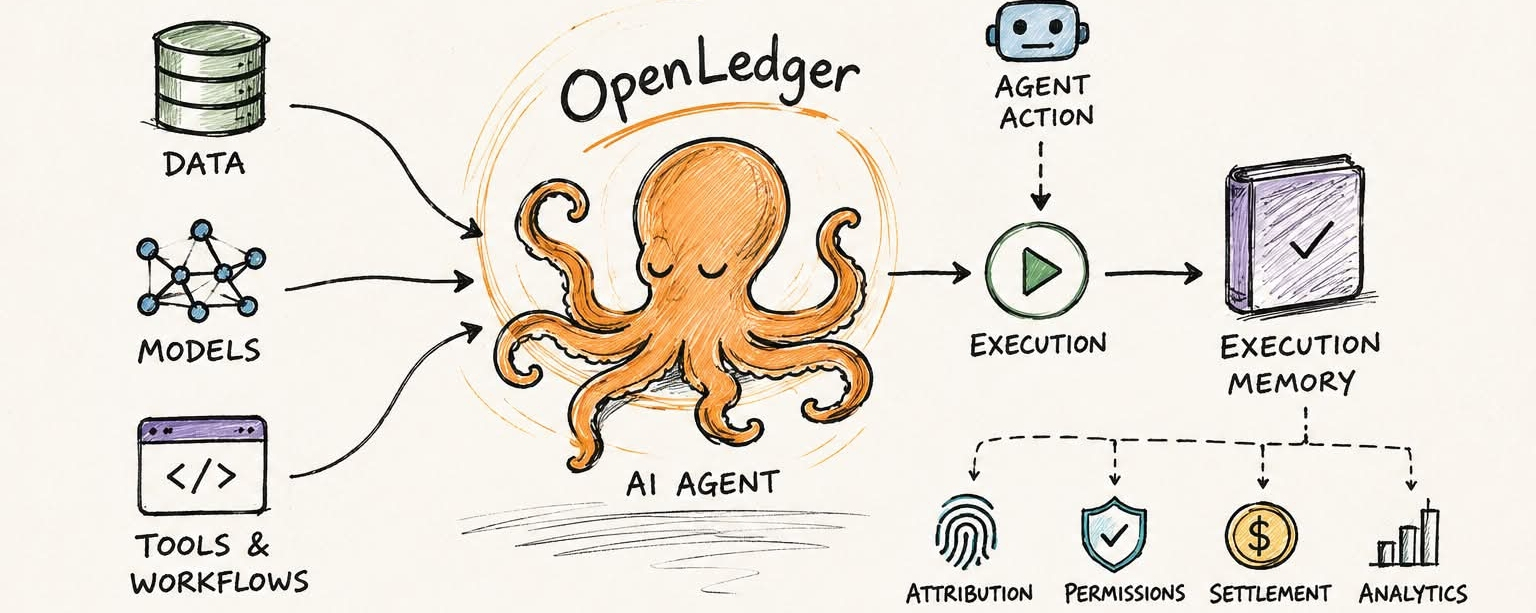
I keep noticing one strange problem around AI agents that people rarely talk about properly. Everyone talks about what the agent can do, but very few people talk about what the system remembers after the agent does it. That difference sounds small at first, but inside OpenLedger it starts feeling like the real line between a simple AI workflow and serious infrastructure.
Because an agent action without memory is just movement.
It may look useful for one moment. It may create a route, prepare a strategy, read a market condition, call a model, use a dataset, or push a workflow closer to execution. But once that moment passes, the real question becomes harder. What stayed behind? What did the system retain? Can the action be understood again later, or did it disappear into a clean interface where the result is visible but the path is gone?
That is where @OpenLedger keeps feeling different to me.
Not because it makes agents look more powerful from the outside, but because it keeps pulling attention toward the parts of agent behavior that usually vanish. The data behind a decision. The model route behind an output. The permission surface behind a workflow. The attribution behind the intelligence. The cost behind the usage. The settlement logic behind the activity. All the things that do not look exciting in a demo, but become very serious once agents start interacting with real economic systems.
The more I sit with it, the more I feel OpenLedger is not really chasing the easiest agent narrative. The easiest narrative is simple: agents will trade, agents will automate, agents will replace manual work, agents will make everything faster. That kind of story travels quickly because it is easy to understand. But it also feels thin. Speed alone does not make an agent reliable. Automation alone does not make an agent trustworthy. A smart output alone does not create accountability.
The harder question is what happens when autonomous intelligence starts leaving consequences behind.
That is where execution memory becomes important.
By execution memory, I do not mean a normal log or a simple transaction history. A log tells you something happened. Execution memory tells you why the system was able to produce that action in the first place. It connects the output back to the environment that shaped it. It keeps the relationship between data, model, workflow, permissions, attribution, and settlement from being erased after the agent moves.
That feels like one of the strongest hidden angles for OpenLedger.$OPEN
Because agentic systems will not only need intelligence. They will need memory strong enough to survive execution.
Most AI tools today are still built around the moment of response. You ask, it answers. You request, it generates. You prompt, it produces. If the answer is useful, people move on. If it is wrong, they blame the model. That structure works when the output is mostly informational. But once the output becomes part of a workflow, the old pattern starts to break.
An agent does not only answer. It can prepare. It can route. It can compare. It can trigger. It can interact with external systems. It can get close to capital. It can influence a user’s decision before any final signature appears. That means the output is no longer just content. It becomes part of a chain of action.
And chains need memory.
This is why OpenLedger’s architecture feels important from inside the system rather than from outside explanation. The interesting part is not that there are datasets somewhere, or models somewhere, or agents somewhere. The interesting part is what happens when they stop being separate things and start forming a living execution path. A Datanet does not stay passive if it shapes what an agent understands. A model route does not stay invisible if it changes the direction of a workflow. Proof of Attribution does not stay decorative if the final action depends on earlier intelligence. OctoClaw does not stay just an agent surface if it becomes the place where configuration, workflow, and action start touching.
This is where OpenLedger starts becoming less about “AI output” and more about AI behavior that can be remembered.
That memory matters because real systems do not only care about outcomes. They care about reconstruction. If an agent produces a route and the route works, the system still needs to understand what made it work. If an agent produces a route and the route fails, the system needs that even more. Without memory, success becomes hard to price and failure becomes hard to diagnose.
This is a problem most agent narratives avoid because it makes the story less shiny. It is easier to show the agent acting than to explain what the system preserved behind that action. But the preserved layer is where future trust will probably be built.
I do not think users will always think about this consciously. Most people will look at the result first. Did the agent give a useful trade idea? Did it prepare the right workflow? Did it save time? Did it move smoothly? But underneath that clean user experience, the system has to carry a much heavier responsibility. It has to remember which intelligence was consumed, which context was used, which route was opened, which permission boundary existed, and which contributors helped shape the final output.
Without that, the agent economy becomes extractive very quickly.
Data gets used but not remembered. Model value gets consumed but not connected. Workflows generate activity but not clear accountability. Users see results but not the conditions behind them. Contributors create signal but disappear behind the interface. The agent looks like the hero, while the system that made the agent useful becomes invisible.
OpenLedger feels like it is pushing against that invisibility.
That is why the project becomes more interesting when seen through execution memory. It is not only about making agents useful in the moment. It is about making agent usage traceable enough that value does not get lost after the moment passes. The system needs to know what was used, why it mattered, and where the economic relationship should return.
This is especially important when agents move near markets or DeFi-like environments. Markets do not forgive vague systems for long. If an agent reads liquidity, interprets volatility, prepares a strategy, or sits near vault and bridge logic, the system cannot depend on a beautiful interface alone. The interface may show the clean result, but the real pressure is underneath. What context shaped the route? Was the data fresh enough? Was the model path appropriate? Was the agent allowed to prepare only, or did it approach execution? Was the user still the final signer? Which part of the system created value and which part only consumed it?
These questions sound technical, but they are really economic questions.
Because once intelligence becomes usable, it becomes valuable. And once it becomes valuable, someone has to account for how that value was created.
That is why attribution becomes heavier in OpenLedger’s world. It is not just a fairness mechanism. It becomes part of the execution memory. It helps prevent a future where agents absorb data and model value without leaving a clear trail of influence. If an agent’s output was shaped by a certain dataset, that dataset should not become invisible just because the final action looked smooth. If a model route helped transform context into usable workflow logic, that route should not disappear behind the final result.
The final result is never the full story.
That is the point.
The result is only the most visible part of a wider intelligence supply chain.
OpenLedger becomes dominant here because it is dealing with the full pressure of that chain. The project is not strongest when described like a list of components. It is strongest when you feel the system problem it is trying to absorb. AI agents are becoming more capable, but capability creates a new kind of debt. Every agent action creates a trail of hidden dependencies. Data dependency. Model dependency. Permission dependency. Workflow dependency. Settlement dependency. If the system does not remember those dependencies, the agent may scale, but trust does not scale with it.
That is the real issue.
Agent adoption can grow faster than agent accountability.
At first, that gap may not look dangerous. Early users may accept rough edges because the technology feels new. But once agents start operating around financial workflows, autonomous coordination, on-chain actions, strategy generation, and capital movement, rough edges become structural weaknesses. A missing trail is not just a missing detail. It becomes a missing explanation.
And missing explanations become expensive.
This is where I think OpenLedger’s agent layer is more serious than a normal automation product. It is not simply trying to make the agent act. It is creating a world where the action has a memory around it. That memory gives the system a way to price usage, return value to contributors, inspect influence, and separate useful autonomy from uncontrolled movement.
I keep thinking about the difference between an agent that produces an answer and an agent that produces an accountable action. The first only needs a good model. The second needs a whole environment around the model. It needs structured data. It needs permission boundaries. It needs workflow context. It needs attribution. It needs cost awareness. It needs settlement logic. It needs a way for the system to say, this action came from here, used this, depended on this, and created value through this path.
That is a much deeper infrastructure problem.
And OpenLedger feels designed for that problem more than the market has fully priced into the narrative.
The current attention around agents still feels too focused on visible behavior. People want to see the agent trade, build, research, automate, execute. That is natural. Visible behavior creates excitement. But the next serious phase will probably care less about how impressive the agent looks and more about how well the system can remember the action after it happens.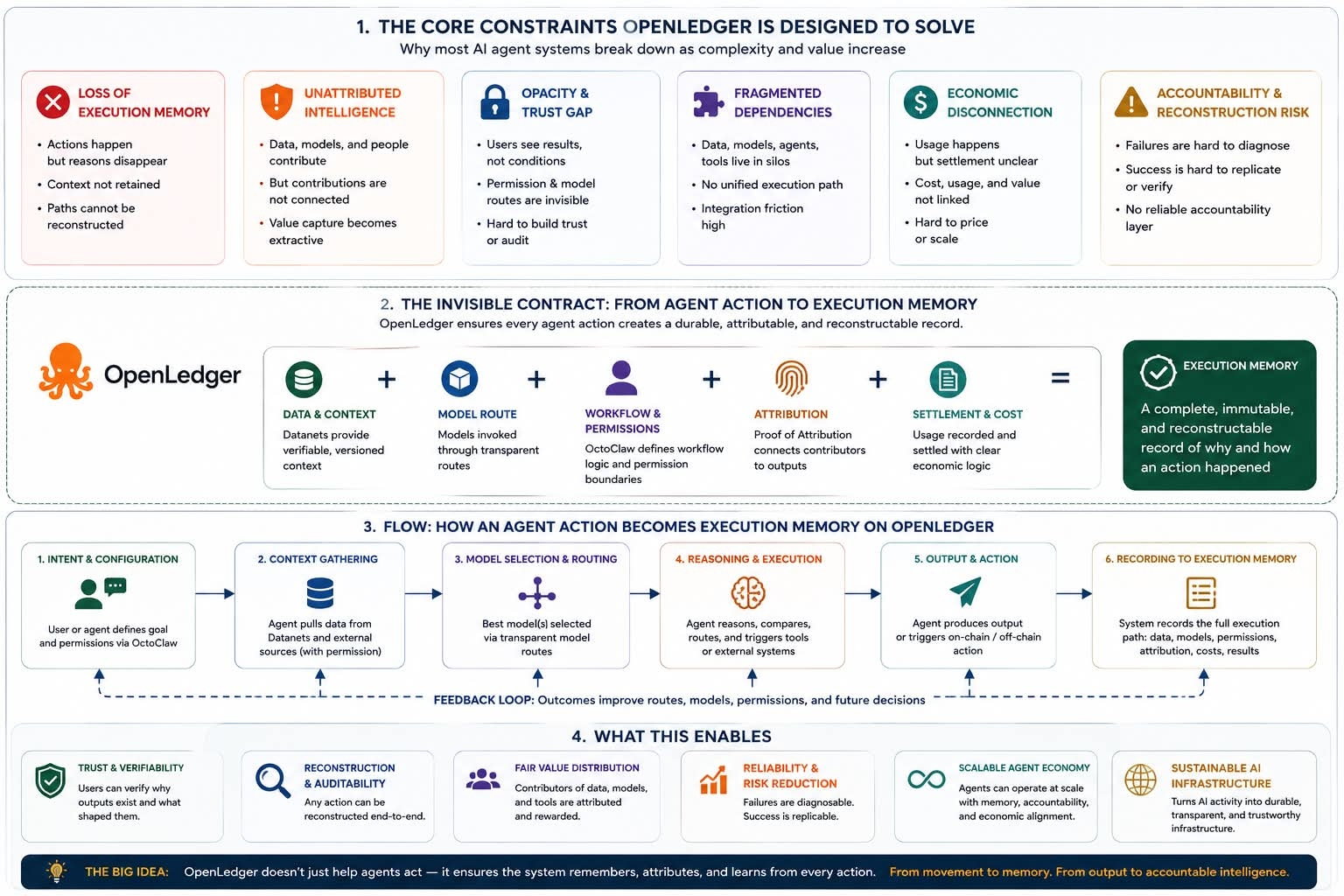
Memory becomes a trust layer.
Not memory as storage. Memory as accountability.
This is why I think OpenLedger has a strong hidden position in the agent economy. It is sitting close to the place where intelligence becomes usage and usage becomes economic activity. When an agent uses a Datanet, routes through a model, prepares a workflow, or creates an output that influences execution, the system needs to capture more than the final event. It needs to preserve the relationship between all the pieces that made the event possible.
That relationship is where value lives.
A dataset alone may be useful, but its real value becomes clearer when it can be tied to outputs. A model alone may be powerful, but its economic role becomes clearer when usage can be tracked. An agent alone may feel impressive, but its reliability becomes clearer when the system can reconstruct its behavior. A workflow alone may complete a task, but its importance grows when the system can show how intelligence moved through it.
OpenLedger’s deeper role is making those relationships harder to erase.
That is not a small thing.
In most AI systems, the interface eats the history. The user sees a clean result, but the deeper chain disappears. In OpenLedger, the more interesting direction is the opposite. The interface may stay simple, but the history behind the result becomes more meaningful. The system keeps the invisible layers from becoming worthless background.
This changes how I see too. Not as a token sitting beside the narrative, but as part of the system’s economic memory. If agents create usage, consume intelligence, and move through workflows, then the network needs a way to make that activity count. Usage has to be priced. Contribution has to be recognized. Settlement has to connect back to the value created. Otherwise the agent layer becomes another extraction machine where everyone feeds the system, but only the final interface captures attention.
That is not sustainable.
A real AI economy needs memory because value creation is distributed.
The agent may be the visible actor, but the agent is not the only source of value. The data shaped it. The model transformed it. The workflow directed it. The permissions constrained it. The attribution layer preserved it. The settlement layer made it economically real. OpenLedger’s strength is that it keeps these pieces connected instead of letting them dissolve behind one polished output.
This is where the project feels more mature than the usual agent hype.
It understands that autonomous intelligence is not just about doing more. It is about making more things accountable as they happen. The agent economy will not be healthy if every action becomes a black box wrapped in a nice user experience. It needs systems where the invisible work behind intelligence remains visible enough to be trusted, rewarded, and improved.
That is why execution memory feels like a fresh way to understand OpenLedger.
The project is not only giving agents more room to act. It is creating the conditions where action can leave behind a meaningful record. That record is what lets the system learn from usage, reward the right contributors, inspect the right paths, and keep autonomy from becoming uncontrolled abstraction.
Without that record, agents become impressive but shallow.
With that record, agents become infrastructure.
And that is the difference I keep coming back to.
OpenLedger does not become important only when an agent moves. It becomes important because something inside the system remembers what movement actually depended on. That memory is what turns action into accountability. It turns usage into settlement. It turns data into economic contribution. It turns model routing into something that can be inspected. It turns the agent from a black box into a participant inside a traceable network.
That is the part I think many people are still missing.
The next stage of AI agents will not be judged only by intelligence. Intelligence is becoming common. The harder moat is accountable intelligence. Agents that can act are interesting. Agents whose actions can be remembered, attributed, priced, and reconstructed are much harder to build.
That is where OpenLedger feels strongest.
Not at the surface of the action.
Inside the memory of why the action existed at all.
