

The moment I started digging deeper into how modern AI actually works, one question kept bothering me:
Why are the people creating the data getting the smallest share of the value?
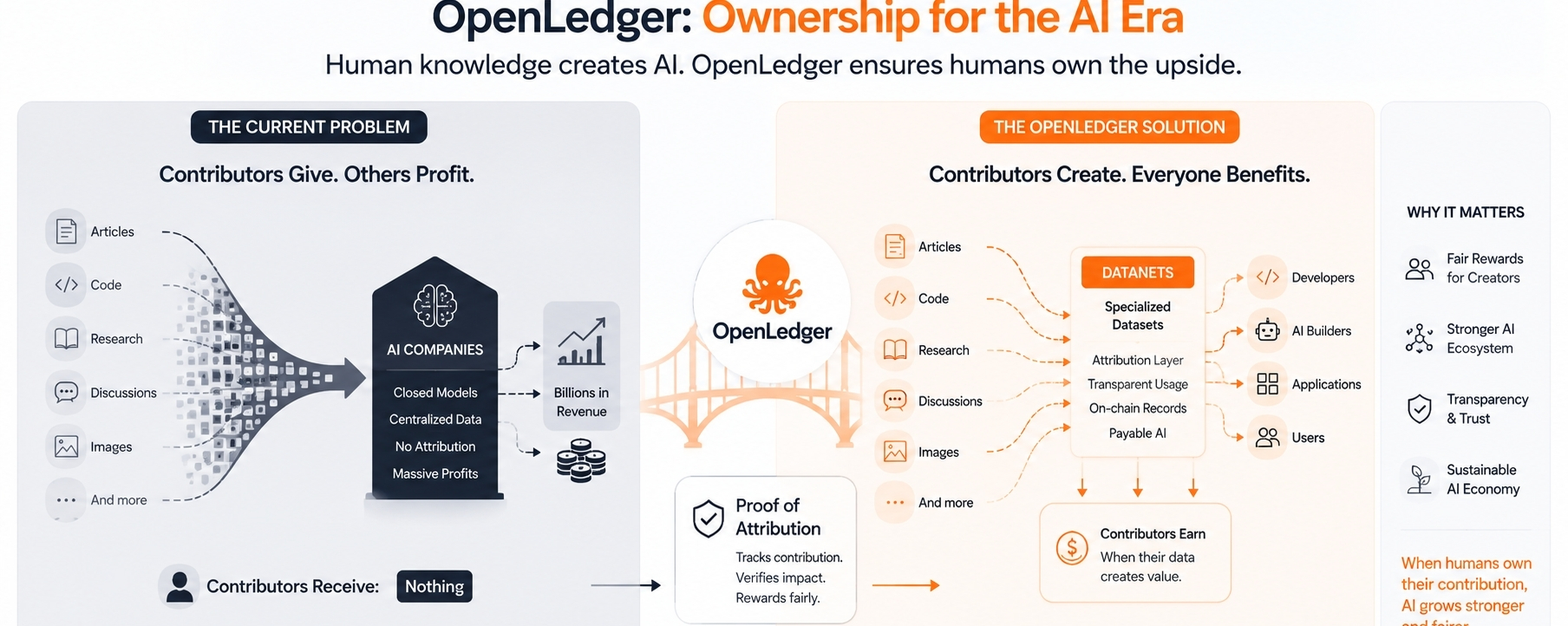
That thought stayed in my mind longer than I expected. Because the more I researched AI infrastructure, the more I realized something uncomfortable almost the entire AI economy is built on information collected from millions of people who never truly own what they contribute.Every article written online, every research thread, every dataset, every piece of code, every image, and even social discussions become fuel for AI systems. Yet once that data enters the machine, ownership becomes blurry, attribution disappears, and most contributors are forgotten entirely.
That’s what made OpenLedger stand out to me.
At first, I assumed it was just another project trying to attach “AI” to blockchain for attention. The market is already flooded with AI narratives, and honestly, most of them sound nearly identical. Faster models, autonomous agents, decentralized compute, AI tooling — the same themes repeated everywhere.
But OpenLedger felt different because it wasn’t only talking about intelligence.
It was talking about ownership.
And I think that changes everything.
The deeper I looked into OpenLedger, the more I realized the project is trying to solve a problem most AI projects barely acknowledge: how to fairly track and reward the value created by data contributors.That may sound simple, but economically it’s one of the biggest unanswered questions in artificial intelligence today.
Global AI spending is expected to move toward hundreds of billions of dollars annually over the coming years, while the companies building large-scale models continue scaling aggressively. Yet despite all that growth, the actual contributors powering these systems often receive nothing in return.
That imbalance feels unsustainable long term.
OpenLedger’s core idea revolves around something called “Proof of Attribution.” Instead of treating data like a free public resource, the system attempts to track where AI value comes from and reward the people contributing to it.
The first time I understood that model properly, I genuinely paused for a second.
Because suddenly the conversation around AI looked very different.
Most projects are focused on making AI smarter.
OpenLedger seems focused on making AI economies fairer.
And in my opinion, that distinction matters more than people think.
The platform introduces concepts like “Datanets,” where contributors can provide specialized datasets that developers and AI systems can use. But unlike traditional AI pipelines where data disappears into centralized systems, OpenLedger attempts to preserve attribution and create direct economic incentives around contribution.
That’s the part I find most interesting.
The project isn’t simply asking:
“How do we build better AI?”
It’s asking:
“How do we build an AI economy where contributors actually participate?”
That question becomes more important every single year.
Right now, some of the biggest debates in AI involve copyright disputes, content ownership, training transparency, and creator compensation. Writers, artists, researchers, and developers increasingly want to know whether their work is being used without permission inside commercial AI systems.
And honestly, I think those concerns are valid.
Because AI models don’t emerge from nowhere.
They are reflections of massive amounts of human knowledge.
That’s why OpenLedger’s “Payable AI” narrative caught my attention. The idea is that whenever AI systems benefit from contributed data, the contributors themselves should also receive economic value.
It reminds me of how content platforms evolved over time.
In the early internet era, creators generated value while platforms captured most of the economics. Over time, monetization systems improved because platforms realized creators needed incentives to continue producing quality content.
AI may eventually face the exact same reality.
Without sustainable incentive structures, ecosystems become extractive.And extractive systems rarely survive forever.
What also surprised me about OpenLedger is how aggressively it’s positioning itself around infrastructure instead of short-term hype. The project reportedly secured millions in funding from major crypto-focused investors and has continued expanding its ecosystem around decentralized AI tooling, attribution systems, and builder incentives.
That tells me this isn’t being framed as a simple meme narrative.
They’re attempting to build foundational rails for how AI economies could function in the future.
Of course, that doesn’t automatically guarantee success.
The decentralized AI sector is extremely competitive right now. Many projects sound ambitious on paper but struggle to achieve meaningful adoption. OpenLedger still has to prove real scalability, developer traction, ecosystem growth, and sustainable usage.
And technically, attribution at scale is incredibly difficult.
Tracking which datasets influence model outputs across large AI systems is not a simple engineering challenge. It requires infrastructure, transparency, verification systems, and incentive alignment working together simultaneously.
That’s why I’m more interested in the problem they’re trying to solve than blindly chasing the narrative itself.
Because even if OpenLedger evolves over time, the core issue it highlights isn’t disappearing.
The AI economy still has an ownership problem.
And I think most people haven’t fully realized how important that becomes once AI reaches larger commercial scale.
The more powerful artificial intelligence gets, the more valuable human-generated knowledge becomes. But if the systems benefiting from that knowledge remain centralized while contributors stay invisible, eventually friction becomes unavoidable.
That’s the deeper reason OpenLedger stayed on my radar.
Not because it promises unrealistic hype.
Not because it’s another trending AI token.
But because it forced me to rethink something bigger:
Maybe the future of AI won’t only depend on who builds the smartest models.
Maybe it will depend on who builds the fairest economic systems around them.