
For a long time, I noticed something strange about many infrastructure tokens.
The story always sounded powerful.
Big vision. Strong technology. Good exchange listings. Heavy community excitement.
But the charts often told a different story.
Price moved like traders were only renting attention for a short time instead of believing in a long-term system. The hype arrived quickly, but real demand rarely stayed.
That made me think more carefully about projects connected to AI infrastructure.
And honestly, that is what slowly changed the way I look at OpenLedger.
At first, the idea seemed straightforward.
People contribute data.
AI models use that data.
Usage gets tracked.
Contributors receive rewards.
And OPEN becomes the token coordinating the whole system.
Simple enough.
Crypto markets usually understand this kind of narrative because tokenized marketplaces are familiar territory.
But after thinking deeper, I started asking a different question.
What if AI memory eventually becomes expensive to keep?
That sounds abstract at first, but it becomes very real once you think about how AI systems actually operate.
Everyone talks about memory as if more memory is always better.
More context.
More training data.
Better intelligence.
But memory also creates responsibility.
If an AI model keeps using old contributor influence, somebody may still expect payment. Old attribution records may need to stay active. Legal disputes may appear later. Permissions can change. Regulations may evolve. Some data may become risky to keep.
In other words, intelligence does not only collect knowledge.
It also collects obligations.
And this is where OpenLedger started looking different to me.
Maybe this is not only an attribution network.
Maybe it could eventually become something much more important:
A system that manages the economics of remembering — and forgetting.
Not forgetting in the simple technical sense where model weights suddenly disappear overnight. That is far more complicated.
I mean economic forgetting.
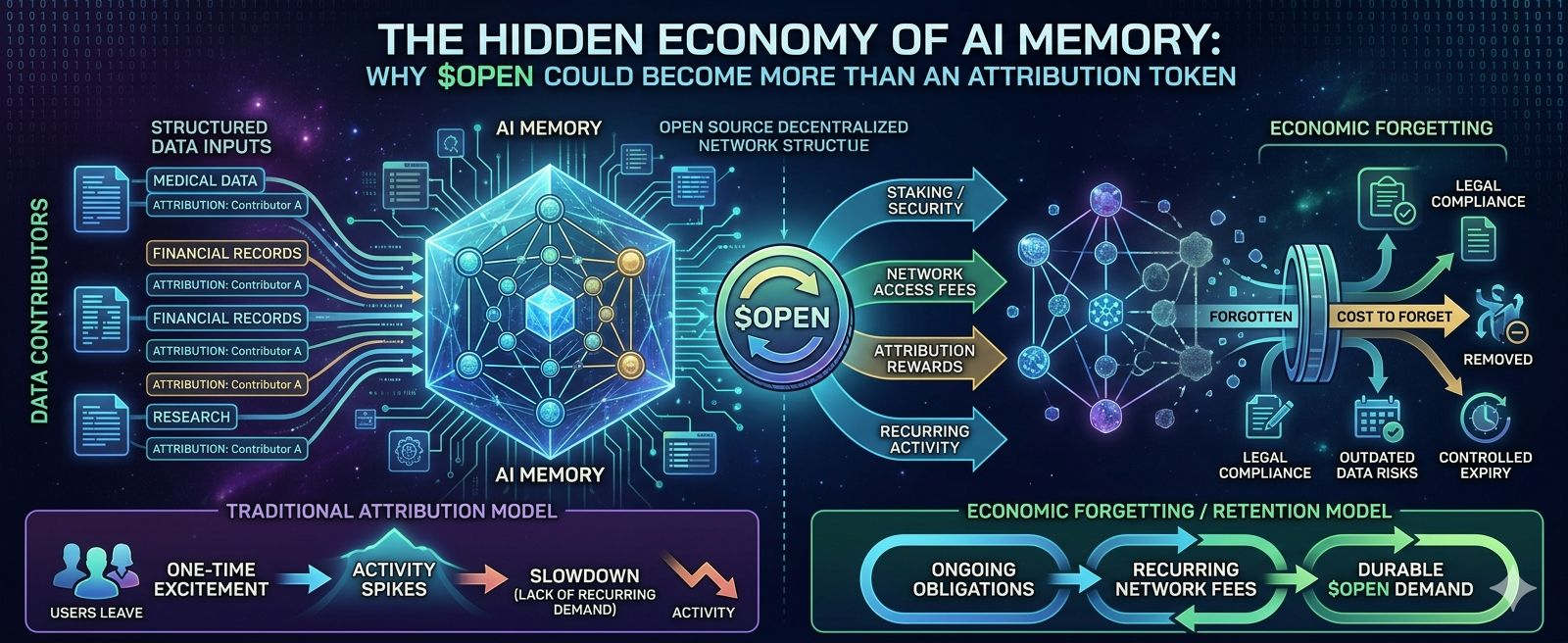
A structure where keeping memory has a cost, and removing old influence also becomes part of the network economy.
That changes the entire demand model for a token like $OPEN.
Because many attribution systems face the same problem.
A contributor uploads valuable data, gets rewarded once, and leaves. Builders consume what they need, activity spikes temporarily, and then participation slows down.
We have seen this happen many times with infrastructure tokens.
The narrative sounds strong, but recurring demand never truly forms.
The more interesting model is where memory itself becomes an active economic asset.
Imagine a company using proprietary medical, financial, or research data through a decentralized AI network.
At first, keeping that memory inside the model is useful.
But months later, things change.
The data becomes outdated.
Legal risk increases.
Commercial priorities shift.
Compliance costs rise.
Now suddenly, retaining that old influence is no longer free.
And that is where $OPEN potentially becomes much more interesting.
Instead of functioning only as an access token, it could become part of a system that prices retention rights, attribution persistence, and controlled memory expiry.
That matters because strong crypto economies are usually built around ongoing obligations, not one-time excitement.
Gas fees work because transactions never stop.
Security models work because validators must continue participating.
Successful infrastructure tokens survive because users keep returning to the network for necessary operations.
Recurring activity is what creates durable demand.
That is why the “memory expiry” idea feels structurally more powerful than simple attribution alone.
Still, traders should separate theory from reality.
A smart concept does not automatically create a successful token.
Tokenomics still matter.
If future token unlocks are too large compared to real adoption, even strong infrastructure can struggle badly in the market. Crypto history is full of projects with beautiful architecture and terrible price structure.
That is why the most important question is simple:
Who needs to keep buying $OPEN repeatedly?
Builders paying for network access is one possibility.
Contributors staking tokens is another.
Validators bonding capital may also help if the network truly depends on security participation.
But sustainable demand only exists if those actions remain economically necessary over time.
Otherwise, activity can easily become artificial.
And that danger is real.
Low-quality contributors may farm rewards.
Fake attribution loops may appear.
Projects may simulate usage without creating real value.
Once trust inside an attribution system weakens, the entire network becomes harder to validate.
And attribution itself is not easy to measure.
How much of an AI response truly came from one contributor?
How do disputes get solved?
How do you measure influence inside probabilistic systems?
These questions sound simple in presentations, but become much harder in production environments.
There is also another challenge most people ignore.
Optional utility rarely creates strong token demand.
If builders can find similar data outside the network more cheaply, the token layer becomes unnecessary.
And if enterprise users need stricter compliance guarantees than decentralized attribution systems can realistically provide, adoption may stay limited.
That is why I think the “economic forgetting” framework matters even if OpenLedger never directly markets itself that way.
Because it forces people to ask a deeper question.
Not just:
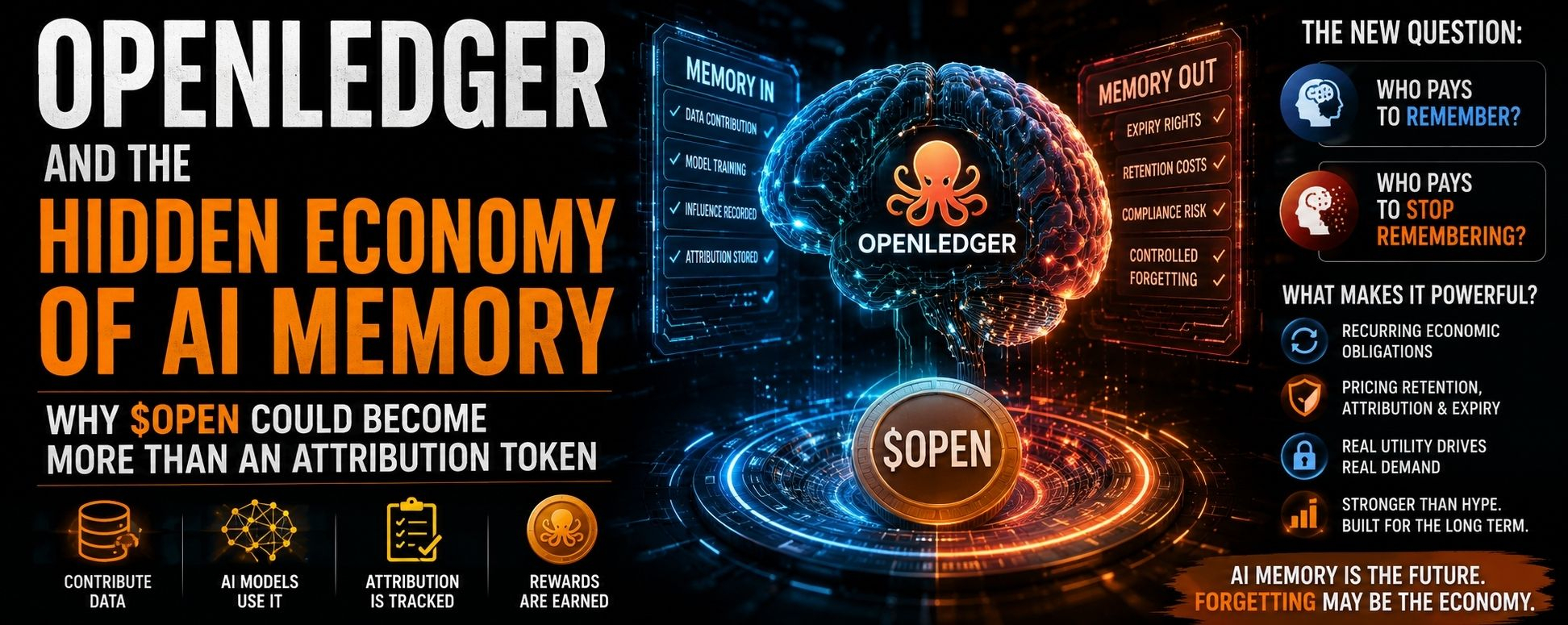
“Who pays to remember?”
But also:
“Who eventually pays to stop remembering?”
That could become a far stronger long-term economic loop.
As a trader, I would focus less on storytelling and more on behavior.
Are real fees being generated consistently?
Are contributors remaining active without depending completely on token emissions?
Are builders returning because they truly need the network?
Is on-chain activity growing alongside exchange volume?
Those signals matter far more than social media excitement.
And supply pressure matters too.
Even brilliant infrastructure can trade badly if unlock schedules overwhelm demand.
The market eventually notices the difference between real usage and speculative attention.
That does not mean OpenLedger fails.
It may simply mean the market has not fully understood what type of infrastructure this could become.
I think many investors still price AI infrastructure tokens incorrectly.
They focus on the intelligence narrative first.
But in reality, maintenance economies are usually more important than intelligence itself.
Attribution alone is easy to market.
The harder question is whether the network creates ongoing economic obligations that users cannot avoid.
That is where durable token demand usually comes from.
So if you are watching $OPEN, maybe the most important question is no longer whether AI needs attribution.
Maybe the real question is this:
Once AI memory becomes valuable, will forgetting eventually become valuable too?