
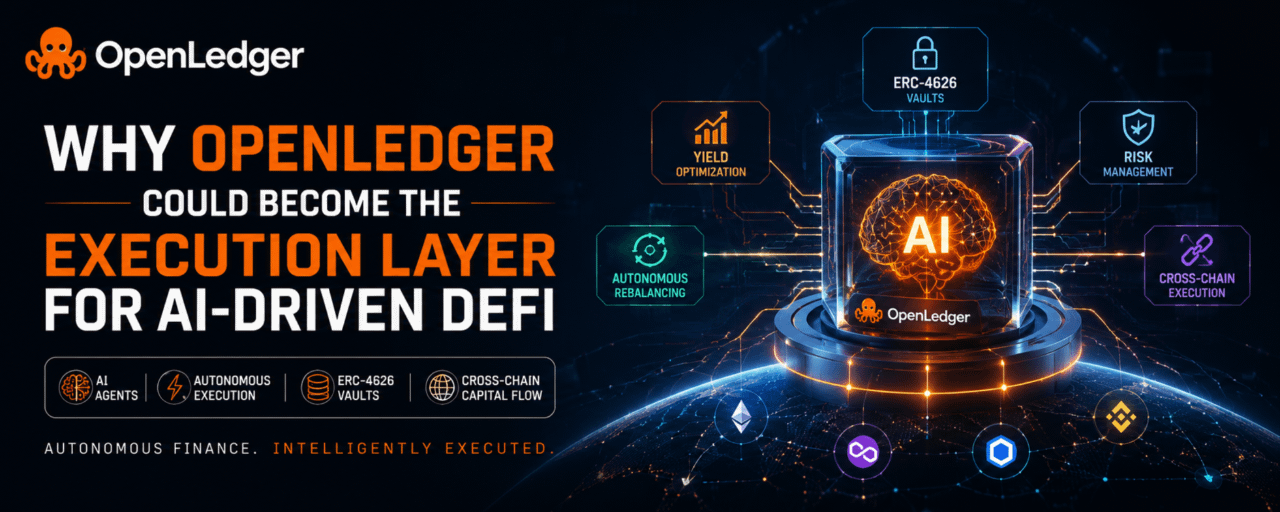
For a long time, most people thought AI in crypto would mainly be about chatbots, trading indicators, or market sentiment tools.
But the more I study this space, the more I feel the real opportunity is somewhere else entirely.
Execution.
That’s one of the main reasons I’ve been paying close attention to @OpenLedger lately.
What caught my interest is that they don’t seem focused on building another “AI assistant” for crypto users. Instead, the bigger idea appears to be creating infrastructure that allows AI systems to actually manage and move capital efficiently on-chain.
And honestly, that’s a much bigger conversation.
Because if you look at DeFi today, the issue usually isn’t lack of information.
People already know where the best yields are.
They know which chains are active.
They know where liquidity is moving.
The problem is reacting fast enough.
Markets move 24/7, while humans obviously can’t.
By the time someone manually shifts funds, compounds rewards, or adjusts positions, the opportunity may already be gone.
That’s why the @OpenLedger thesis feels interesting to me.
Especially when you connect it with ERC-4626 vault infrastructure.
Most people ignore ERC-4626 because it sounds technical and boring, but I actually think it could become one of the most important standards for AI-driven finance.
Why?
Because it standardizes how vaults and yield strategies work across DeFi.
That means AI systems can interact with liquidity, rebalancing, deposits, withdrawals, and yield optimization through a shared structure instead of fragmented systems.
Now imagine autonomous AI agents operating on top of that.
You suddenly get systems that can:
⚡ move liquidity automatically
⚡ optimize yield in real time
⚡ rebalance portfolios continuously
⚡ reduce risk dynamically
⚡ rotate capital across chains instantly
without needing constant human input.
That changes the entire idea of DeFi participation.
The advantage may no longer belong to the person who discovers opportunities first…
but to the system that can execute them fastest.
And I think that’s where projects like @OpenLedger become very important.
The narrative is slowly shifting from “AI that gives information” to “AI that takes action.”
That’s a major difference.
If autonomous execution actually works at scale, then one of the biggest inefficiencies in crypto — slow human coordination — could eventually disappear.
Of course, execution is the hard part.
Ideas always sound good in theory.
The real challenge is whether these systems can perform reliably in live market conditions where volatility, liquidity, and risk constantly change.
But if they can…
then we may be looking at the early foundation of AI-managed financial infrastructure.
Not just another AI trend.
And that’s why I think many people are still underestimating what @OpenLedger could eventually become.
