
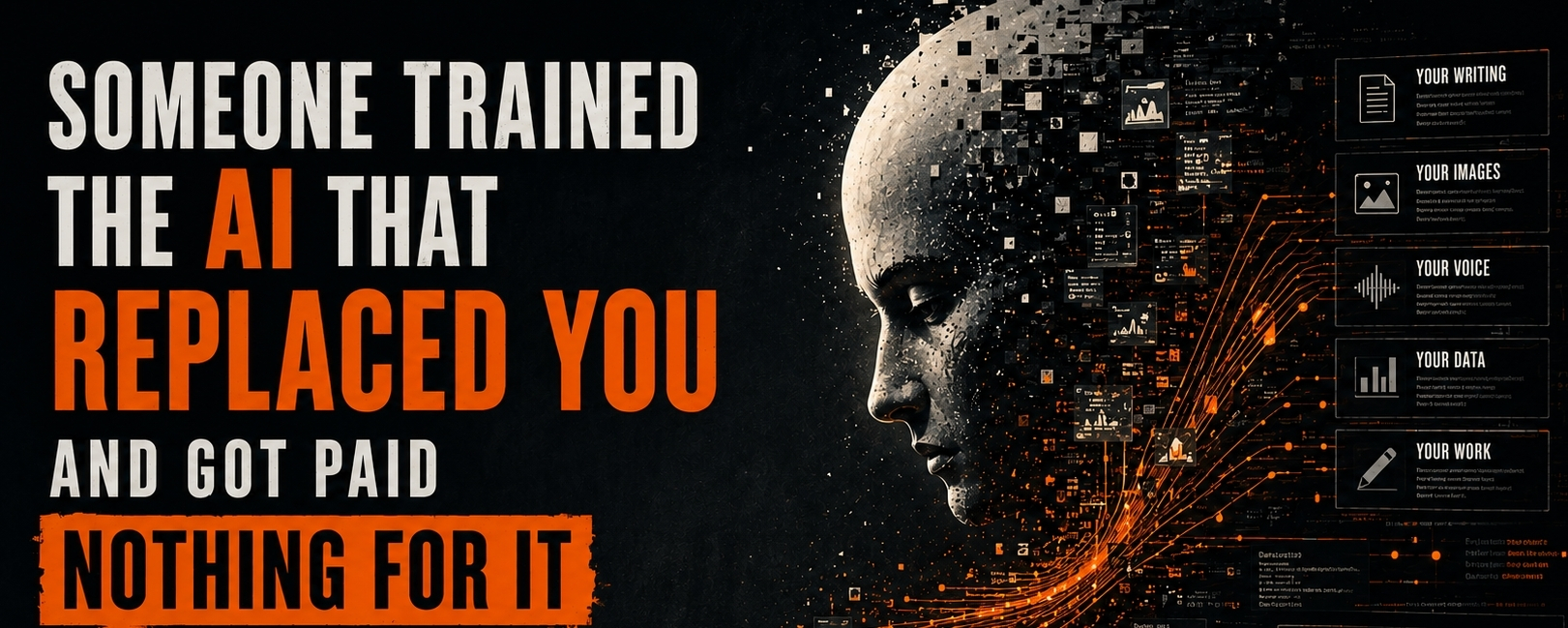
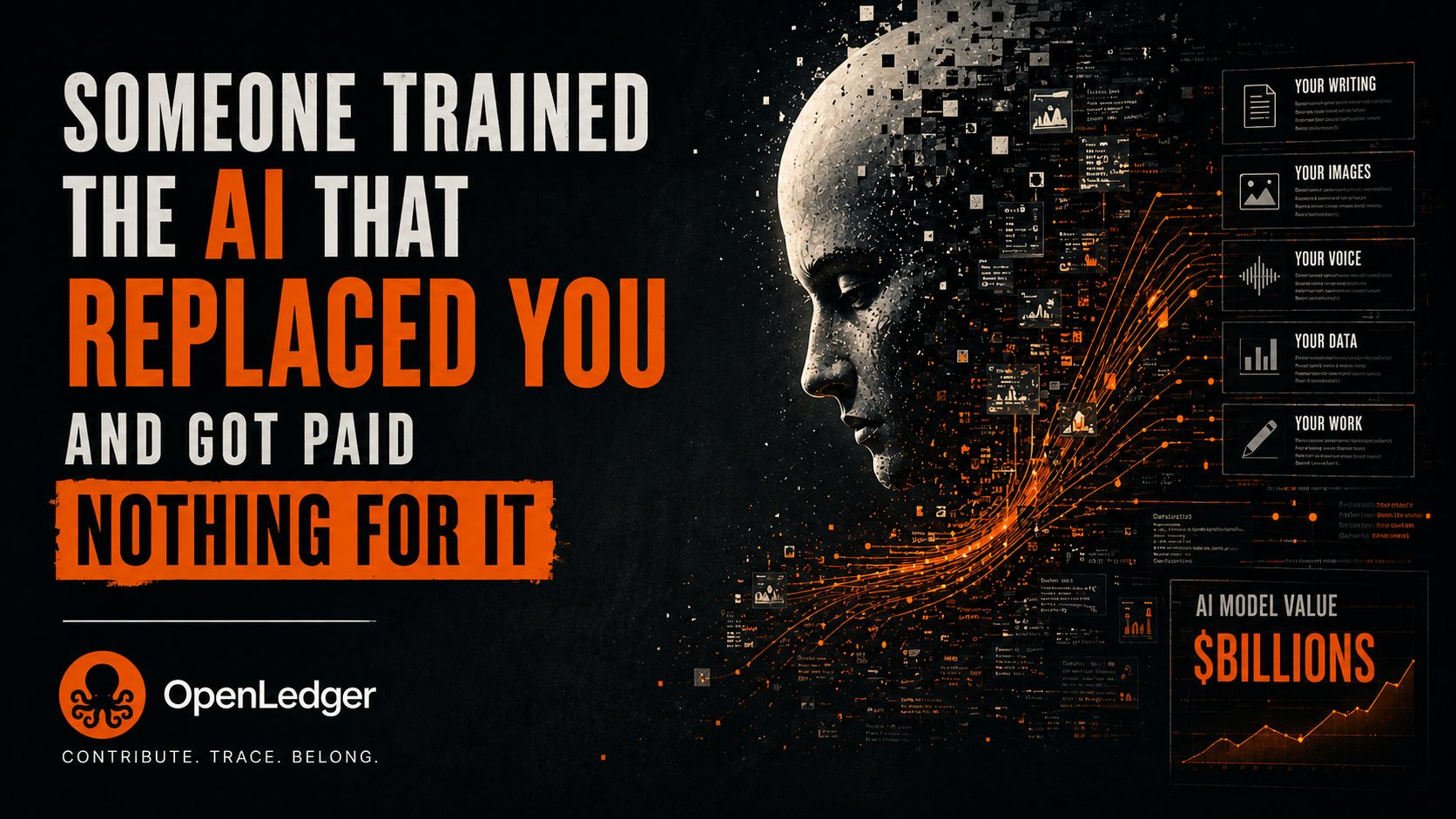
 Sometimes I think about the person who wrote the article that trained the model that wrote the article that put them out of a job.
That's not a hypothetical. That happened. It is still happening.
And I keep turning over this specific thing — not the job loss part, because that conversation is everywhere and it's mostly people yelling past each other — but the ownership part. The invisible part. The part where your data, your words, your medical records, your behavioral patterns, your creative work, all of it flows upward into systems that become extraordinarily valuable, and nothing flows back down to you. Not even acknowledgment. Not even a record that you contributed.
This is the uncomfortable truth I can't stop thinking about. AI is the first technology in history that is built almost entirely from human output and yet treats those humans as raw material rather than participants.
Think about what that actually means.
You created something. It got scraped. It trained a model. The model is now worth billions. You got nothing. You don't even know it happened.
That's not a bug. That's the design.
I've been in crypto long enough to watch dozens of projects claim they were going to fix something fundamental about how the world works, and most of them were either lying or deluded or both. So when I started looking at what OpenLedger is building — an AI blockchain where data monetization, model training, and agent deployment happen entirely on-chain — my first instinct was skepticism. Strong skepticism. The kind you develop after holding tokens that went to zero.
But I kept reading, because the problem they're pointing at is real. Not constructed. Not a narrative engineered to sell a token. The problem of unattributed human contribution to AI systems is real, it is structural, and it is getting worse as the models get larger.
The way OpenLedger approaches this is by making the entire pipeline visible. Data comes in, its origin is recorded, its usage is tracked, and the $OPEN token is the mechanism through which value moves back toward contributors. Because it follows Ethereum standards completely, it doesn't require anyone to trust a proprietary system — the rails are the same rails the rest of the ecosystem already uses. That matters to me. Closed proprietary AI infrastructure where you have to trust the company's word about what happened to your data is exactly the problem we're trying to escape.
But here's what I genuinely don't know yet.
I don't know if contributor incentives hold at scale. I've watched tokenized contribution systems collapse before, not because the idea was wrong, but because the incentive math stops working when you have millions of participants and the marginal value of each additional data point drops toward zero. I don't know if the on-chain model training they're describing actually works at the level of complexity where it becomes useful, or if it works for simple cases and hits a wall when it needs to. I don't know if regulators who are already circling AI data practices will view this as a solution or as a new surface area to attack. These are open questions. I'm not pretending to have answers.
What I do know is that the question of who owns the output of human intelligence — and whether any system can actually enforce that ownership in a way that survives contact with power and money — is the defining question of this decade.
Most people contributing to AI right now are doing it for free, without consent, without knowledge, and without recourse.
That's worth sitting with for a second.
Not as a market thesis. Not as a reason to buy anything. Just as a fact about the world we're living in.
The models will keep getting smarter. The companies will keep getting richer. And somewhere out there, the person whose writing, whose images, whose voice, whose data made all of it possible, is still waiting for something they will probably never receive.
Technology doesn't fix that automatically. But sometimes the right architecture creates the conditions where it becomes possible. Whether OpenLedger becomes that architecture is something only time and actual usage will answer. I'm watching it closely, not because I'm certain, but because the problem it's trying to solve is one I can't stop thinking about.
@OpenLedger @Binance Square Official



#OpenLedger #TrendingTopic #Binance #MegadropLista #meme板块关注热点