

Most people still think the AI race is about who builds the smartest model
Bigger parameters. Faster inference. More polished demos. Every week another company claims it’s changing the future. And honestly? Half the time it feels like watching tech firms throw fireworks at each other while the real infrastructure underneath remains strangely fragile.
Because here’s the uncomfortable truth nobody talks about enough:
AI is starving for good data.
Not just any data. Valuable data. Human-shaped data. Context-rich information created through behavior, decisions, conversations, industries, habits, and specialized knowledge. The kind of data that actually makes models useful instead of just impressive in benchmark screenshots.
That’s where OpenLedger becomes interesting.
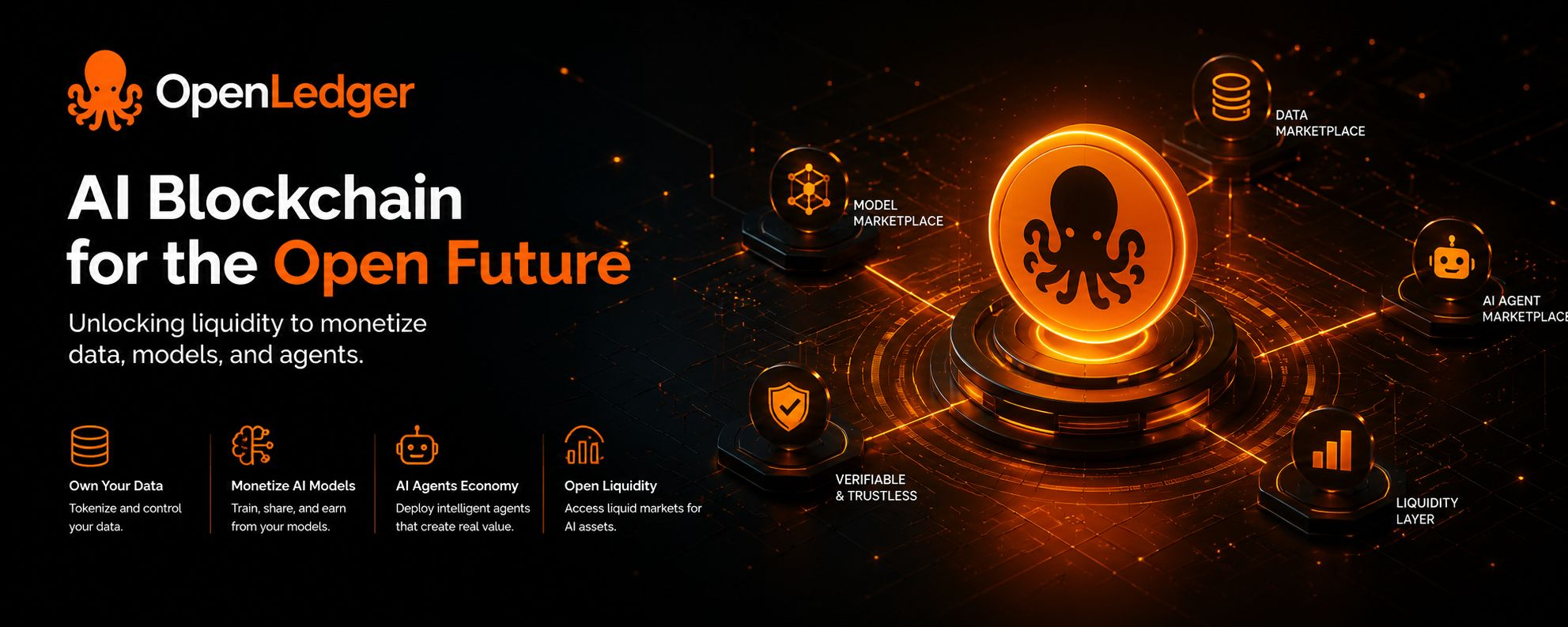
Not because it calls itself an “AI blockchain.” Every project says something dramatic these days. What caught my attention is the deeper idea underneath it: turning AI contributions into liquid digital assets. Data, models, agents — things that normally disappear into closed systems — suddenly becoming monetizable and trackable on-chain.
And if that idea works at scale, it changes much more than crypto.
It changes who owns intelligence itself
The Strange Economy Behind Modern AI
Right now, most AI users participate in a system they don’t really benefit from.
People generate data constantly. Every search query, image prompt, correction, rating, workflow, and conversation becomes fuel for training and optimization. Yet the value extraction usually flows upward toward centralized platforms.
Users contribute. Platforms accumulate. Models improve. Profits concentrate.
The cycle repeats.
What makes OpenLedger different is that it seems to ask a more uncomfortable question:
What if AI infrastructure behaved more like an open economy instead of a walled garden?
That question matters more than people realize.
Because the future AI market probably won’t be dominated by a single supermodel. It’ll be fragmented into thousands of specialized systems trained on niche datasets and coordinated by agents that interact autonomously across networks.
Healthcare agents. Trading agents. Gaming agents. Research agents. Regional language agents.
The real scarcity won’t just be compute power anymore. It’ll be access to trustworthy, domain-specific intelligence.
And suddenly, ownership becomes everything
Data Has Been Undervalued for Years
People say “data is the new oil,” but honestly that phrase already feels outdated.
Oil gets consumed once.
Data compounds.
A medical dataset can improve diagnostics for years. A behavioral dataset can reshape recommendation systems indefinitely. A strong language dataset for underserved regions can create entirely new digital economies.
Yet most contributors never participate in the upside.
OpenLedger seems built around correcting that imbalance by creating liquidity layers for AI assets themselves. Not just tokens floating around speculation cycles, but usable AI components that can theoretically generate recurring value.
That’s a much more serious direction than meme-driven token ecosystems pretending to have utility later.
And there’s another layer here people overlook: attribution.
AI development has become so massive and opaque that creators increasingly lose visibility into how their contributions are used. Models absorb millions of inputs until everything becomes anonymous fog.
Blockchain changes that dynamic.
Not perfectly. Not magically. But enough to introduce accountability and traceability into systems that currently operate like black boxes.
That alone could become incredibly important over the next five years
Why AI Agents Need Economic Infrastructure
There’s a weird misconception floating around crypto and AI circles that agents are simply chatbots with branding.
They’re not.
The serious vision for AI agents involves autonomous systems performing tasks, coordinating services, negotiating resources, executing transactions, and interacting with digital environments independently.
Now think about what happens when millions of these agents exist simultaneously.
How do they pay each other How do they verify ownership? How do they access trusted dataset How do contributors earn from improving agent performance? Who controls permissions and incentives
Traditional infrastructure wasn’t really designed for that kind of machine-native economy.
This is where OpenLedger starts feeling less like a trendy blockchain narrative and more like an attempt to build economic rails for autonomous intelligence.
That’s a very different framing.
Instead of asking: “How do we put AI on blockchain?”
The better question becomes: “How do intelligent systems exchange value at scale without centralized gatekeepers
Big difference
The Hidden Shift Most Investors Are Missing
A lot of crypto investors still chase narratives the same way people chased ICOs years ago. Fast rotations. Short attention spans. Endless excitement around token charts detached from actual infrastructure progress.
But AI ecosystems are forcing the market to mature a little.
Why
Because AI products create measurable utility faster than most Web3 sectors ever did.
If an AI model saves a company 200 hours a month, that’s tangible. If an AI agent automates logistics coordination, that’s tangible. If a decentralized dataset outperforms closed alternatives, markets notice.
Speculation still exists, obviously. It always will.
But utility is starting to matter again.
And projects like OpenLedger sit right in that transition zone between speculation and infrastructure. That’s usually where the most important systems quietly emerge before the broader market fully understands them.
Not flashy enough for mainstream hype cycles. Too early for traditional institutions. Too technical for casual traders.
Which, historically, is often where the interesting things happen
There’s Also a Cultural Shift Happening
This part fascinates me the most.
For years, the internet trained people to give away value for free. Content, behavior, creativity, preferences platforms absorbed all of it while users received convenience and entertainment in return.
AI accelerates that imbalance dramatically unless ownership layers evolve alongside it.
OpenLedger feels connected to a broader cultural correction: people increasingly want participation, not just access.
Musicians want ownership. Creators want monetization. Developers want attribution. Communities want governance. Data contributors want compensation.
That desire isn’t going away.
The next generation of internet systems probably won’t succeed simply because they’re decentralized. Most users honestly don’t care about decentralization as a slogan anymore.
They care about fairness. Visibility. Control. Economic participation.
Subtle difference, but massively important
The Risk Nobody Should Ignore
Of course, none of this guarantees success.
AI infrastructure is becoming brutally competitive. Every month new protocols appear claiming to decentralize compute, tokenize intelligence, or reinvent machine learning economics.
Many won’t survive.
Some will overpromise. Some will collapse under technical complexity. Some will realize too late that token mechanics alone cannot manufacture adoption.
And AI moves frighteningly fast. A system that feels innovative today can look obsolete within eighteen months.
That’s the reality.
But even with those risks, the broader direction still feels inevitable: AI economies need open coordination layers. The current closed-platform model creates too much concentration, too little transparency, and too many bottlenecks around ownership.
Something eventually fills that gap.
The real question is which ecosystems manage to balance usability, incentives, scalability, and trust without collapsing into speculation theater.
That’s the hard part
Why OpenLedger Feels Worth Watching
What makes OpenLedger compelling isn’t hype. It’s timing.
The project is emerging during a moment when AI and blockchain are finally starting to intersect in ways that feel structurally meaningful instead of purely narrative-driven.
That distinction matters.
A few years ago, “AI + crypto” mostly meant buzzwords stapled together for attention. Now there’s an actual economic reason for these systems to connect.
AI needs open coordination. Blockchain needs real utility. Data contributors need incentives. Agents need transaction layers.
Suddenly the puzzle pieces fit together more naturally.
And maybe that’s the biggest takeaway here.
The future AI economy probably won’t belong entirely to giant corporations or entirely to decentralized networks. It’ll be a messy hybrid system where ownership, intelligence, liquidity, and automation constantly interact.
Projects like OpenLedger are trying to build the rails for that future before the rest of the market fully sees where things are heading.
Sometimes the most important technologies don’t arrive loudly
They arrive quietly, underneath the systems everyone is already distracted by