
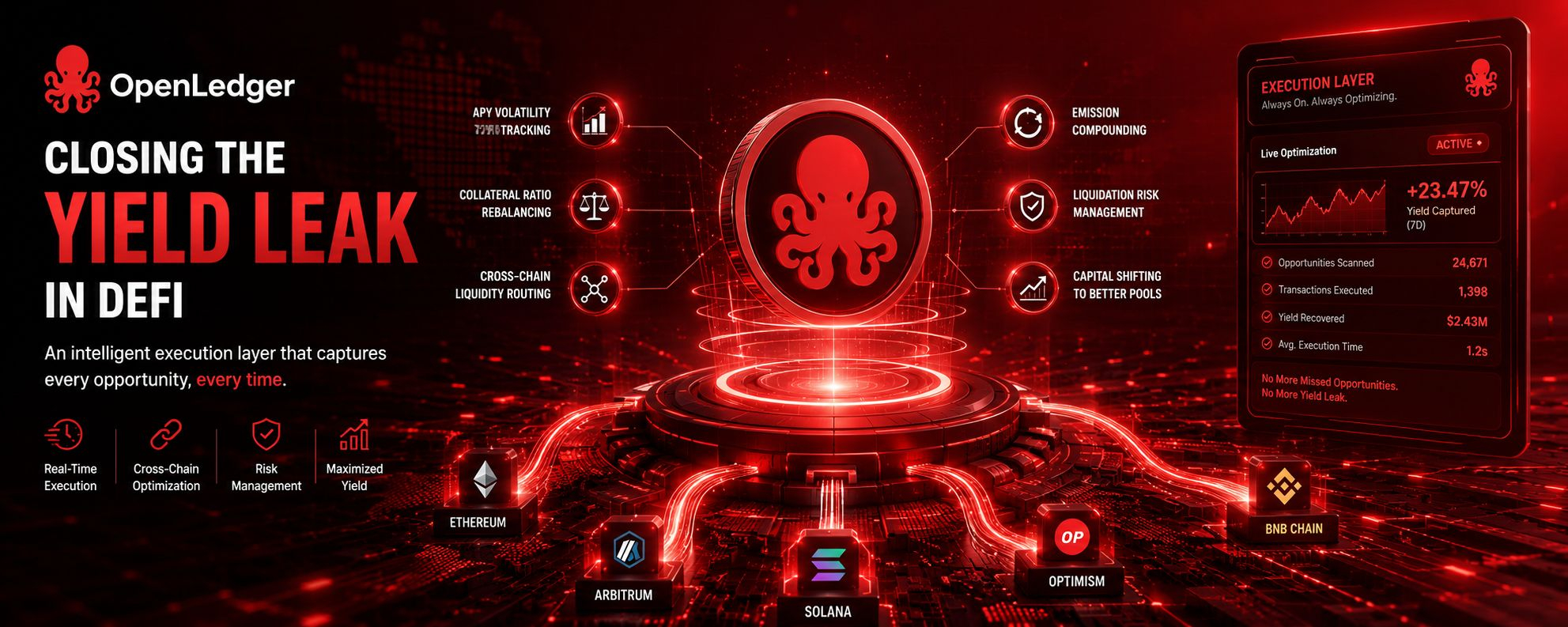
There’s something about @OpenLedger that keeps pulling me back into the same thought again and again… maybe the biggest weakness inside DeFi was never lack of information. Maybe it was always execution.
The deeper I think about it, the more this “yield leak” idea starts making sense to me. In crypto, people already know almost everything. They know which pools are paying more, which chains are active, where incentives are flowing, and which protocols are attracting liquidity. Information spreads fast now. Alpha does not stay hidden for long. But even when people know exactly what they should do, most still fail to capture the full opportunity. And honestly, that gap between knowing and actually acting is where the leak begins.
DeFi moves at a speed that humans simply cannot match consistently. Markets shift while people sleep. APYs change within minutes. Liquidity rotates across chains unexpectedly. Reward emissions lose efficiency if they are not compounded quickly enough. Loan positions become dangerous if collateral ratios are ignored for too long. None of these problems come from ignorance. They come from delayed execution. That is the part I keep thinking about.
When I look at what OpenLedger seems to be hinting at, it feels less like a simple “earn more yield” story and more like an attempt to solve the invisible inefficiencies people have normalized in DeFi. And once you notice that, the whole narrative changes. Because suddenly the conversation is no longer about discovering opportunities… it becomes about reacting to them faster than human behavior normally allows.
Take APY volatility for example. Yields move constantly across protocols, but nobody realistically monitors every opportunity every second of the day. By the time most people react, the edge is already gone. Then there is collateral management, which is honestly one of the harshest realities in DeFi. One bad market move and a position can become vulnerable instantly. Humans hesitate, get distracted, or simply miss timing. Protocols do not care about excuses. Liquidations happen anyway.
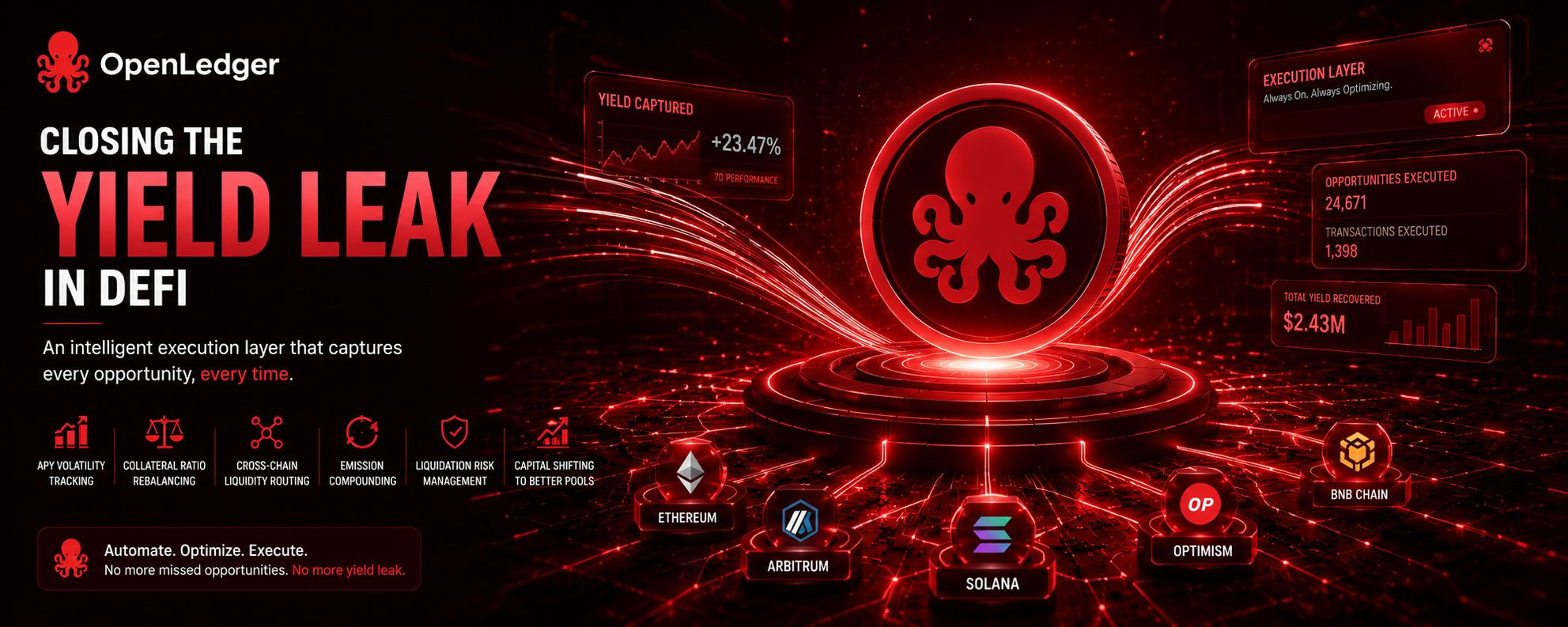
Cross-chain liquidity movement sounds easy when people explain it on timelines, but in reality it is slow, fragmented, and full of friction. Moving capital from one ecosystem to another at the right moment is rarely seamless. Add gas fees, timing issues, bridge delays, and emotional hesitation into the mix, and suddenly “optimizing yield” becomes much harder than it sounds. Even reward compounding becomes a problem at scale. Every delay quietly reduces long-term efficiency, but nobody can realistically sit there compounding rewards manually forever.
This is why I think OpenLedger is really pushing a much bigger idea underneath the surface. It feels like they are trying to shift DeFi away from being a pure knowledge game and toward becoming an execution game. In other words, understanding the market is no longer enough. The real advantage comes from how fast and how intelligently you can respond to changing conditions.
And this is exactly where things become interesting for me… because this is also where hype and reality separate very quickly.
If an intelligent execution layer can genuinely monitor, decide, rebalance, route liquidity, manage risk, and optimize strategies automatically in real time, then the structure of DeFi changes in a very meaningful way. Suddenly, people are no longer competing only with information. They are competing with systems that never sleep, never hesitate, and never miss timing because of emotion. That is a completely different market dynamic.
At the same time, I cannot fully ignore the risks behind the narrative either. Crypto has always been full of beautiful concepts that sounded revolutionary until real-world complexity exposed the gaps. Automation sounds powerful, but seamless automation inside volatile decentralized markets is extremely difficult to execute properly. If the infrastructure is weak, if decisions are inefficient, or if execution cannot handle real pressure, then the entire thesis weakens very fast.
That is why I am somewhere in the middle right now. Not blindly convinced, but definitely not ignoring it either.
The idea feels strong. The logic feels real. And the problem itself absolutely exists. What makes OpenLedger interesting to me is not the promise of “higher yield.” It is the framing around recovering lost efficiency that already exists inside DeFi every single day. That is a much smarter narrative because people immediately understand the pain of missed opportunities, delayed actions, and preventable losses.
So the way I see it, OpenLedger is not just talking about making DeFi smarter. It is quietly asking a deeper question: what happens when execution becomes more important than knowledge itself?
And honestly… if that transition really happens, then one of the most overlooked problems in DeFi could quietly turn into one of the biggest opportunities in the entire space. 🚀