
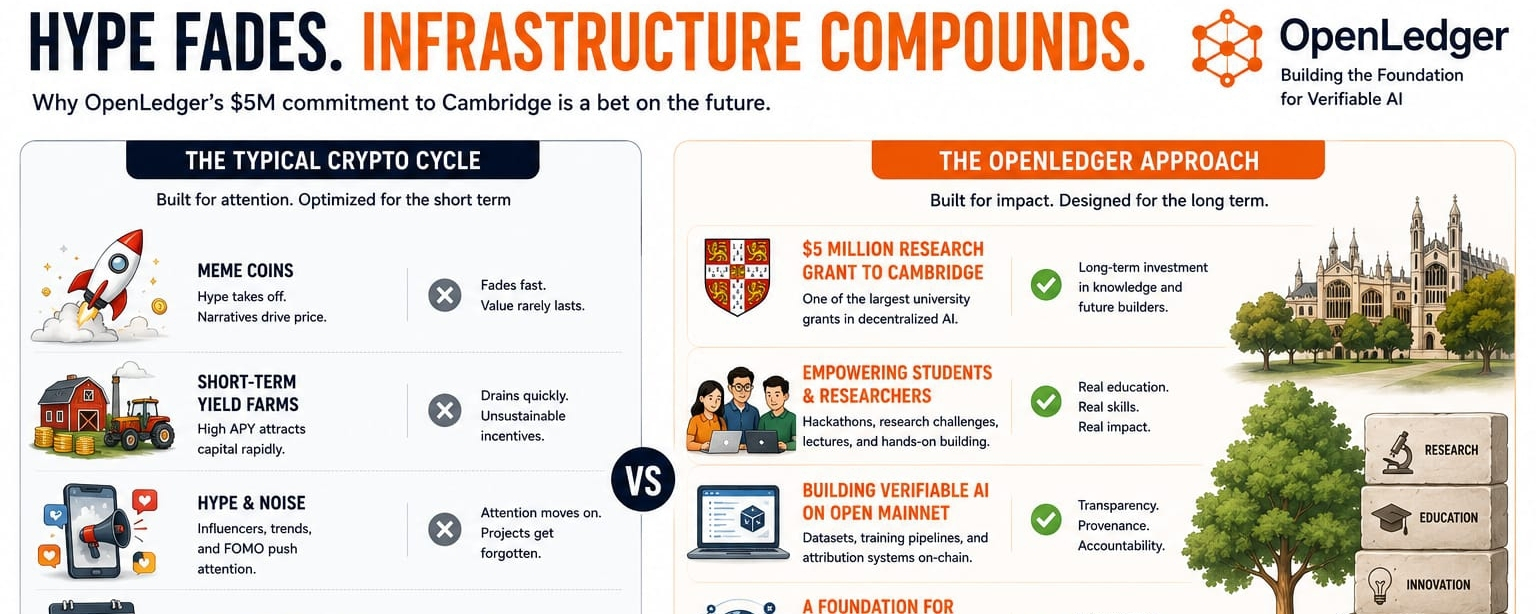
I have a confession: for years, whenever I heard the words “university partnership” in crypto, I mentally filed it under marketing fluff. A logo swap, a joint webinar nobody attends, a press release that evaporates within a week. So when I first noticed OpenLedger had cut a $5 million check to the Cambridge University Blockchain Society, my reflex was skepticism. But something made me pause and actually read.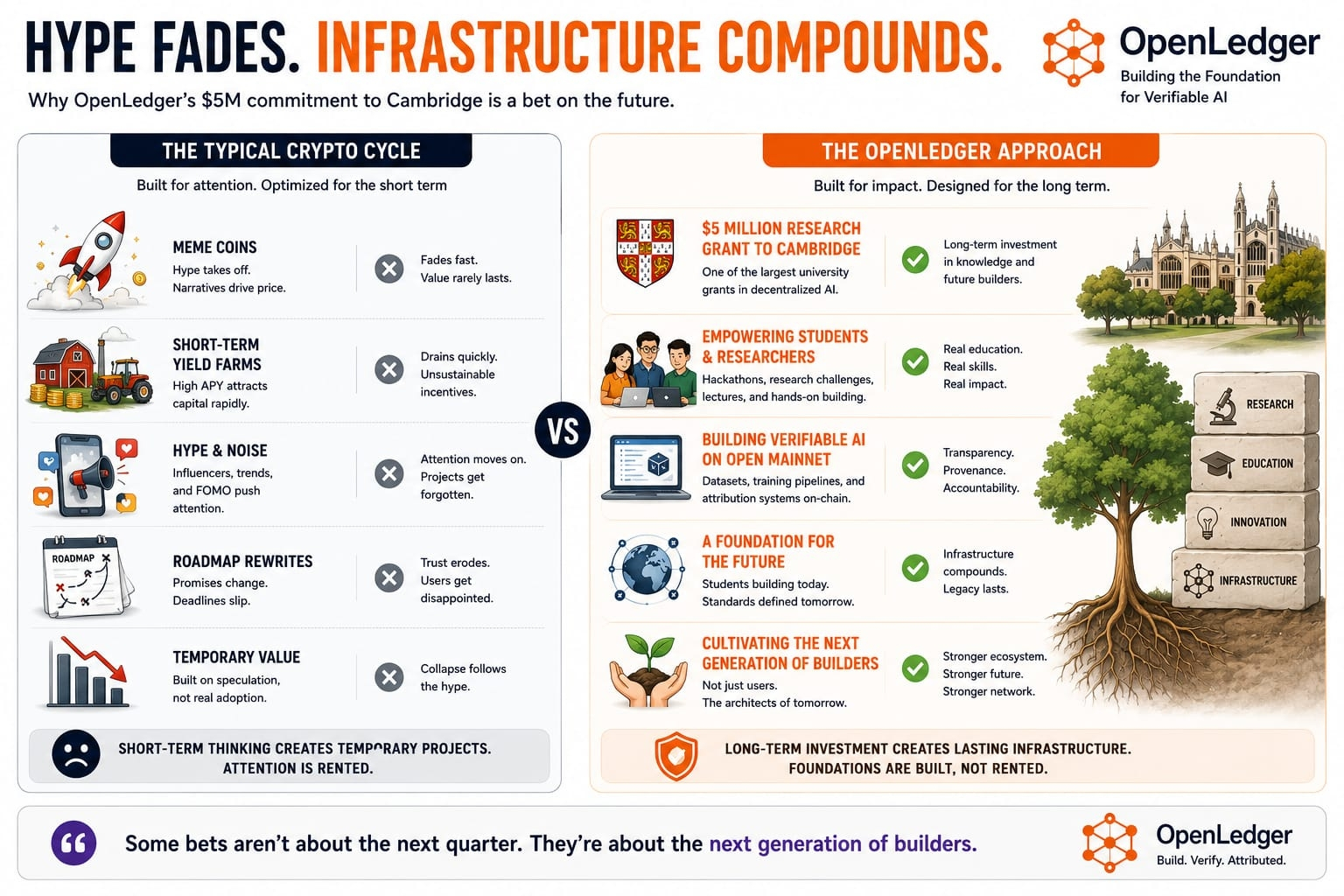
This wasn't a sponsorship. It was a long-term research grants program one of the most substantial university-focused commitments in the entire decentralized AI ecosystem. The money isn't buying branding rights on a lecture hall. It's funding students and researchers to build verifiable datasets, transparent training pipelines, and attribution-driven reward systems directly on the OPEN mainnet. Hackathons, deep-dive research challenges, expert lectures the kind of messy, rigorous, unglamorous work that actually moves knowledge forward. Cambridge's blockchain society chairman called it a "transformational opportunity" for students to not just study the future of AI, but to build it. That language landed differently than a typical crypto announcement.
What genuinely caught me off guard was how coherent the broader picture looked once I zoomed out. The mainnet is already live with 20 datasets spanning medical imaging, financial markets, and crypto governance including, wonderfully, a dataset dedicated entirely to internet memes. Tools like ModelFactory and OpenLoRA are enabling no-code model fine-tuning without centralized cloud lock-in. The x402 protocol is turning API endpoints into autonomous revenue-generating assets so AI agents can pay for what they consume. And through partnerships with Theoriq, every agent action in live DeFi markets carries cryptographic attribution. Most projects would be shouting about any one of these. OpenLedger is quietly stacking them.
The Cambridge grant crystallized something I'd been struggling to articulate. In a space addicted to short-term hype cycles meme coins, yield farms that last six weeks, roadmaps rewritten every quarter there's something almost radical about a project that plants a flag in academia and says: we're playing the long game. Students building on OPEN mainnet today could become the researchers who define AI provenance standards in five years. That's not marketing. That's infrastructure cultivation.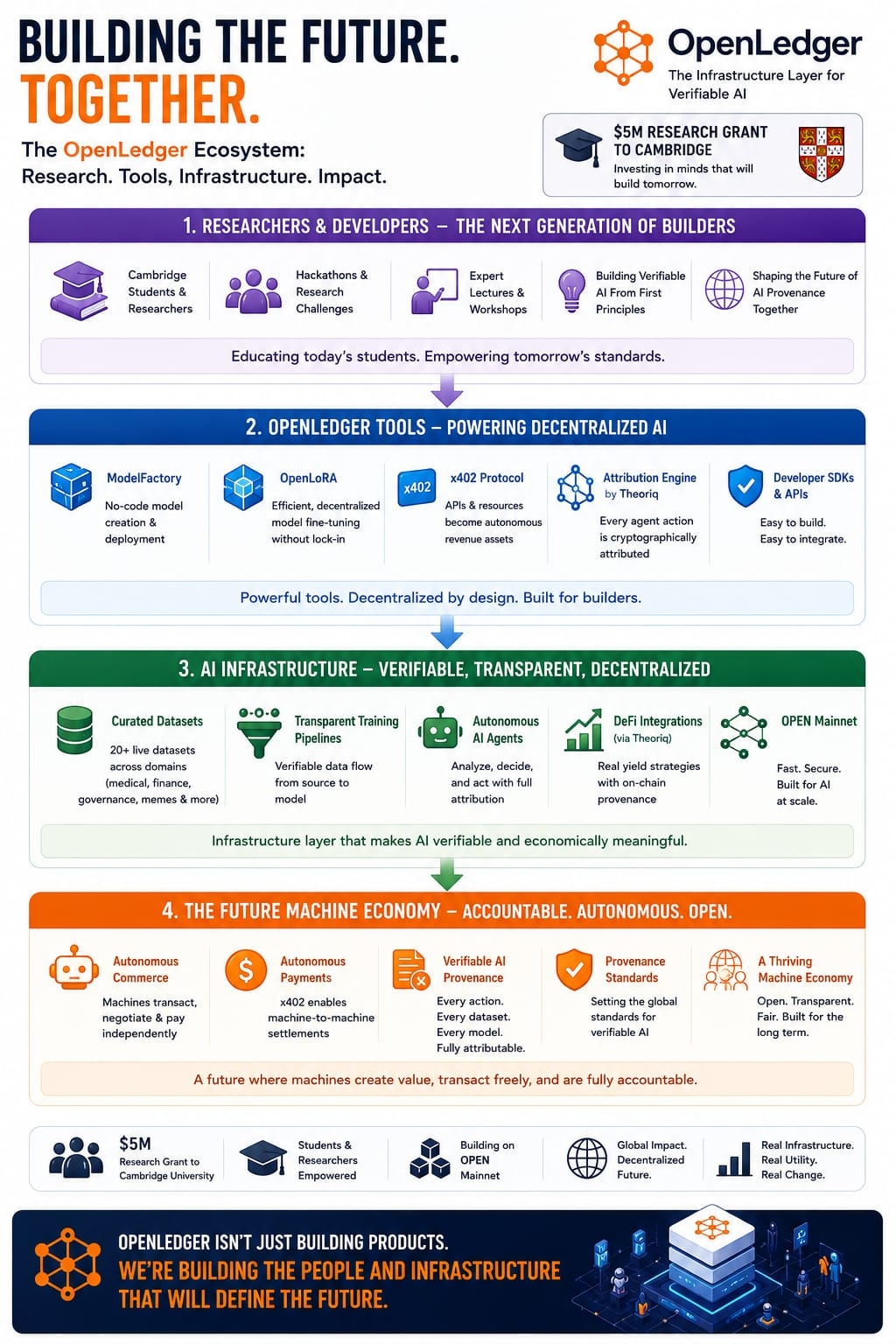
I'm not saying this makes OpenLedger a guaranteed success. Token prices are volatile, competition is relentless, and September's unlocks are a legitimate question mark. But I've started measuring projects differently. Not by their whitepaper elegance, but by where they choose to invest when nobody is watching. A $5 million commitment to Cambridge students to the slow, patient work of building verifiable AI from first principles tells me something that no roadmap slide ever could. Some bets aren't about the next quarter. Some bets are about the next generation of builders. And that's a conversation I didn't expect crypto to start.
