
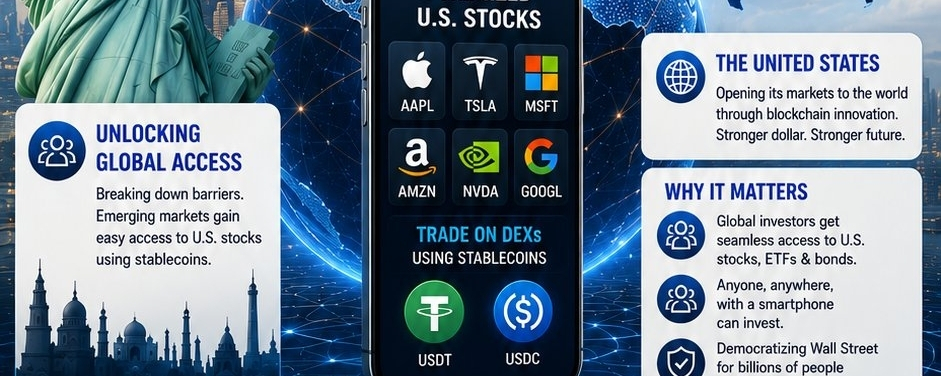
The global financial system may be approaching one of its biggest transformations since the rise of the internet. Recent discussions around the U.S. Securities and Exchange Commission (SEC) considering innovation-friendly exemptions for blockchain-based financial products hint at a future where traditional American equities could trade directly on decentralized crypto networks.
If this transition becomes reality, it would not simply modernize investing, it could fundamentally reshape global capital flows, strengthen the dominance of the U.S. dollar, and merge Wall Street with decentralized finance (DeFi) in ways never seen before.
Breaking the Walls of Traditional Finance.
Today, access to the U.S. stock market remains heavily dependent on centralized financial infrastructure. International investors often face restrictions such as banking limitations, brokerage regulations, minimum capital requirements, currency conversion hurdles, and regional compliance barriers.
Decentralized finance changes that equation entirely.
Anyone with a smartphone, internet access, and a decentralized wallet can already participate in crypto markets from virtually anywhere in the world. Stablecoins such as Tether and USD Coin have effectively become digital dollars circulating across global blockchain networks.
Now imagine a world where tokenized shares of companies like Apple, Tesla, or Microsoft can be bought directly through decentralized exchanges using stablecoins without traditional brokers, cross-border banking systems, or institutional intermediaries.
For millions of retail investors in emerging economies, this would represent their first real access to U.S. capital markets.
Unlocking Trillions in Global Demand.
The appetite for dollar-based assets has never been stronger. Across many regions in Asia, Africa, and Latin America, local currencies continue to struggle against inflation, debt crises, and macroeconomic instability.
Historically, access to American financial markets has largely been reserved for institutional players such as sovereign wealth funds, hedge funds, and multinational banks. Retail participation from developing nations has remained extremely limited.
Tokenized real-world assets (RWAs) could change this overnight.
Instead of relying on expensive financial infrastructure, investors could hold fractional shares of U.S. companies directly on-chain. A college student in Nigeria, a freelancer in Argentina, or a small business owner in India could gain exposure to the same equity markets previously dominated by global institutions.
This is not just a technological innovation, it is a democratization of financial access on a global scale.
The Stablecoin Explosion.
The implications go far beyond stock trading.
If tokenized equities gain mass adoption, global investors will first need digital dollars to participate. That means converting local currencies into stablecoins such as USDT and USDC.
This could trigger an enormous surge in stablecoin demand worldwide.
As more capital flows into stablecoins, the issuers behind these assets would need to hold increasingly large reserves, most of which are typically backed by short-term U.S. Treasury securities.
In simple terms.
More tokenized stock trading.
More stablecoin demand.
More purchases of U.S. Treasuries.
Stronger demand for the U.S. dollar and American debt markets.
A Strategic Advantage for the United States.
This creates a powerful geopolitical and economic advantage for the United States.
Higher demand for U.S. Treasuries generally lowers bond yields, allowing the U.S. government to refinance debt at cheaper rates. At a time when national debt levels continue to rise, maintaining strong global demand for Treasury securities is critically important.