
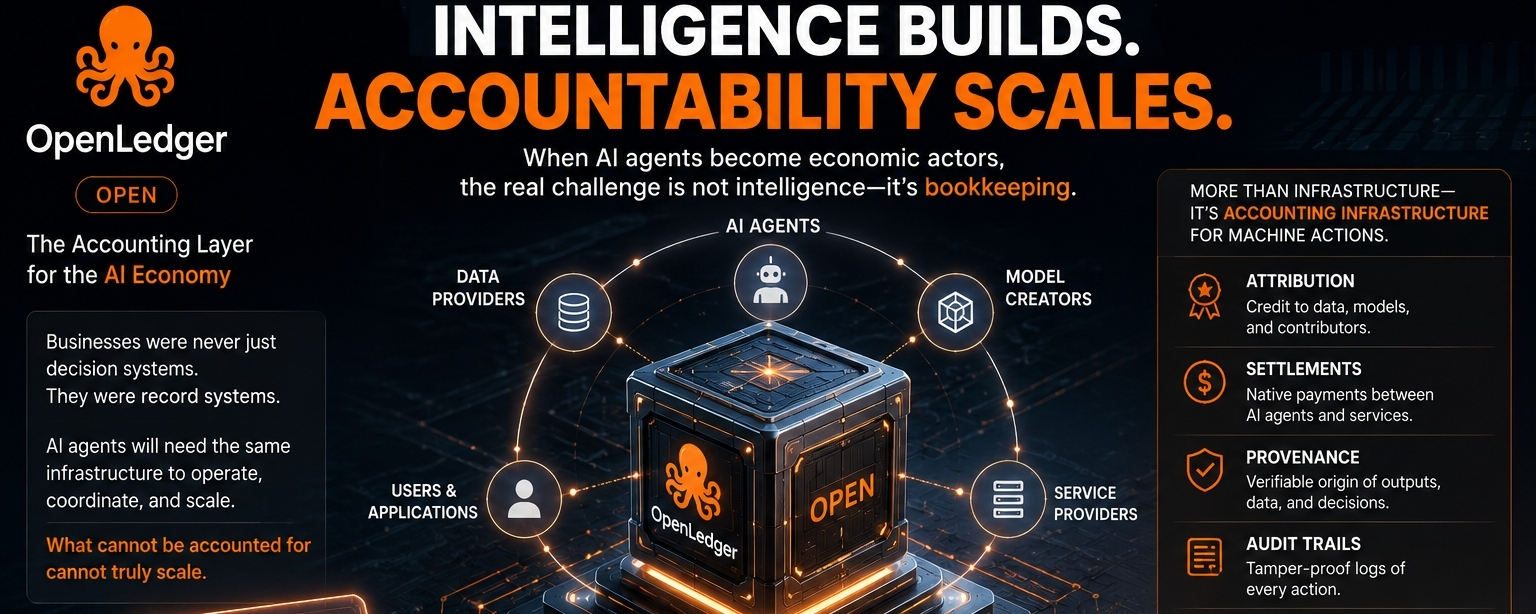
@OPEN LEDGER #OpenLedger keep seeing people frame the future of AI around one question:
“How intelligent can the models become?”
But honestly, I’m not sure intelligence is the real bottleneck anymore.
The more I think about autonomous AI agents interacting with each other — buying services, using datasets, generating outputs, making decisions, sending payments — the more I realize the bigger challenge might be something far less exciting:
keeping track of everything.
Because the moment AI starts operating economically, you need accountability.
You need to know where an output came from.
Which model contributed to it.
Who should be compensated.
Whether the result can be trusted.
Whether an action can be verified later.
And that’s interesting to me because businesses were never just built on decisions.
They were built on records.
Invoices.
Ledgers.
Audit trails.
Reconciliation.
Ownership.
The invisible systems that allow trust to exist at scale.
That’s partly why OpenLedger (OPEN) caught my attention.
I don’t really see it as “just another AI blockchain.”
It feels more like infrastructure for machine accountability.
A layer where AI actions, contributions, payments, and outputs can actually be tracked and settled in a transparent way.
And maybe that sounds boring compared to the hype around agents and superintelligence.
But historically, the boring layers are often the ones that matter most.
The internet scaled because protocols created coordination.
Financial systems scaled because accounting created trust.
AI economies will probably need the same thing.
Because in the end, intelligence alone is not enough for markets to function.
What cannot be accounted for cannot truly scale.
And I still think the market is underestimating how important that becomes once AI stops being a tool and starts becoming an economic participant.