
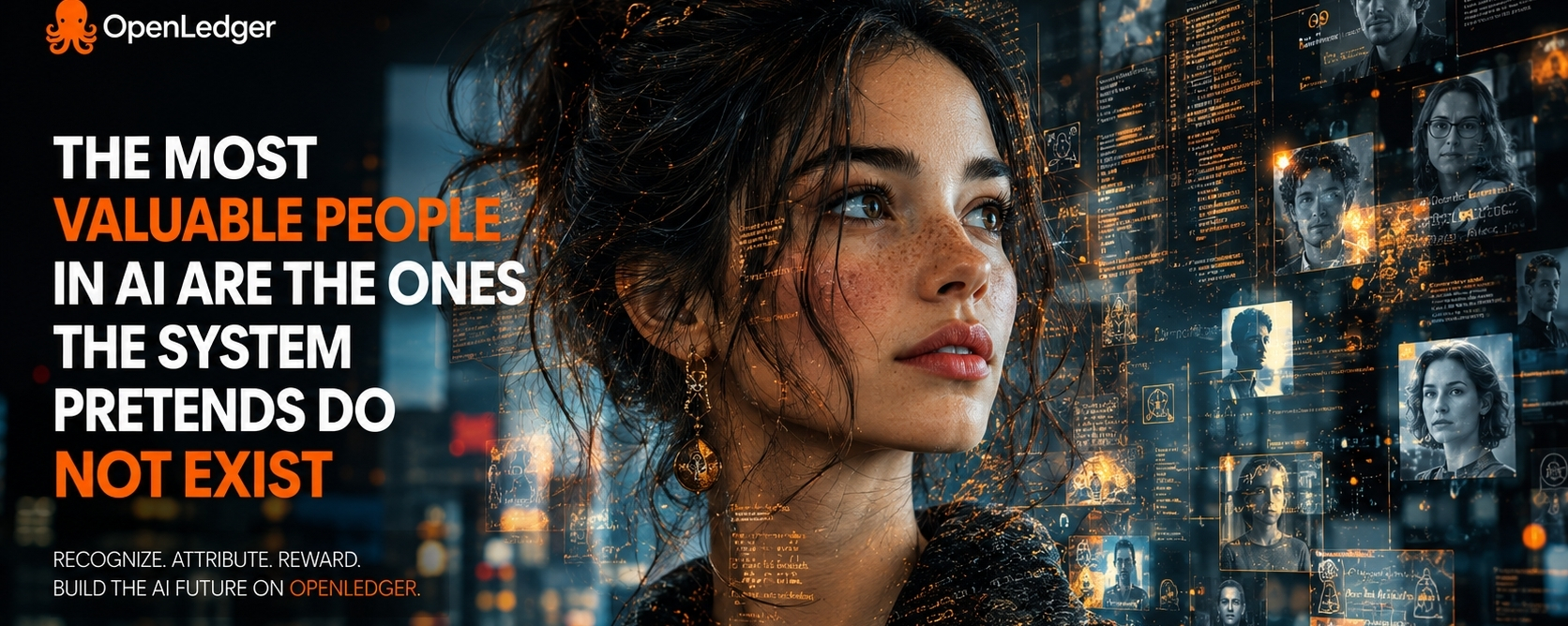
I keep coming back to this uncomfortable thought.
The AI industry keeps talking about models like they appeared out of nowhere.
As if intelligence emerged from compute alone.
As if the datasets trained themselves.
As if human contribution is just background noise.But every useful model was built on millions of invisible people leaving pieces of themselves online for years.
Code.
Writing.
Conversations.
Images.
Research.
Corrections.
Opinions.
Patterns of thought.
Human residue became infrastructure.
And somehow the people who created that value are still the least protected part of the entire system.
That feels backwards to me.
Crypto was supposed to solve ownership problems.
AI accidentally made them worse.
Because now value extraction happens at a scale most people still do not fully understand. A system can absorb the work of millions, generate billions in value, and still have no native mechanism to remember who contributed what in the first place.
That is not intelligence.
That is industrialized forgetting.
And honestly, I think this becomes a much bigger problem over the next few years than people realize.
Not because models stop improving.
Because trust starts breaking.
If creators believe the system only takes from them, eventually the quality of what enters the system degrades too. People stop sharing openly. Data becomes polluted. Attribution becomes legally hostile. Everyone starts building walls around information.
The internet becomes less human.
That possibility feels very real to me.
Which is partly why @OpenLedger caught my attention.
Not in the usual crypto way where people chase narratives for two weeks and move on to the next ticker.
More because it is one of the few projects I have seen trying to build AI infrastructure around accountability instead of pretending accountability can be added later after scale already arrives.
Everything being on-chain changes the conversation slightly.
Data monetization.
Model training.
Agent deployment.
All tied together transparently instead of scattered across closed systems nobody can audit properly.
And the role of $OPEN inside that structure makes more sense to me when I think about coordination rather than speculation. The token is connected to system activity itself instead of existing as this detached object floating above the product with no real relationship to usage.
Maybe that sounds obvious.
But crypto has produced years of ecosystems where the token and the actual utility barely knew each other existed.
I still do not know if OpenLedger fully solves the contributor problem though.
That would be too easy.
There are still questions I cannot answer confidently.
Can attribution systems stay accurate once the network becomes massive?
Can on-chain AI actually scale without sacrificing efficiency somewhere important?
Will people genuinely value transparent data provenance once faster and cheaper black-box systems appear?
I do not know yet.
And I think pretending certainty this early is exactly how people get trapped in narratives instead of understanding what they are holding.
But I do think the next phase of AI will force one uncomfortable realization into the open:
The systems creating the most value in the world may ultimately depend on people they never learned how to properly acknowledge.
That feels unstable in a way technology alone cannot fix.



#OpenLedgar #TrendingTopic #MegadropLista #meme板块关注热点 #Binance