

I used to think most “AI-native blockchain” projects were just marketing with better graphics.
Every few months, a new platform appears claiming it will completely redefine AI, data ownership, or decentralized intelligence. Usually the story sounds exciting at first, but after looking deeper, many of them feel like old blockchain ideas wrapped inside AI terminology.
That was honestly my first reaction to OpenLedger too.
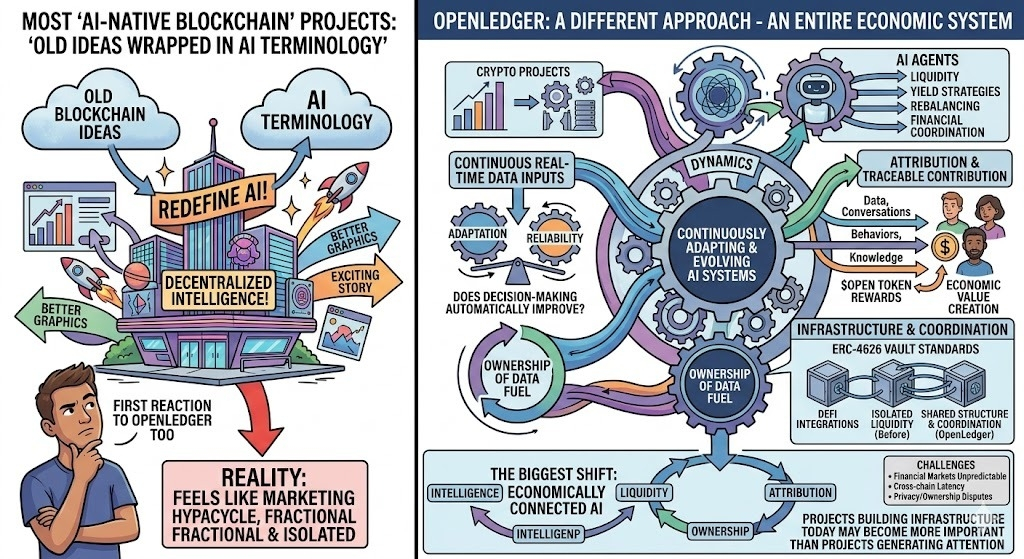
But the more I explored the project, the more I realized it is trying to approach AI from a different angle. Not just as software that gives answers, but as an entire economic system where data, attribution, liquidity, and decision-making continuously interact with each other.
What interested me most was the idea that AI may no longer stay limited to static models trained once and updated occasionally. OpenLedger seems focused on creating systems that continuously adapt, coordinate, and evolve alongside changing conditions. That sounds exciting, but also slightly unsettling if I am being honest.
Because the more intelligence becomes connected to real-time environments, the more complicated the system becomes.
If AI systems are constantly processing new information, does decision-making automatically improve? Or does constant input create more instability and noise? I keep thinking about how difficult it is to balance adaptation with reliability.
Another part that genuinely caught my attention was OpenLedger’s focus on attribution. Most AI systems today operate like black boxes. People contribute data, conversations, behaviors, or knowledge, but very few contributors are rewarded when that data later creates economic value.
OpenLedger is trying to challenge that structure by making contribution traceable and economically connected through the $OPEN ecosystem. That changes the conversation completely.
Because if data is becoming the fuel of modern AI, then ownership of that fuel becomes one of the biggest questions in technology.
And honestly, I think this is where the project becomes more interesting than most people realize.
The conversation is no longer only about building smarter models. It is becoming about who owns intelligence, who benefits from it, and who controls the infrastructure supporting it.
The deeper I looked, the more I realized OpenLedger is also thinking beyond simple AI products. Its direction toward ERC-4626 vault standards, AI-managed liquidity systems, and autonomous financial coordination suggests something larger may be developing underneath the surface.
At first, ERC-4626 sounded like another technical Ethereum standard that only developers would care about. But over time I started understanding why these standards matter so much.
Without shared infrastructure, ecosystems stay fragmented.
Different protocols cannot coordinate smoothly, integrations become difficult, and liquidity remains isolated. Standards like ERC-4626 create a shared structure that allows vaults, applications, and financial systems to interact more efficiently.
Now imagine AI agents operating on top of that infrastructure.
Suddenly AI is not only generating text or predictions anymore. It could eventually coordinate liquidity, optimize yield strategies, rebalance positions, or manage financial systems automatically across different environments.
That possibility feels much bigger than the typical “AI chatbot” narrative dominating crypto discussions right now.
At the same time, I still remain cautious.
Autonomous systems sound impressive in theory, but reality is always more difficult. Financial markets are unpredictable. Cross-chain execution introduces latency and liquidity risks. Attribution systems become complicated once regulation, privacy, and ownership disputes enter the picture.
And honestly, I think many people underestimate how difficult these problems really are.
Still, I cannot dismiss what OpenLedger is trying to build.
Because unlike many projects that focus purely on hype cycles, OpenLedger seems more focused on infrastructure, coordination, and long-term system design.
That does not guarantee success.
But it does make the project worth paying attention to.
The biggest shift may not be AI becoming smarter.
The bigger shift may be AI becoming economically connected, where intelligence, liquidity, attribution, and ownership all become part of the same evolving network.
And if that future actually happens, the projects building infrastructure today may become far more important than the projects simply generating attention.
So the real question is:
Are we watching the early foundation of a completely new AI-driven economic system, or are these experiments simply the first rough drafts of something the industry still does not fully understand?
