
I’ve traded through enough liquidation cascades to stop caring about narratives before I care about execution.
Most people remember the candle. I remember the delay.
I remember trying to flatten a perp position during a volatility spike and watching the cancel request sit there just long enough for the market to move another percent against me. I remember signing a hedge transaction during gas congestion only to realize the protection itself became another source of slippage. I remember realizing that in DeFi the problem usually is not direction. The problem is friction
That is why projects like OpenLedger caught my attention in the first place.
Not because I think every infrastructure token suddenly becomes important. Most do not. Most become another cycle narrative attached to metrics nobody actually stress tests. But when you spend enough time inside order books you start paying attention to systems trying to solve execution quality instead of just promising higher yields.
And that is where the “yield leak” conversation becomes interesting.
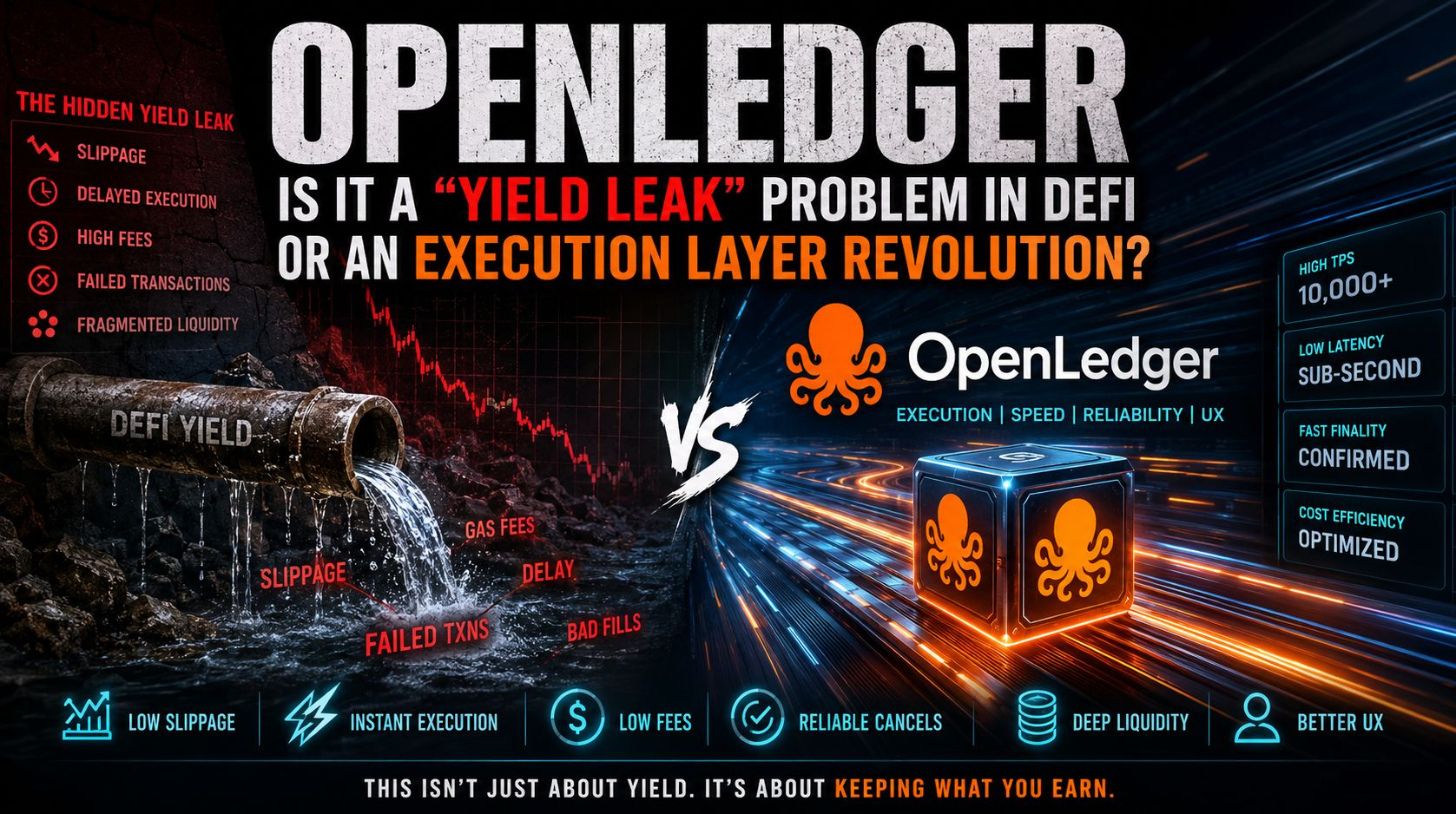
Because a lot of DeFi users think they are losing money from bad trades. In reality many are bleeding through invisible inefficiencies. Failed confirmations. Slippage expansion. Delayed fills. Fragmented liquidity. Repeated wallet interactions. Small frictions compound fast when volatility increases.
That is the part I think OpenLedger is trying to address underneath the branding.
At the time of writing the token is trading around live market levels that fluctuate daily across major tracking platforms like [CoinMarketCap](https://coinmarketcap.com/?utm_source=chatgpt.com) and [CoinGecko](https://www.coingecko.com/?utm_source=chatgpt.com). Volume has been active enough to keep it on trader watchlists but not yet deep enough to remove execution concerns entirely. Circulating supply and market cap numbers continue adjusting as liquidity and participation evolve. I do not treat those numbers as bullish or bearish signals by themselves. I mostly use them to judge whether a market is mature enough to absorb volatility without collapsing into spread chaos.
Because liquidity quality matters more to me than market cap headlines.
From what I have studied OpenLedger is attempting to position itself closer to an execution and coordination layer rather than simply another yield farm ecosystem. The practical idea seems less about promising impossible APYs and more about reducing inefficiencies around how users interact with decentralized systems.
That distinction matters.
Most traders eventually realize the real enemy inside DeFi is not always directional risk. Sometimes it is operational drag.
Repeated wallet confirmations interrupt momentum. Routing inefficiencies widen effective entry prices. Network congestion changes decision making in real time. During stress events traders stop behaving rationally because infrastructure itself becomes unstable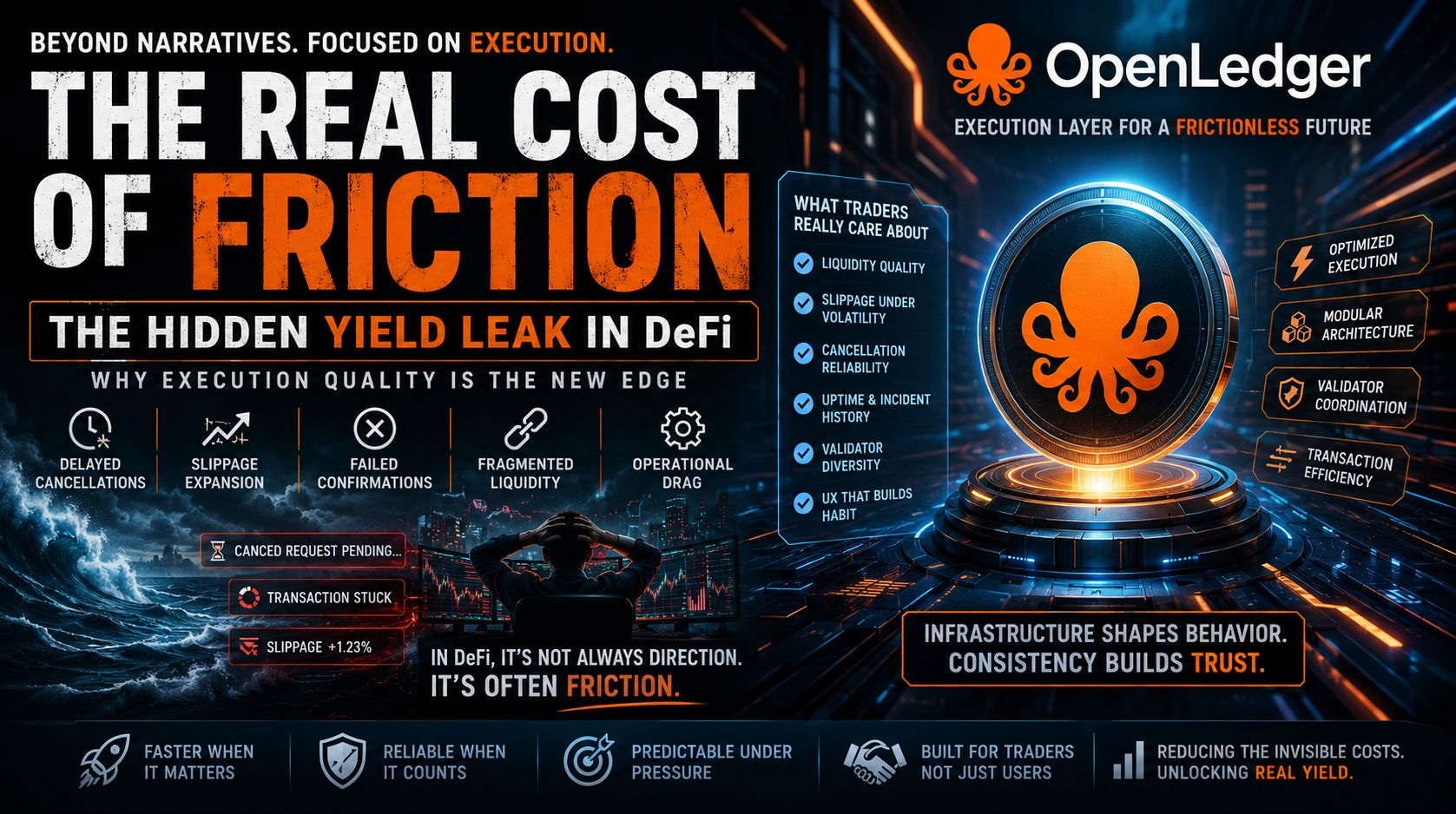
If OpenLedger succeeds anywhere it will probably be in reducing those behavioral interruptions.
Technically the architecture discussions around modular execution systems validator coordination and optimized transaction handling sound impressive on paper. But I try to translate all technical design into one simple question
“What happens during panic?”
Because every chain feels fast when nothing is happening.
The real test comes during forced unwinds when funding flips negative liquidity disappears and traders rush to the exits simultaneously.
That is why performance numbers alone never impress me.
Yes TPS matters. Block times matter. Finality matters. Launch architecture matters. But traders do not emotionally experience TPS. They experience confidence.
A fast chain with unstable reliability still creates hesitation. A slower chain with predictable confirmation behavior often creates calmer execution.
That psychological difference changes positioning behavior more than people realize.
If a trader trusts cancellations to process reliably they size differently. If they trust settlement timing they hedge more aggressively. If they trust that spreads will not explode during volatility they stay engaged longer instead of fleeing back to centralized exchanges.
Infrastructure changes behavior long before it changes narratives.
Still there are tradeoffs.
Every optimization layer introduces new centralization questions. Validator concentration matters. Geographic clustering matters. Dependency on a smaller infrastructure set matters. If performance gains come from tighter coordination among fewer actors then censorship resistance and resilience become fair concerns.
I always watch validator diversity closely because many systems look decentralized until stress conditions expose operational bottlenecks.
The failure modes matter more than the marketing diagrams.
How does the system behave during sudden traffic spikes?
What happens when RPC endpoints fail?
How does transaction ordering behave under pressure?
Can cancellation requests still process consistently during liquidation cascades?
Those are the questions traders eventually care about because that is where actual money disappears.
And honestly I think the biggest challenge for DeFi is still retention rather than onboarding.
Most users do not leave because they suddenly stop believing in crypto. They leave because interacting with protocols becomes mentally exhausting.
Too many signatures.
Too much latency uncertainty.
Too many gas surprises.
Too many moments where users feel infrastructure friction more than financial opportunity.
That is the real “yield leak” in my view.
Not just capital inefficiency but cognitive exhaustion.
If OpenLedger can reduce interaction friction at the execution layer then the impact could matter more than another temporary yield cycle. Because habit formation in trading often depends on whether the system feels stable during stress.
I think about this through real market scenarios.
Imagine BTC drops 8% in under an hour. Perp funding flips violently negative. Altcoin liquidity thins out. Liquidation engines begin accelerating volatility. Traders rush to hedge delta exposure while stablecoin routing starts slowing down.
In that environment every second changes outcome quality.
A delayed cancellation becomes a bad fill.
A failed confirmation becomes forced exposure.
A congested bridge becomes trapped collateral.
And suddenly traders stop optimizing returns and start optimizing survival.
That is where infrastructure either earns trust or loses it permanently.
The interesting thing about OpenLedger is not whether it claims to be faster. Every project claims that. What matters is whether execution quality remains consistent when volatility becomes emotional.
Because that consistency is what retains serious traders.
Going forward I am watching several things carefully.
Liquidity quality first.
Not headline liquidity. Real executable liquidity under pressure. Tight spreads during calm markets mean very little if depth disappears during stress.
Second is slippage behavior during volatility. I want to see whether routing efficiency actually holds up when volume spikes.
Third is cancellation reliability. Most people underestimate how important cancellation processing is during fast markets. Reliable exits matter as much as entries.
Fourth is uptime and incident history. Stable infrastructure compounds trust slowly. One bad outage during a liquidation cascade can permanently damage confidence.
Fifth is validator churn and operational concentration. Healthy ecosystems distribute risk instead of hiding it.
And finally I watch whether UX improvements become habitual.
That part matters most.
If traders naturally return because the system feels smoother under pressure then the infrastructure solved something real. If users still treat it like a temporary farming venue then the retention problem remains unsolved.
Personally my framework stays simple.
I verify metrics independently.
I read validator documentation.
I test execution paths myself.
I paper trade volatile conditions before sizing real capital.
I compare slippage behavior across different environments.
And I pay attention to my own behavior while using the system because traders unconsciously reveal trust through positioning decisions.
That is ultimately how I look at OpenLedger right now.
Not as a guaranteed winner.
Not as another hype cycle.
But as a project trying to address something most of DeFi still struggles with which is the invisible cost of friction.
And after enough years trading through lag unstable routing and execution failures I think that problem deserves more attention than most narratives currently getting priced into the market.