
Artificial intelligence is growing fast, but one major problem still exists — ordinary people do not own or earn from the data used to train AI systems. Most large AI companies collect data, build powerful models, and keep all the profits under centralized control.
This is where OpenLedger is trying to change the system.
OpenLedger is not just another AI platform like ChatGPT or Midjourney. It is designed as an AI-native Layer 2 blockchain network that gives value back to the people who contribute data, models, and computing power. The project combines blockchain technology with artificial intelligence to create a transparent and community-owned AI economy.
What Makes OpenLedger Different?
OpenLedger is built around the idea that data creators should be rewarded whenever their information helps train or improve AI models. Instead of keeping everything under one company, the network allows contributors to own a part of the ecosystem.
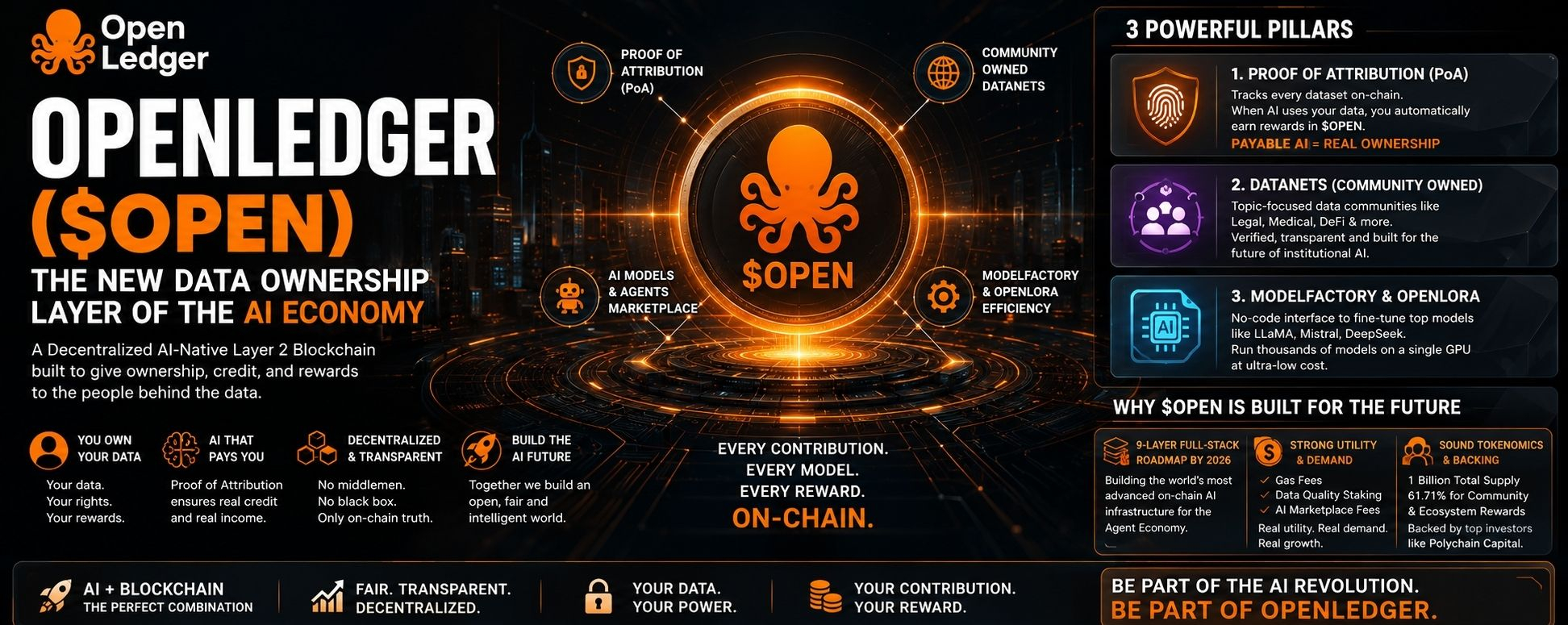
The project is built on three major pillars:
1. Proof of Attribution (PoA) and Payable AI
This is one of OpenLedger’s biggest innovations.
Every dataset uploaded to the network is recorded and tracked on-chain through a system called Proof of Attribution (PoA). If an AI model later uses that data to answer questions, generate content, or improve performance, the original contributor automatically receives rewards in the form of OPEN tokens.
This creates a system called “Payable AI,” where contributors are financially rewarded for the value their data provides.
In simple words, if your data helps AI become smarter, you get paid for it.
2. Datanets: Community-Owned Data Networks
OpenLedger introduces “Datanets,” which are specialized community-owned data hubs.
These Datanets can focus on areas such as:
Legal documents
Medical research
DeFi security data
Financial records
Educational content
Anyone can contribute high-quality information to these networks. Since the source and ownership of data are verified on-chain, institutions and developers can trust the quality and authenticity of the datasets they use.
This could become extremely important in industries where verified and reliable data matters most.
3. ModelFactory and OpenLoRA
OpenLedger also focuses on making AI development easier and cheaper.
ModelFactory
ModelFactory is a no-code interface that allows developers to fine-tune large AI models such as LLaMA, Mistral, or DeepSeek without complex programming knowledge.
Instead of spending months building infrastructure, users can train models using Datanet data through a simple graphical interface.
OpenLoRA
OpenLoRA helps developers run thousands of customized AI models on a single GPU at a much lower cost.
This reduces hardware expenses and makes AI development more affordable for smaller teams and independent creators.
Why OpenLedger Is Getting Attention
There are several reasons why many analysts and crypto communities are watching OpenLedger closely.
A 9-Layer AI Infrastructure Roadmap
According to the project’s official roadmap, OpenLedger plans to launch a complete 9-layer AI ecosystem by 2026.
The vision is to turn AI into a fully transparent and on-chain economy where AI agents can:
Charge fees for their services
Pay other AI agents automatically
Share revenue without human involvement
Operate inside decentralized AI marketplaces
This concept is often described as the “Agent Economy.”
Strong Utility for the OPEN Token
The value of any crypto project depends heavily on real utility, and OpenLedger gives multiple use cases to the $OPEN token.
Gas Fees
All transactions on the network require OPEN for payment.
Data Quality Staking
Data providers must stake tokens to prove the quality and reliability of their datasets.
AI Marketplace Payments
Future AI marketplaces within the ecosystem will use $OPEN for buying, selling, and monetizing AI models and services.
This creates continuous demand for the token inside the ecosystem.
Tokenomics and Ecosystem Support
OpenLedger has a total supply capped at 1 billion tokens.
More than 60% of the supply has been allocated to community rewards and ecosystem growth. Users can already participate by running nodes, staking, and contributing data.
The project also reduces the risk of heavy short-term selling because team and investor allocations follow a linear unlock schedule instead of immediate release.
In addition, OpenLedger has received backing from major venture capital firms, including Polychain Capital.
Final Thoughts
OpenLedger is trying to build a future where AI is not controlled by a few large corporations. Instead, contributors, developers, and users can all participate in the value created by artificial intelligence.
The project combines AI, blockchain, data ownership, and decentralized finance into one ecosystem. Its goal is simple but powerful: make AI transparent, community-owned, and rewarding for everyone involved.
If OpenLedger successfully delivers its roadmap, it could become one of the strongest examples of how AI and blockchain can work together in the future digital economy.