
Everyone is obsessed with making AI agents smarter.
Smarter reasoning.
Smarter decisions.
Smarter autonomy.
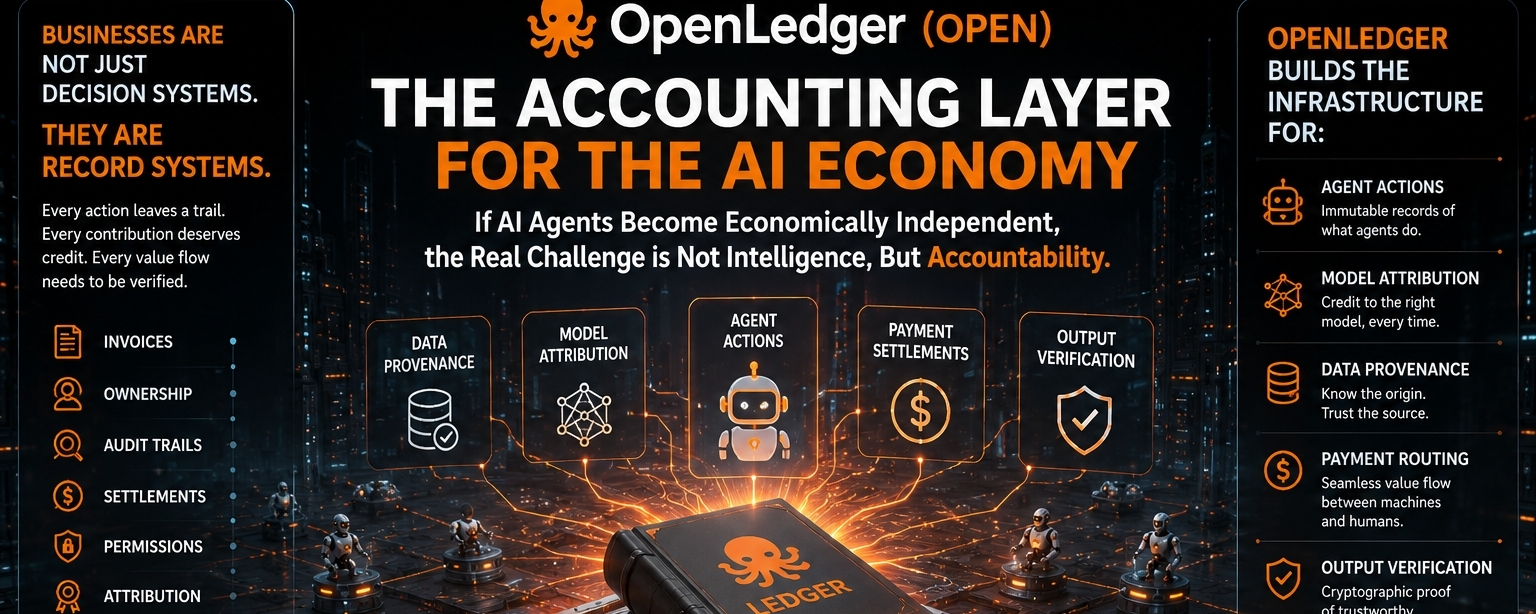
But if AI agents eventually start operating like independent economic actors — earning money, paying for services, using datasets, coordinating with other agents — then intelligence is only half the story.
The harder problem is trust.
Because the second machines begin creating real economic value, people will ask very human questions:
Who did the work?
Where did the data come from?
Who deserves payment?
Can the output be verified?
Who’s responsible if something goes wrong?
And suddenly the conversation stops being about intelligence and starts becoming about records.
That’s why OpenLedger stands out to me.
Not because it’s another “AI + blockchain” narrative, but because it feels like infrastructure for accountability.
Almost like a financial memory layer for machine economies.
A place where actions, payments, attribution, and outputs can actually be tracked instead of existing in a black box.
The funny thing is, this layer sounds incredibly unsexy compared to AGI headlines.
But history usually works that way.
The systems that quietly handle accounting, settlement, and coordination often become more important than the systems generating the activity itself.
Businesses were never just decision-making machines.
They survived because they could keep reliable records.
AI economies probably won’t be any different.
And honestly, I think the market still underestimates how important that becomes once autonomous agents start interacting at scale.
Because what cannot be accounted for cannot really scale.