
Think about what you've put online over the last five years. Forum posts, tutorials, code on GitHub, product reviews, comments. Real thinking. Real time.
That content was scraped, packaged into training datasets, and used to build AI products generating billions in annual revenue. Nobody asked. Nobody paid.
This isn't a niche grievance. It's the foundational business model of the AI industry. And in 2026, between mounting lawsuits and regulatory pressure, that model is starting to buckle.
@OpenLedger was built for what comes next.
So what is OpenLedger, actually?
The core idea is straightforward: if your data influences an AI model's output, you should be able to prove it and get compensated for it.
The mechanism that makes this work at scale is called a Datanet. Think of it as a community-owned dataset with a full audit trail. Every upload is timestamped on-chain, every contributor identified, and every time a model trains on or queries that data, the system logs who contributed what and how much it mattered.
Compensation flows automatically in $OPEN tokens based on those influence scores. No manual accounting. No trust required.
The infrastructure underneath
Three tools power the system:
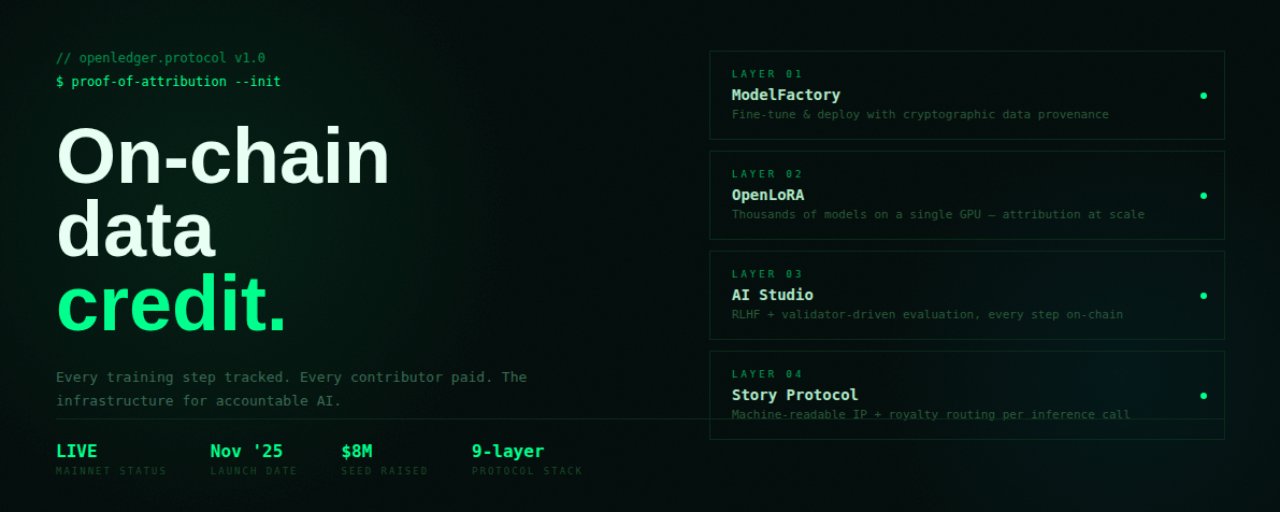
ModelFactory is a no-code dashboard for fine-tuning and deploying AI models on the OpenLedger network. Every training run is cryptographically linked to its data sources.
OpenLoRA is a model-serving layer that hosts thousands of fine-tuned models on a single GPU. This is what makes attribution-aware AI commercially viable, not just technically interesting.
AI Studio is the environment for supervised fine-tuning and reinforcement learning with human feedback. Every step logged on-chain, every contributor's influence tracked.
Together, they turn a dataset from a one-time upload into a recurring revenue stream. Your data earns every time a model trained on it gets queried.
The legal layer: Story Protocol
In January 2026, OpenLedger partnered with Story Protocol to add machine-readable IP ownership on top of the attribution system.
What this enables in practice: an AI model can train on attributed data, price its inference via x402, collect payment in $OPEN, and route royalties back to data contributors, all within a single HTTP request-response cycle.
Where things stand
OpenLedger was founded in 2024 by Ashtyn Bell and Pryce Adade-Yebesi. The company raised an $8M seed round led by Polychain Capital and Borderless Capital. Mainnet went live in November 2025.
The 2026 roadmap covers a nine-layer platform spanning data attribution through agent economies. A DeFAI product called OpenFin was teased in March 2026 and is still incoming.
$OPEN is trading well below its all-time high. Whether that's a structural opportunity or an early-adoption discount is yours to assess.
Do your own research. #OpenLedger
Not financial advice. Crypto assets are volatile.