
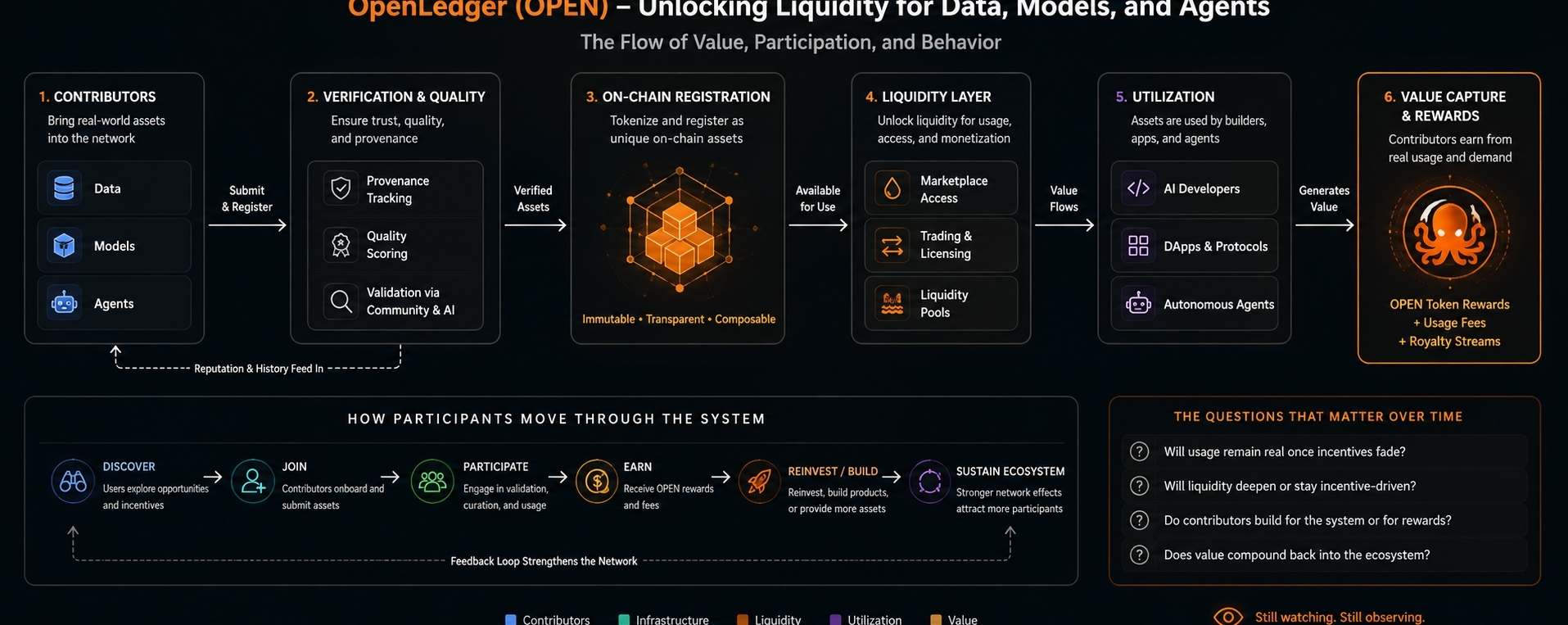
I’m watching, I’m waiting, I’m looking, I’ve been paying attention, I focus on small details because projects like OpenLedger seem to reveal more in movement than in announcements. I keep staring at the spaces between activity rather than the activity itself. I watch where people gather, how they move through the system, how quickly attention forms and how quietly it shifts. Sometimes the interesting things are not visible in the numbers themselves but in the rhythm underneath them, the repeated behavior that starts to look less like participation and more like gravity pulling people toward a predictable center.
OpenLedger introduces an idea that immediately creates curiosity around liquidity for data, models, and agents, but I keep finding myself less interested in the language and more interested in the mechanics that emerge around it. Systems often describe themselves one way while behaving another way entirely. I’ve been paying attention to whether people appear to be building around the system or orbiting rewards inside it. There is a difference between those two things even when they look identical at first glance.
I keep watching where value settles after movement slows down. Early activity always creates noise. Users arrive, interactions increase, metrics expand outward, and for a while everything seems alive because motion itself can imitate health. But eventually patterns begin to harden. Some users become contributors, some become extractors, some become observers, and some disappear completely. That transition always feels more revealing than the beginning.
What stands out to me should feel like a realization rather than a conclusion. I notice how much depends on the assumption that attention keeps reproducing itself. I notice how systems built around participation can sometimes create behavior designed for the reward instead of behavior designed for the system itself. The difference is subtle at first, almost invisible, until repetition starts exposing it.
I keep coming back to what happens when incentives stop speaking so loudly. What happens once behavior becomes routine, once novelty loses weight, once participation becomes ordinary instead of exciting. That’s where it gets interesting because momentum can hide weaknesses while it exists. Once it slows, structure has to stand by itself.
And I think that is the thing I keep circling around without fully landing on it. I’m still watching whether movement here is creating foundations or just creating movement. Those can feel identical for a while. Until suddenly they don't.
