
I keep thinking about how strange the AI economy has quietly become.
Millions of people write posts, upload images, answer questions, label datasets, and create digital behavior trails every day. Researchers publish open work. Developers build tools on public repositories. Communities generate discussions that later become training material. Yet once that information enters large AI systems, ownership often disappears into abstraction. The people creating value rarely keep any long-term connection to it.
For years, this imbalance has existed in plain sight, but it remained unresolved because data itself was difficult to treat as an asset. Unlike traditional commodities, data is fragmented, copied endlessly, and usually gathered by platforms that already control distribution. Most users accepted this arrangement because the internet normalized “free access” in exchange for invisible extraction. AI accelerated the problem. Suddenly, human-generated information became one of the most valuable resources in technology, while the individuals producing it still had little leverage.
Earlier attempts to address this issue were incomplete. Some Web2 platforms introduced creator monetization systems, but these depended entirely on centralized rules. Users could earn income, but they never truly owned the underlying infrastructure or datasets. In crypto, several projects experimented with decentralized data marketplaces, yet many struggled with a practical question: why would anyone pay for data that could often be copied elsewhere? Others focused heavily on token incentives without solving quality verification, provenance, or usability for actual AI development.
That is where I think projects like become interesting—not because they fully solve the problem, but because they try to reorganize the relationship between AI systems and the people contributing to them.
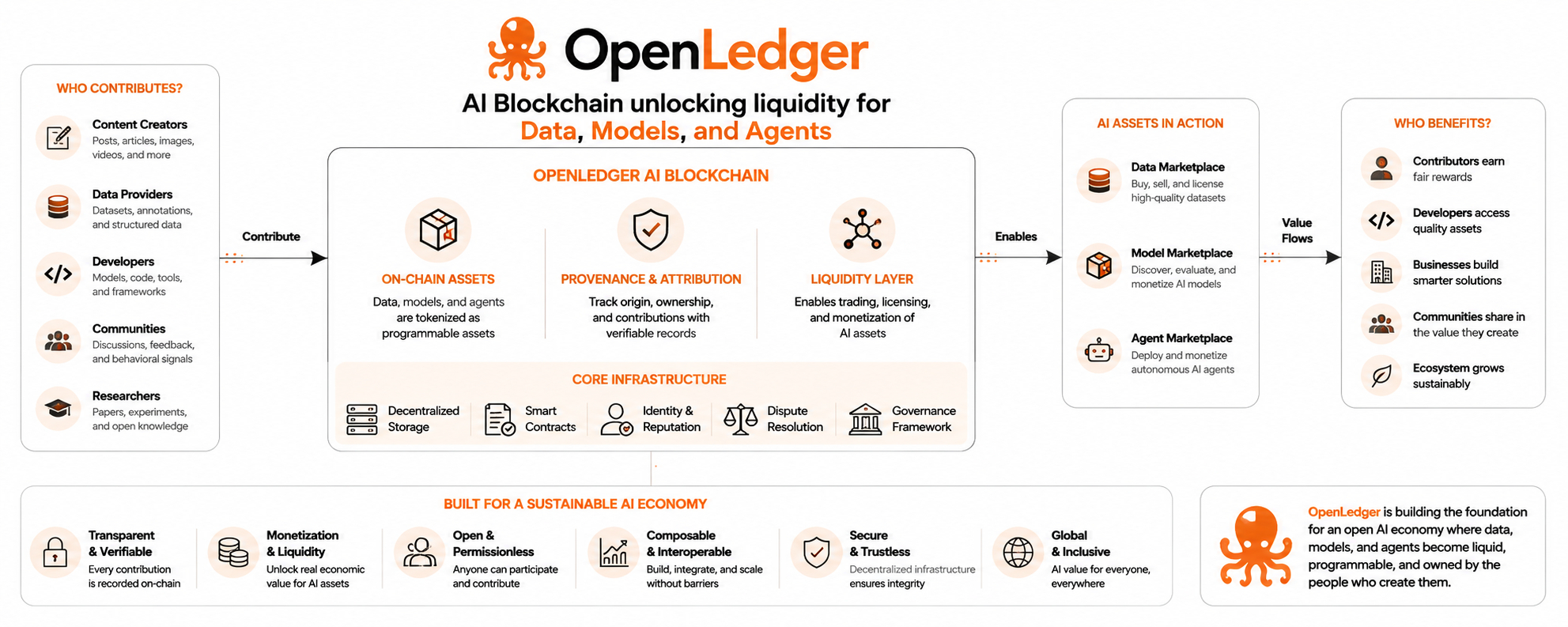
OpenLedger describes itself as an AI-focused blockchain designed to unlock liquidity around data, models, and autonomous agents. In simpler terms, the project appears to be asking whether AI-related assets can become programmable economic units rather than remaining locked inside closed corporate ecosystems.
The idea sounds ambitious, but the underlying motivation is understandable. Right now, most AI value flows upward toward large platforms with enough computing power and infrastructure to aggregate information at scale. Smaller contributors usually operate at the edges. Data creators contribute raw material. Developers contribute experimentation. Communities contribute behavior and feedback. Yet ownership tends to consolidate at the model layer.
OpenLedger seems to approach this imbalance by turning AI components into trackable on-chain assets. Instead of viewing data as something that disappears once consumed, the network attempts to create attribution and economic participation around it. Models, datasets, and AI agents are treated less like static software products and more like active participants inside an open marketplace.
What I find notable is that the project does not focus only on model training. Many AI discussions revolve entirely around larger models and faster inference. OpenLedger appears more concerned with coordination: who contributed, who benefits, and how economic relationships are maintained after an AI system evolves.
That distinction matters because the AI industry increasingly resembles infrastructure rather than software. Once systems become deeply embedded into search, productivity, automation, and decision-making, questions about ownership become political and economic, not merely technical.
Still, I think there are reasons to remain cautious.
One challenge is verification. It is relatively easy to claim that contributors should be rewarded for useful data, but measuring usefulness inside AI systems is incredibly difficult. Modern models absorb enormous amounts of information simultaneously. Tracing output value back to individual contributions may become messy or even impossible in practice. Blockchain records can improve transparency, but they cannot automatically solve attribution at scale.
There is also the question of whether financialization improves AI ecosystems or complicates them further. Turning datasets, models, and agents into liquid assets could create new incentives for contribution, but it could also encourage speculation around low-quality content. Crypto systems often struggle with separating genuine utility from extractive behavior. AI networks may face the same pressure.
Another issue is accessibility. Open AI infrastructure sounds democratic in theory, but participation still depends on technical knowledge, computing resources, and network access. Wealthier actors may continue dominating high-value model development even within decentralized systems. Smaller contributors could end up supplying labor while larger entities accumulate the most strategic advantages.
I also wonder about governance over time. Many blockchain projects begin with decentralization as a core principle, then gradually shift toward concentration around validators, insiders, or early stakeholders. AI ecosystems already have strong centralizing forces because advanced model development requires enormous capital and infrastructure. It is not clear whether blockchain coordination alone can counterbalance that reality.
There is a broader cultural issue as well.
Part of the internet’s creative energy came from open participation without constant monetization. Not every conversation, image, or interaction was treated as an economic asset. If every contribution becomes financialized through AI markets, online behavior itself could subtly change. People may optimize for measurable rewards rather than curiosity, experimentation, or genuine collaboration.
At the same time, ignoring the ownership problem does not seem sustainable either. AI systems are becoming increasingly dependent on human-generated knowledge while simultaneously reducing visibility into how that knowledge is used. That imbalance will likely intensify as autonomous agents and synthetic content become more common.
Perhaps that is why projects like OpenLedger deserve attention—not as finished answers, but as signals that the structure of AI ownership is still unsettled.
I do not think the future question is simply whether AI becomes decentralized or centralized. The more difficult question may be whether ordinary contributors can meaningfully participate in the value created from their own digital existence once intelligence itself becomes an economic layer of the internet.
And if that participation eventually becomes programmable, who actually gains power from it: individuals, communities, or simply a new class of infrastructure owners?
