
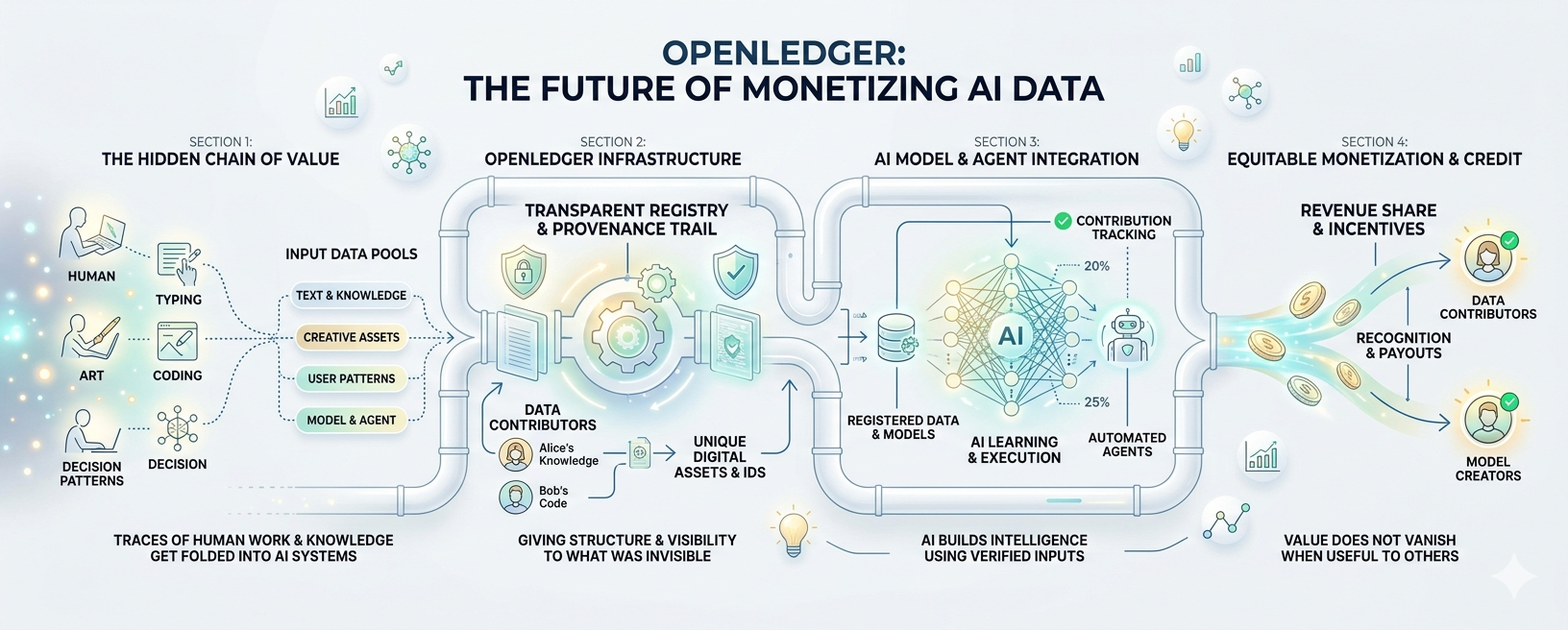
People love to talk about what these systems can do. They write about speed, scale, automation, and all the shiny things that sound impressive in a pitch deck. But the awkward question sits underneath all of it: where does the value actually come from?
Not from nowhere. That much is obvious, even if the industry sometimes behaves like it is not. AI is built on data. Not abstract data, either. Real traces. Real work. Real people leaving behind patterns, words, behavior, decisions, and knowledge that get folded into something bigger. And once that value is extracted, it often disappears into systems that make it very hard to see who contributed what.
That is why OpenLedger feels interesting. Not because it is trying to be loud. Not because it is dressing itself up as the answer to everything. It just seems to be looking at a problem that has been sitting in plain sight for a while: if AI is making money from data, models, and agents, why should all of that value stay hidden?
That question matters more than it first looks.
For years, data has been treated like air. Everyone uses it. Everyone depends on it. Very few people stop to think about ownership, credit, or compensation. A dataset gets collected. A model gets trained. A product gets launched. Then the original source gets blurred into the background until it barely exists as a memory. That always felt a little off to me. Not because every piece of data needs to become a payday, but because the current system has a way of making contribution invisible.
OpenLedger seems to push against that invisibility.
At its core, the idea is pretty straightforward: make data, models, and agents more than silent inputs. Give them a structure where they can be tracked, valued, and monetized in a way that is actually visible. That may sound technical, but the emotional undercurrent is simple. It is about not losing the trail. It is about not pretending intelligence appears out of thin air. It is about making sure the people and systems that feed AI are not erased by the very thing they helped create.
That is a stronger idea than a lot of crypto projects manage to offer.
Of course, the moment you start talking about monetizing AI data, the room gets complicated. Who owns what? Who decides what counts as useful contribution? How do you handle messy, duplicated, or low-quality data? How do you keep the system from turning into a playground for people who are only there to game the incentives?
Those are not side questions. They are the actual challenge.
A lot of ideas sound elegant until they meet human behavior. Then they get tested in ways nobody could fully plan for. Incentives bend. People get clever. The neatest systems often end up being the easiest to exploit. So if OpenLedger is serious, the real test is not whether the concept sounds smart. The test is whether it can hold up once real users, real value, and real opportunism all show up at the same time.
That said, the concept still has something honest in it.
AI has made intelligence feel almost frictionless. You type, and something appears. You ask, and something answers. You feed a system a little context, and it returns something polished enough to look effortless. But the effort never disappears. It just gets hidden. OpenLedger brings that hidden layer back into view. It says, in effect, that the pipeline matters. The source matters. The chain matters.
That is not just a technical point. It is a cultural one.
People want recognition. Not always in some dramatic, ego-driven way. Sometimes they just want the thing they contributed to stop acting as if it came from nowhere. There is a very human frustration in watching work get absorbed by a system and then come back out as a product with the origin story scrubbed clean. That happens everywhere in tech, but AI makes it feel sharper because the output is so convincing. The machine speaks well enough that we forget to ask who taught it how.
OpenLedger seems to be trying to answer that.
Not with a grand speech. Not with some dramatic claim about changing the world overnight. Just by building a framework where data and model contributions can be treated as real assets instead of invisible background noise. That alone is meaningful. It gives structure to something that has been vague for too long.
What I like about that idea is that it does not require pretending the internet is fair. It does not require pretending that every dataset is sacred. It just says that value should not vanish the moment it becomes useful to someone else. That feels reasonable. Almost stubbornly reasonable.
And maybe that is why it stands out.
Because so much of the AI world is obsessed with speed and spectacle, while this kind of project is asking a slower question. Who gets credited? Who gets paid? Who gets left out? What does ownership mean when intelligence is built from shared input? Those are not flashy questions, but they are the ones that matter once the excitement wears off.
OpenLedger is appealing precisely because it lives in that tension. It is not pure idealism. It is not empty hype either. It sits in the uncomfortable middle, where the real work usually happens. It recognizes that AI needs data, and data has value, and value without recognition tends to become extraction sooner or later.
That is the part people tend to skip over.
They focus on the output and forget the chain behind it. They admire the model and ignore the source. They celebrate the agent and overlook the infrastructure that made the agent possible in the first place. OpenLedger seems to be pulling that chain back into sight.
And honestly, that makes the project feel more human than a lot of the language around AI usually does.
Not because it is sentimental. Not because it is trying to be poetic. But because it starts from a very human instinct: if something you made helps create value, you should not disappear from the story.
That is a simple idea. But simple ideas are often the ones that matter most.
