
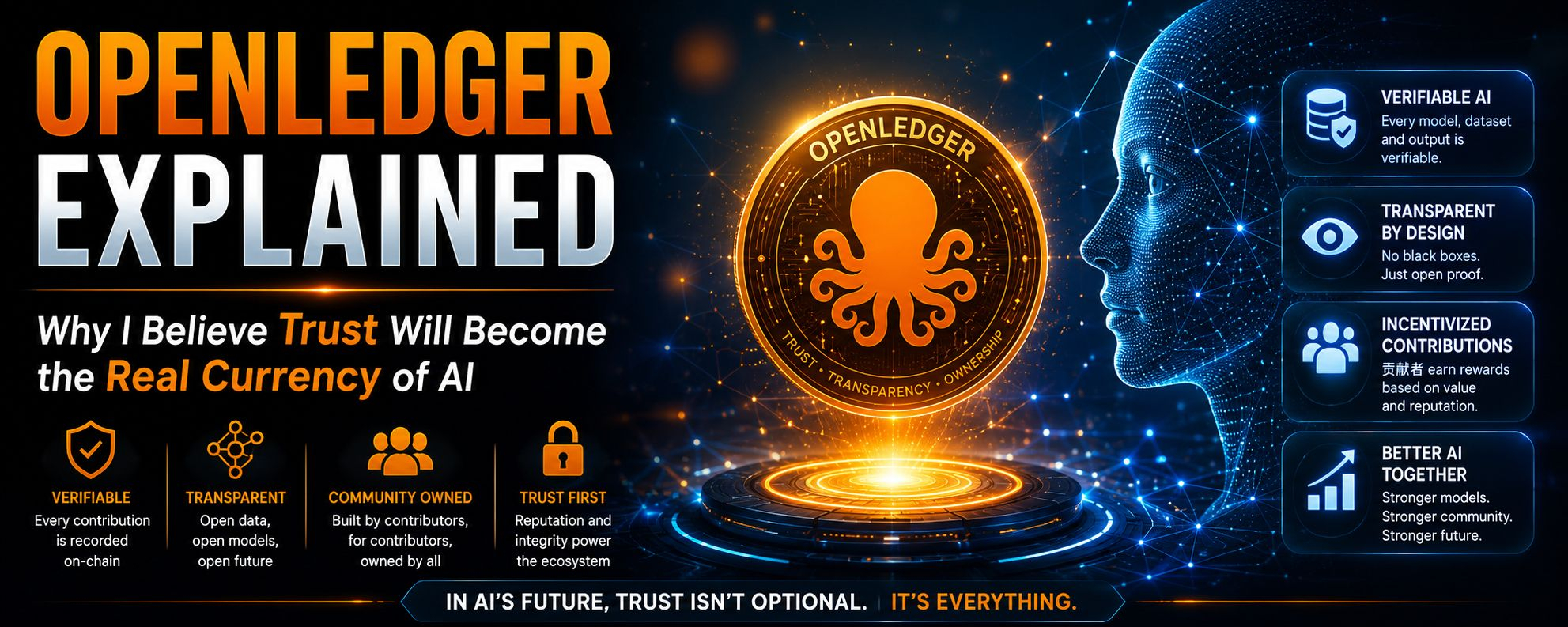
When I first looked at OpenLedger, I did not see it as just another AI-and-blockchain experiment chasing market hype. I have spent enough time watching crypto cycles to know that many projects sound revolutionary in theory but never solve a real human problem. What immediately caught my attention with OpenLedger was that I could actually see the emotional and operational gap it is trying to address. I think the project understands something many AI companies still underestimate: people do not want to lose control over their data, especially when that data is deeply personal, commercially valuable, or sensitive.
I see OpenLedger as an attempt to redesign how value flows inside the AI economy. Right now, I think the structure is heavily imbalanced. Massive AI firms absorb data from users, researchers, institutions, and businesses, then centralize most of the economic upside around model ownership. OpenLedger appears to challenge that structure by turning data, AI models, and autonomous agents into assets that contributors can continuously monetize while maintaining some level of ownership and selective disclosure.
What makes this emotionally compelling to me is that I can connect it to real human situations rather than abstract blockchain theory. I imagine a hospital holding years of cancer imaging records that could dramatically improve AI diagnostics. Today, those institutions often hesitate to share information because privacy regulations, legal exposure, and patient trust create enormous pressure. Even anonymized records are not always fully safe. I think this is where OpenLedger’s philosophy becomes meaningful. Instead of completely surrendering the dataset to a centralized AI company, the hospital could theoretically expose only controlled layers of information while maintaining auditability, permission management, and monetization rights.
I personally believe healthcare is one of the strongest examples for why selective disclosure systems matter. If I were a patient, I would probably support my medical history helping improve AI-driven treatments, but only if I knew exactly who was accessing it, why they were accessing it, and whether my identity remained protected. That emotional trust layer is critical. Most people are not anti-AI. I think they are anti-losing-control.
I also see practical applications far beyond healthcare. I can imagine legal firms monetizing specialized compliance models without exposing confidential case files. I can imagine financial institutions allowing AI systems to learn from transaction behavior without revealing raw customer identities. I can imagine scientific researchers contributing proprietary datasets into collaborative AI environments while automatically receiving compensation whenever their information improves downstream models.
What interests me most is that OpenLedger is not simply trying to tokenize data for speculation. I think the bigger vision is creating liquidity around intelligence itself. That changes the entire economic structure of AI participation. Instead of contributors giving away value one time, the system attempts to make data and models behave like continuously productive digital assets.
Operationally, I actually think this could solve a real headache for organizations. Right now AI infrastructure is fragmented almost everywhere. Data storage exists in one environment, licensing agreements exist in legal contracts, payments happen through separate financial systems, and access permissions are managed elsewhere. I see OpenLedger trying to compress all of that into programmable infrastructure where attribution, monetization, and permission management become automated.
From my perspective, that convenience matters more than the blockchain branding itself. Enterprises do not care about decentralization ideology nearly as much as crypto communities do. What they care about is reducing friction, lowering coordination costs, improving security, and simplifying compliance workflows. If OpenLedger can genuinely make AI collaboration easier without increasing operational complexity, then I think it has a realistic path toward relevance.
At the same time, I cannot pretend I do not have skepticism. I have seen many AI-blockchain projects present beautiful visions that collapse once they face enterprise reality. Hospitals are conservative. Regulators move slowly. Large corporations prioritize reliability and legal accountability over experimental infrastructure. I think the biggest challenge for OpenLedger is not technical innovation. It is behavioral adoption.
I also question whether blockchain is always necessary at every layer of AI coordination. Sometimes I feel parts of the crypto industry force decentralization into problems where traditional systems may already work adequately. If OpenLedger introduces too much technical complexity for institutions, adoption could stall regardless of how elegant the architecture looks on paper.
Another issue I think about is data quality. Incentivizing people to contribute information sounds powerful until low-quality or manipulated datasets start entering the ecosystem. AI systems are only as trustworthy as the information feeding them. So OpenLedger faces a difficult balancing act: creating open participation while maintaining rigorous trust verification. That is incredibly hard.
Privacy is another area where I remain cautious. Selective disclosure, cryptographic proofs, and privacy-preserving computation are advancing rapidly, but healthcare-grade privacy standards are unforgiving. One serious leak involving medical records or proprietary enterprise data could severely damage trust. In industries handling sensitive information, security expectations are brutal for good reason.
Still, I think the timing for OpenLedger is surprisingly strong. AI development costs are exploding globally. High-quality proprietary datasets are becoming strategic assets. Governments are increasingly scrutinizing unrestricted data harvesting. Meanwhile, blockchain infrastructure has matured beyond simple speculation narratives. I think the market is slowly shifting toward systems focused on programmable trust, ownership tracking, and machine-to-machine economies.
That broader environment makes OpenLedger feel more relevant than many earlier AI-chain experiments. I do not see it as a guaranteed success, but I do see it as part of an important structural transition. I think the future AI economy will require systems where data ownership, model attribution, permission control, and monetization are deeply integrated rather than loosely connected through traditional contracts.
What ultimately determines OpenLedger’s future, in my opinion, is whether it can move beyond narrative strength into operational usefulness. If it genuinely helps institutions share sensitive information safely, automate licensing logic, and participate in AI economies without surrendering ownership, then I think it could become valuable infrastructure. But if it becomes trapped inside speculative token culture without solving real workflow pain, it risks becoming another intellectually attractive project that never achieves meaningful adoption.
Personally, I find the project fascinating because it sits at the intersection of two massive tensions shaping the future of technology. On one side, AI systems desperately need more data, more collaboration, and more intelligence inputs. On the other side, people increasingly want privacy, ownership, transparency, and control. I think OpenLedger is essentially trying to build a bridge between those opposing forces.
And honestly, I think whether that bridge succeeds or fails will say a lot about the future direction of the entire AI economy itself.
