
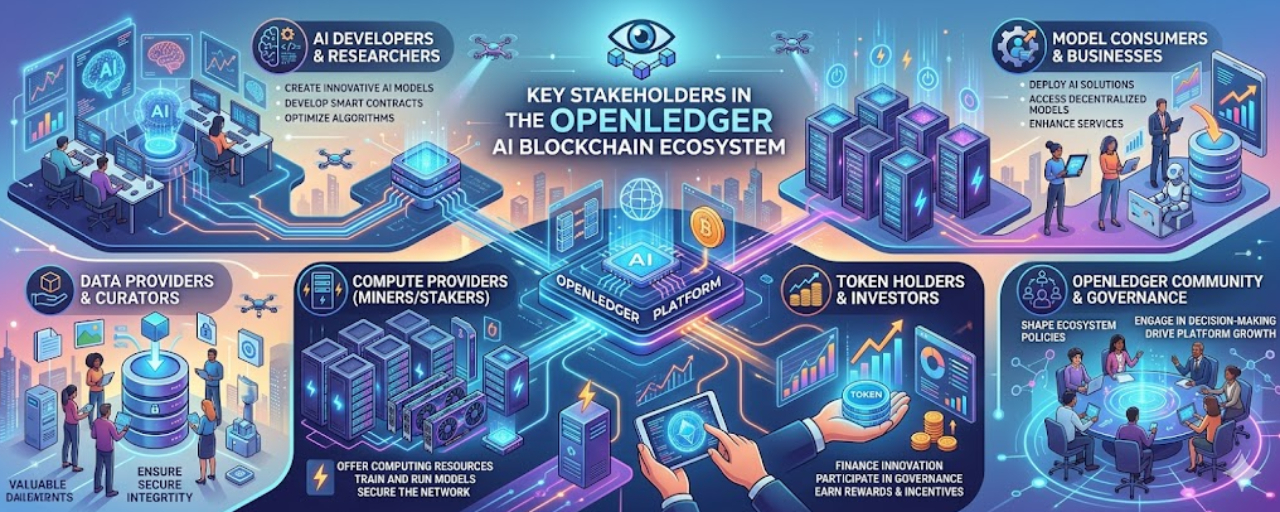

Decentralized intelligence isn’t making waves in isolation—it’s the result of people, computing power, and cryptography working together. As the tech world breaks away from old data monopolies and moves toward independent, specialized networks, the OpenLedger AI Blockchain steps up as the go-to platform for this new era of thinking machines. But let’s be real, a blockchain is only as strong as the folks using it. If you want to understand how OpenLedger is changing the game for AI, you need to look past the code and pay attention to the actual people shaping, sustaining, and benefiting from this ecosystem.
These people form a tightly connected web; everybody’s got a role and every move supports collective growth. At the core are the Data Providers and Curators—their data is the lifeblood of OpenLedger. In the old Web2 world, these providers were basically just exploited for their digital footprints while big corp ran the show. OpenLedger flips this upside down, treating data like a valuable, sovereign asset. So you’ve got medical organizations, legal groups, freelance researchers, and companies working together in Datanets. They bring raw data, scrub and validate it, and get it ready for machine learning. Curators then check everything, using their expertise to filter out junk and make sure the data’s solid. Thanks to this care, OpenLedger’s data is way better than the sloppy stuff general-purpose AI grabs from random internet scraping.
Then come the Model Developers and Fine Tuners—the brains behind the specialized AI models. Before, building cutting-edge AI meant needing huge budgets and massive teams. Now, OpenLedger’s ModelFactory gives anyone the tools to build and train models right on the blockchain, no coding required. These developers might be small startups creating custom financial tools or global teams tracking climate data. And, crucially, they keep full ownership and transparency over their models. They know exactly which data went in, and there’s no risk of losing control to big cloud platforms.
Of course, none of this matters without the Infrastructure Providers and Node Operators. These guys run the decentralized hardware—think high-powered GPUs all over the globe—so models can train and run in real time. On most blockchains, compute power goes to waste solving puzzles. On OpenLedger, it’s used for real, practical workloads. Node operators use OpenLoRA to maximize efficiency and minimize energy usage. They’re the backbone, keeping the network fast and reliable and making sure no central authority can take over or choke the system.
Now, once the models are live, they transform into Autonomous AI Agents and Apps—a totally new kind of stakeholder. They’re not just scripts sitting on someone’s server; these agents are independent economic actors. They own assets, conduct transactions, interact with contracts, and buy services within the network. For example, a tax auditing agent could manage its own funds, pay contributors instantly, and improve itself—all without a single person stepping in. This creates an M2M economy, where AI systems both offer and consume services.
At the end of all this are the Enterprise Clients and End Users—the people and organizations actually using OpenLedger for real-world results. You’ll see corporations, hospitals, banks, and individual creators who need trustworthy, specialized intelligence—not just generic chatbot answers. When someone uses an OpenLedger app like Open Chat, they get access to verified knowledge and enjoy true data privacy and security. They can bring AI into their own operations without worrying about leaks or their data powering a competitor’s next big thing.
Tying everything together, there’s the global community of Token Holders and Governance Participants, running on OPEN tokens. These folks don’t just invest and walk away—they actively help secure and guide the network. They stake tokens, vote on key decisions, and ensure OpenLedger evolves to serve the whole community, not just a boardroom somewhere.
What really sets OpenLedger apart is its Proof of Attribution protocol. The old tech scene was fragmented and exploitative. Here, it’s crystal clear who contributed what—from data to models to compute power—whenever someone pays for an AI service. Payments are automatically split and sent to everyone involved, right as it happens.
The result? A self-sustaining cycle that keeps growing. More clients want specialized AI, generating more rewards for data providers, curators, and node operators. That attracts more talent and hardware, leading to even better models and new applications, which brings in even more clients. It’s nothing like the corporate extraction models—here, everyone owns a piece of the future, sharing in the explosion of global intelligence.