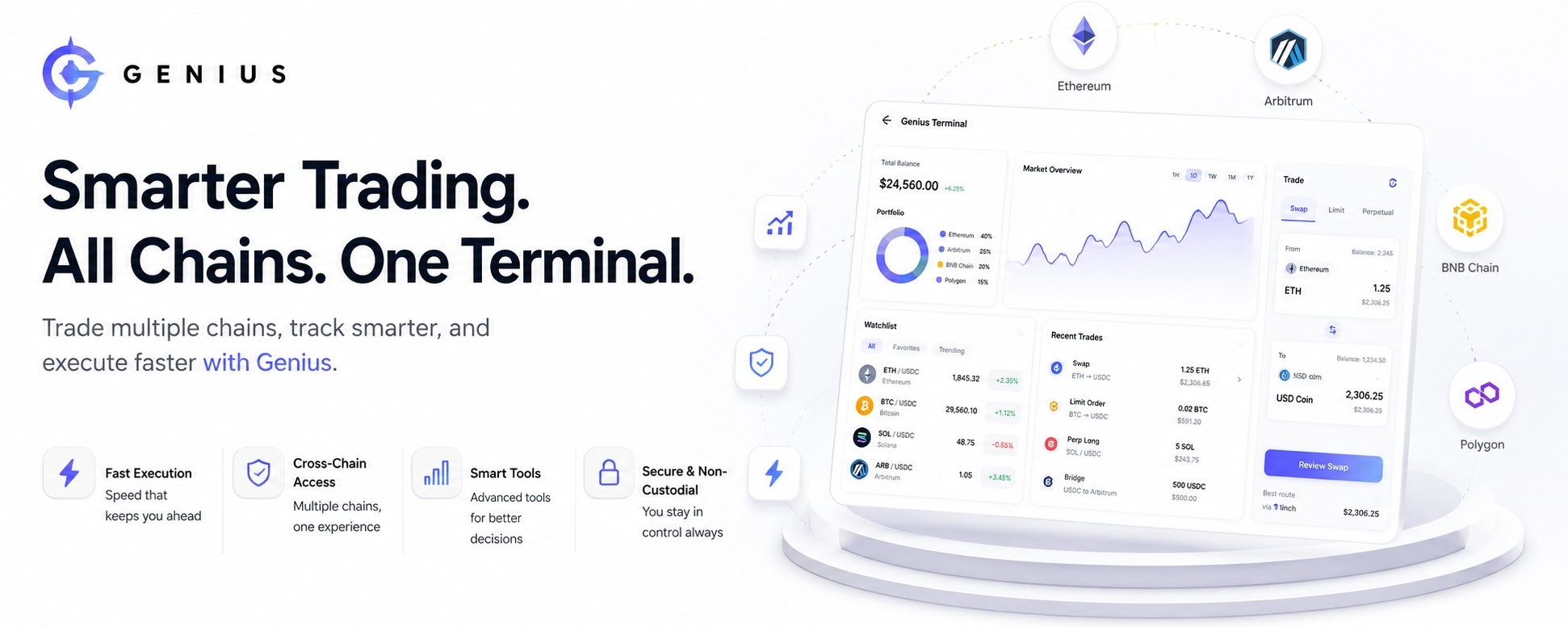

Genius feels like one of those projects that only starts making sense after you have been annoyed by crypto for too long.
Not the exciting kind of annoyed.
The tired kind.
The kind that comes after switching between five tabs just to make one trade. One DEX for this chain. One bridge that may or may not work. One wallet popup asking you to sign something you barely have the patience to read. One chart lying to you with thin liquidity. One influencer yelling “early” while everyone else is already crowded in.
Look, this is the mess.
And Genius seems to be built somewhere inside that mess.
I do not look at it and think, wow, finally, everything is fixed. That would be stupid. Crypto has punished that kind of thinking too many times. But I do understand the frustration it is trying to answer. On-chain trading is still weirdly painful for something that claims to be the future of finance. There is too much friction, too much scattered information, too many places where a normal user can make one small mistake and pay for it.
That is the part Genius is poking at.
The plumbing.
The stuff under the hood that nobody talks about when markets are green, but everyone complains about when something breaks.
Honestly, most people do not want another shiny trading tool. They want infrastructure that actually works when they need it. They want fewer broken routes. Less confusion. Less jumping around. Less feeling like every trade requires a mini investigation.
It is not flashy.
It is just necessary.
And maybe that is why Genius is more interesting than it first looks. Not because it has some perfect answer. Not because it deserves blind trust. But because the pain is real. Anyone who has dealt with bad execution, bridge anxiety, high gas, fake volume, or copy-trading nonsense knows how ugly this side of crypto gets.
The thing is, making it easier to trade is also dangerous.
That part cannot be ignored.
A cleaner terminal can help good traders move better. It can also help bad traders lose faster. More access sounds nice until people start clicking through leverage, chasing low-liquidity coins, copying wallets they do not understand, and calling it strategy. Crypto already gives people enough ways to hurt themselves. A better interface does not magically make them smarter.
So Genius has a hard job.
It has to reduce the mess without turning the mess into a prettier casino.
That is not easy to build. It might take time. It might break in places. It might feel useful to one type of trader and too much for another. Serious traders are not impressed by nice screens. They care about execution, reliability, data, speed, and whether the product still works when the market is violent. Retail users want simplicity, but they also want every opportunity in one place. Those two demands fight each other.
This is where most crypto products get lost.
They add too much.
Then they call it power.
Or they simplify too much.
Then nobody serious uses it.
Genius needs balance, and balance is honestly rare in crypto. Especially when a token is involved. Because once a token enters the room, the conversation changes. People stop asking whether the product is useful and start asking about listings, unlocks, staking, and price. Suddenly the tool becomes background noise and the chart becomes the whole personality of the project.
We have seen that movie.
Many times.
So yes, if Genius has a token, it needs to justify why it exists. Not with fancy wording. Not with some vague community language. It needs to actually make sense inside the system. Otherwise it becomes just another layer of speculation sitting on top of a product that may have been useful without the noise.
That is the risk.
The product could be solving a real problem, but the market may still treat it like another short-term narrative.
And honestly, that would be very crypto.
Still, I cannot dismiss Genius completely. The idea of bringing more order to on-chain trading makes sense. The current experience is too fragmented. Too many chains, too many tools, too many hidden risks. People pretend they enjoy this complexity because it makes them feel early, but most of the time it is just bad user experience wearing a DeFi costume.
Genius seems to understand that part.
At least from the outside.
But understanding the problem is only the first step. The real test is whether people keep using it after the hype cools down. Do traders come back because it saves them time? Does it help them see risk more clearly? Does it work when liquidity is ugly and transactions are stressful? Does it become part of their routine, or just another tab they opened during one market cycle?
That is what matters.
Not the noise.
Not the big promises.
Not the polished words.
For me, Genius sits in that uncomfortable middle space. The problem is real. The idea is practical. The execution still has to prove itself. Maybe it becomes useful infrastructure. Maybe it gets swallowed by the same hype machine it is trying to clean up around.
Maybe it works.
Maybe it does not.
But at least it is aimed at an actual crypto wound. The scattered trading experience. The constant friction. The feeling that everything is possible on-chain, but nothing is simple when you actually try to use it.
That is why I am cautiously interested.
Not excited.
Interested.
There is a difference.