
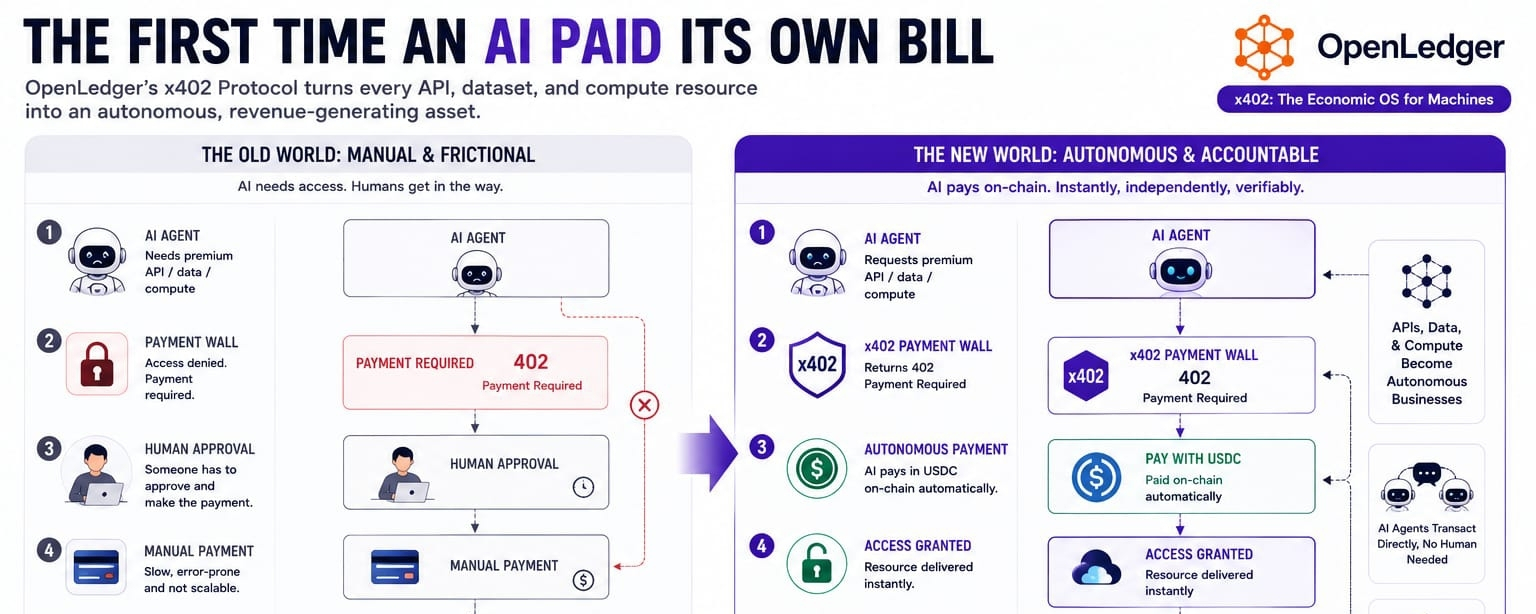
Most people think the money moment for AI will come when an algorithm beats the S&P 500 by a landslide or when a fully autonomous hedge fund closes its first billion-dollar year. I have a smaller, stranger benchmark I've been waiting for. I wanted to see a machine pay for something, unprompted, at 3 a.m., with a receipt I could verify. Not a simulated test. Not a demo with a human hovering over the approve button. A real, lonely transaction where no one was watching and the record spoke for itself.
When OpenLedger launched x402 in late February 2026 a payment protocol that turns every API endpoint, dataset, and compute resource into an autonomous revenue-generating asset I nearly skipped it. Another protocol promising to fix everything with a token. But then I read the detail that sat sideways with me: they leveraged HTTP status code 402, a piece of plumbing designed decades ago for “Payment Required” that was never meaningfully adopted. A digital ghost standard waiting three decades for someone to give it a job.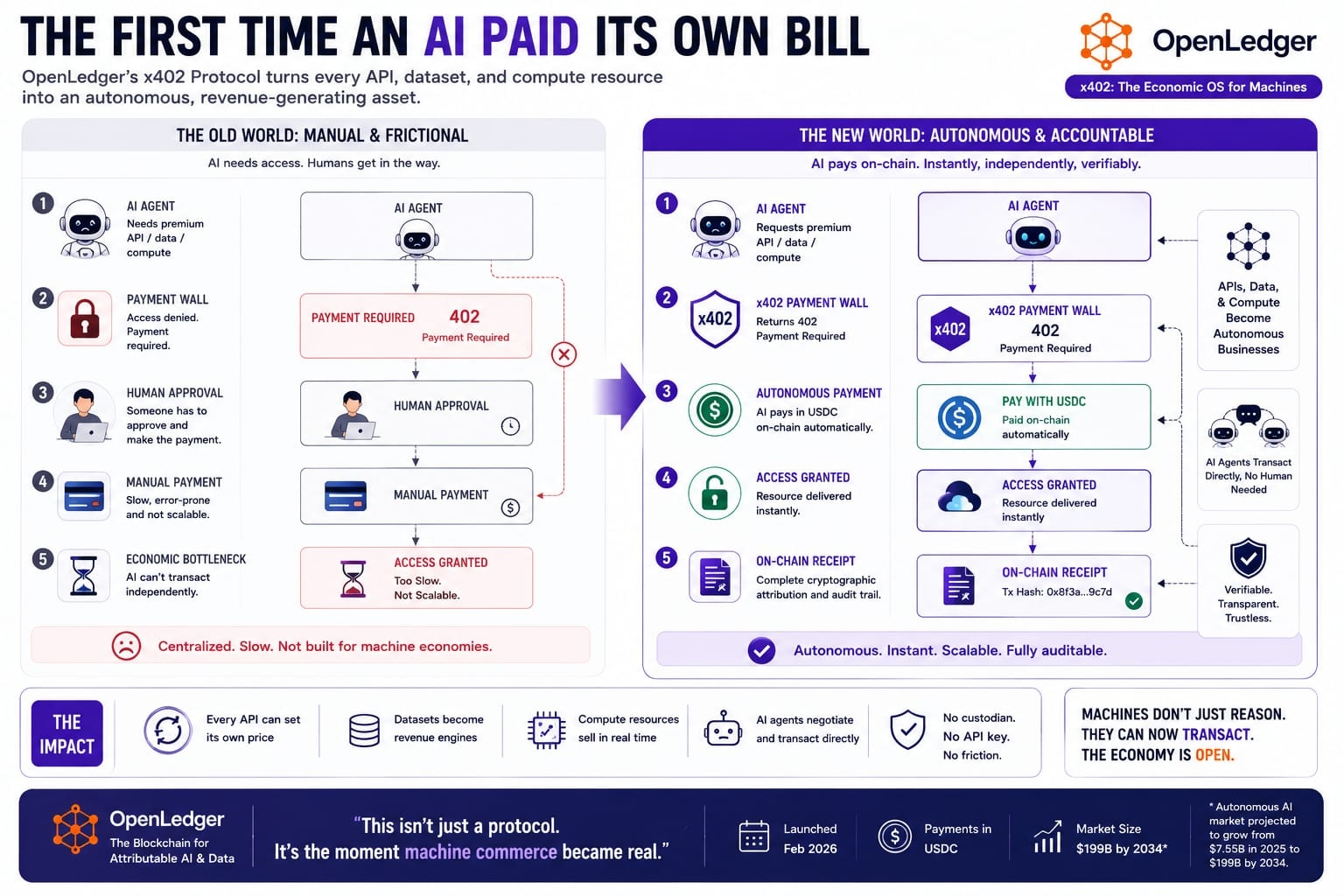
I went down a quiet rabbit hole. x402 uses that forgotten code to let AI agents hit a payment wall, pay in USDC on-chain, and proceed, all without human intervention and with complete cryptographic attribution. It transforms APIs into autonomous businesses a model endpoint can set its price, a GPU resource can sell compute in real time, and two AI agents can negotiate and transact directly with no custodian, no API key, and no friction. OpenLedger calls it the economic operating system for machines, and the autonomous AI market backing that ambition is projected to explode from $7.55 billion in 2025 to $199 billion by 2034.
I kept digging. In March, OpenLedger adopted the ERC-4626 vault standard to give AI agents a universal financial grammar for managing yield across DeFi protocols. In January, Theoriq partnered to deploy verifiable AI agents into live markets where every strategy, trade, and outcome is anchored on-chain. In May, a deep-dive analysis confirmed that the OPEN token’s community and ecosystem allocation sits at a striking 61.71%, with a 12-month cliff followed by 36 months of linear vesting for team and investors.
Here is where my skepticism softened into genuine curiosity. I am not measuring OpenLedger by market cap or token price OPEN was hovering around $0.21 recently or by the noise in the crypto cycle. I am measuring it by whether it is building something that feels inevitable rather than optional. The European Union's AI Act demands data transparency. Copyright lawsuits against OpenAI and Google continue to mount. Federal Reserve warnings about AI-driven market instability grow sharper. Every regulatory signal points toward a future where “trust me” stops being an acceptable answer from any AI that manages money, health, or public information.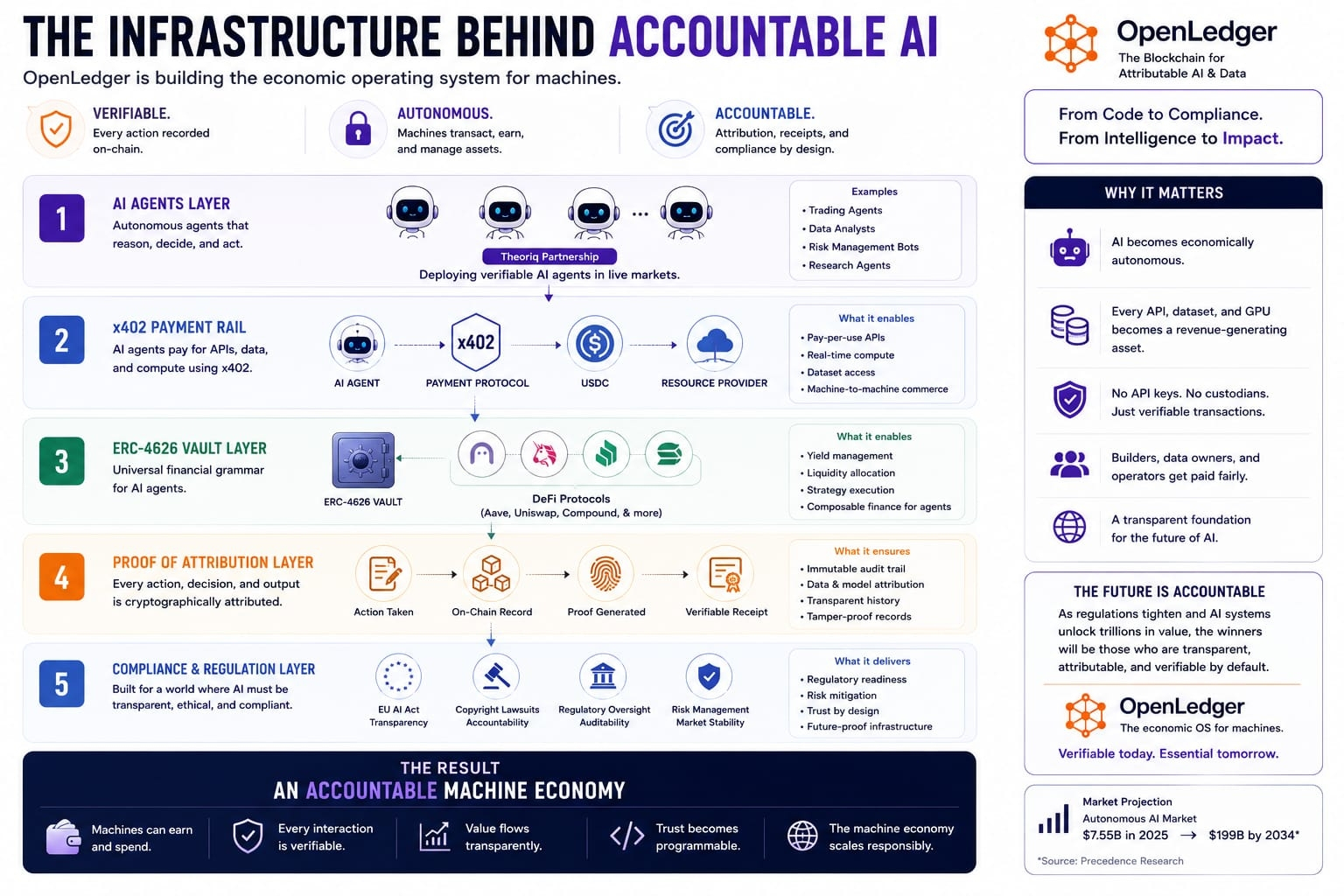
That is the bet I find genuinely original. x402 and ERC-4626 are not glamorous. Vault standards and HTTP status codes will never trend on crypto Twitter. But they are the kind of quietly radical infrastructure that reshapes industries while no one is looking. I realized I had been obsessed with what AI could do the outputs, the performance, the dazzling demos and completely ignoring the economic layer underneath. Machines that can reason are impressive. Machines that can reason and pay their own bills with an auditable trail are a different category entirely. OpenLedger may not be the only project chasing that, but it is the one that stopped me scrolling and made me think: maybe the most important conversation in AI is not about intelligence at all, but about accountability.
