
Most people using AI never think about where the answers actually come from.
You open a chatbot. Ask a question. Get a polished response in seconds. Easy.
What you don’t see is the pile of invisible work underneath it all.
Someone collected the data. Someone cleaned it. Someone trained the model. Thousands of people probably contributed information without ever knowing their work would end up feeding an AI system worth millions — sometimes billions — of dollars.
And that’s where OpenLedger steps in.
The project is built around a simple idea that sounds obvious once you hear it: if people help create AI systems, shouldn’t they be able to benefit from them too?
Right now, that rarely happens.
Big AI companies hold most of the power. They own the infrastructure, the models, and usually the profits. Meanwhile, developers, researchers, and data contributors often disappear from the picture completely once the final product launches.
OpenLedger wants to change that.
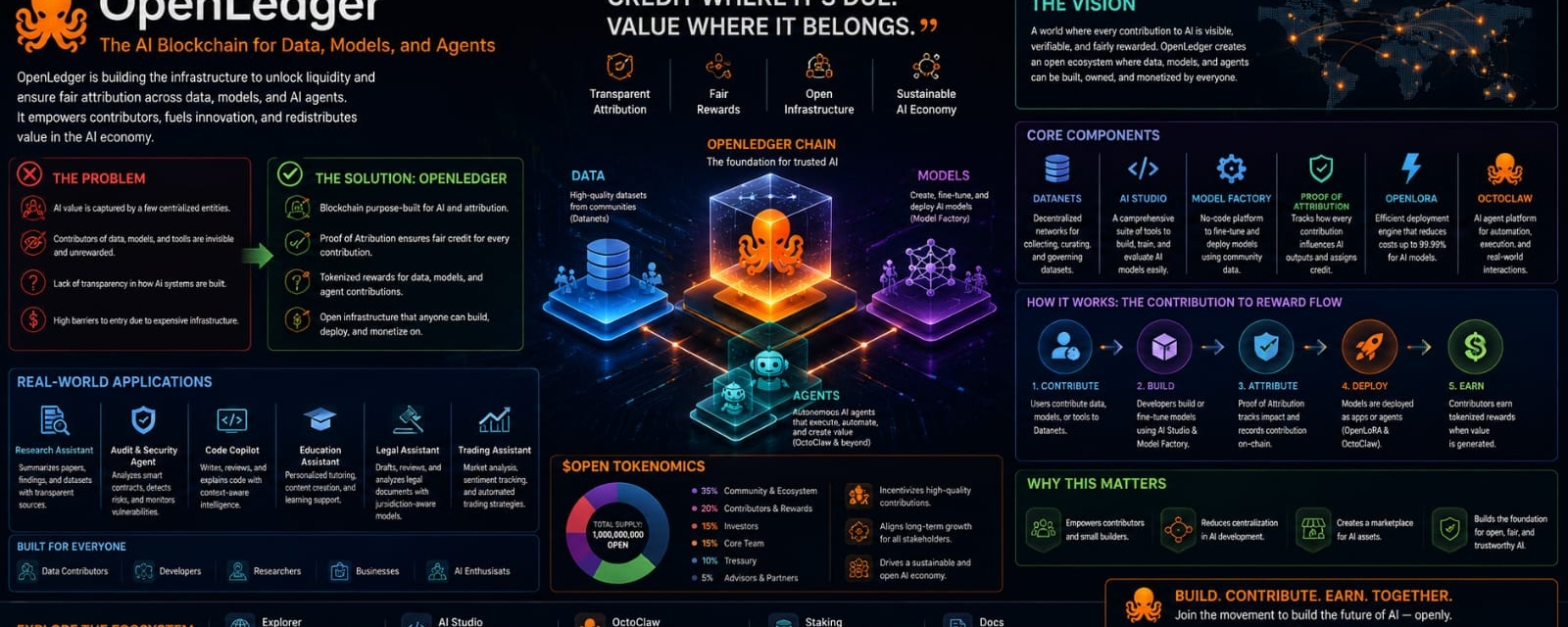
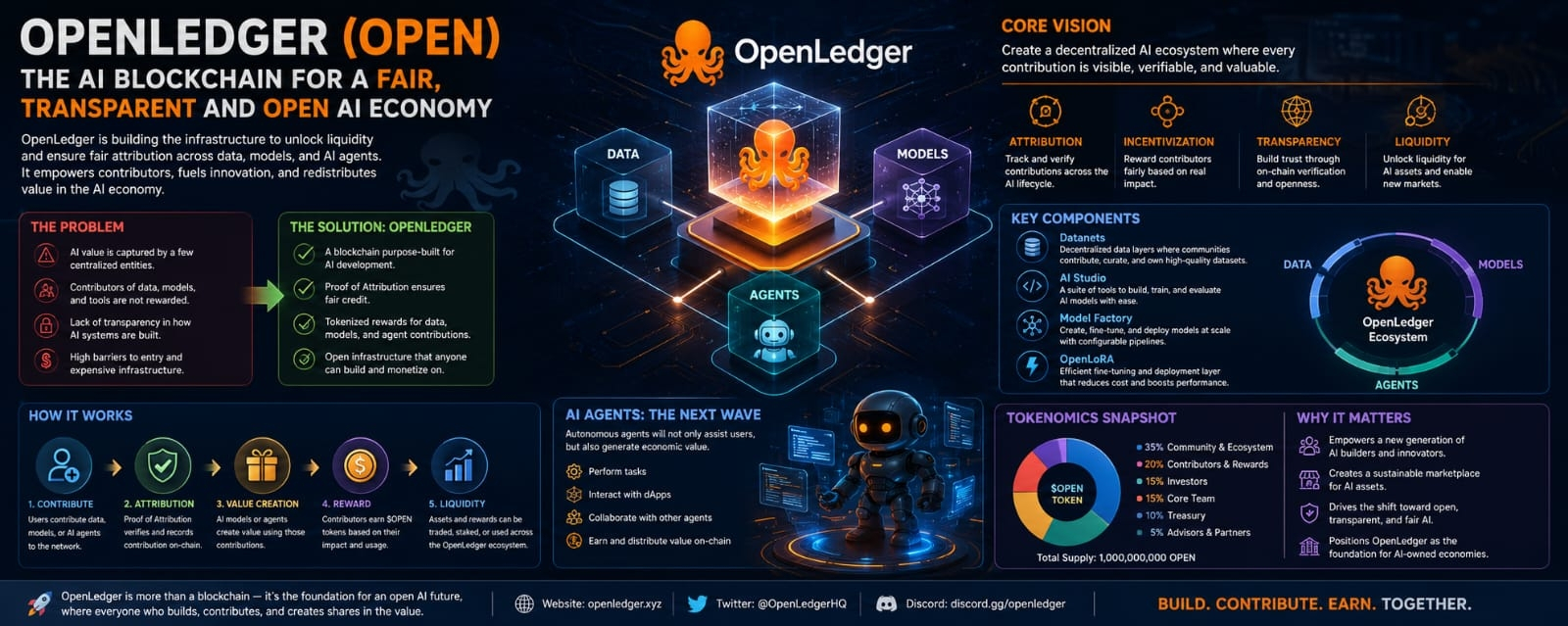
The company describes itself as an AI blockchain focused on data, models, and AI agents. Strip away the crypto language and the idea becomes easier to understand. They’re trying to build a system where contributions to AI can actually be tracked and rewarded instead of getting lost inside a black box.
Sounds reasonable.
The hard part is making it work in the real world.
And honestly, that’s where things usually fall apart in tech.
I’ve watched enough blockchain and AI startups over the years to know that good ideas are cheap. Execution is what destroys people. Especially when you’re dealing with something as messy as machine learning infrastructure.
OpenLedger’s biggest idea revolves around something called Proof of Attribution. Basically, the system tries to track who contributed data or improvements to a model and how much impact those contributions had over time.
Simple concept. Very difficult problem.
AI models don’t think in clean, organized layers where you can easily trace one answer back to one contributor. Data gets mixed together in complicated ways. One dataset might influence thousands of outputs. Another might barely matter at all.
Trying to measure that accurately is a headache.
Still, the timing for this kind of project makes sense. The AI industry is starting to run into trust problems. Copyright fights are getting louder. Regulators are paying closer attention. Creators are questioning how their work is being used. Even developers are becoming uneasy about how centralized the whole ecosystem has become.
That pressure isn’t going away.
And the current system? It’s shaky.
Most AI platforms today operate like sealed vaults. You don’t really know where the training data came from. You don’t know who contributed to the system. You definitely don’t know who’s making money once the product scales.
OpenLedger is betting that future AI systems will need more transparency, not less.
That’s probably the smartest part of the entire project.
The platform also introduces something called Datanets — shared environments where communities can contribute and organize datasets for AI training. In theory, it creates a more open ecosystem for building models.
In reality, managing data is never clean.
You get duplicates. Bad labeling. Outdated information. Spam uploads. Arguments over ownership. Legal gray areas. Developer disagreements over standards that constantly change.
Human systems are chaotic by default. Tech companies just hide it better.
That’s why OpenLedger’s blockchain layer matters to them. The idea is to create records that are visible and traceable instead of relying on trust alone. Whether that works smoothly at scale is another story entirely.
Because scale changes everything.
Small systems look elegant. Large systems expose every weakness.
The project also includes tools like AI Studio and Model Factory, which are designed to make building and fine-tuning models easier for developers. That part actually feels practical. Most developers don’t want to spend weeks fighting infrastructure problems before they can even test an idea.
They want tools that work.
Fast.
If onboarding becomes painful, people leave. That’s true for almost every tech ecosystem I’ve covered.
Then there’s OpenLoRA, which claims it can reduce the cost of deploying AI models dramatically. Maybe it can. Maybe the numbers are overly optimistic. The AI and crypto sectors both have a habit of making huge performance claims before the technology fully matures.
That’s not criticism. It’s just reality.
This space moves fast, and startups are under constant pressure to sound bigger, faster, and more revolutionary than everyone else competing for attention and funding.
But OpenLedger’s broader direction still matters because AI is becoming increasingly centralized. A small number of companies now control most of the compute power, infrastructure, and advanced models. Smaller builders are struggling to keep up with rising costs and dependency on giant platforms.
OpenLedger is trying to push against that concentration.
Not just technically. Economically too.
And then there’s the AI agent side of the project, which honestly might become the most important part long term.
The company talks a lot about autonomous agents — AI systems that can execute tasks, interact with applications, and operate more independently over time. That sounds exciting until you remember how unpredictable AI systems already are.
Because they are.
Bugs happen. Systems fail. Models hallucinate. APIs break. Security holes appear where nobody expected them. Add blockchain infrastructure and distributed systems into the mix and the complexity multiplies quickly.
There’s no such thing as a perfectly smooth tech ecosystem. Especially not in AI.
That’s what makes OpenLedger interesting to watch.
The project isn’t trying to build another flashy chatbot or short-term crypto trend. It’s aiming at something deeper: ownership, attribution, and value inside the AI economy itself.
That’s a much bigger fight.
Whether they succeed is impossible to know right now. A lot of projects with smart ideas collapse once scaling problems, funding pressure, developer chaos, and regulation hit all at once.
And eventually, they always do.
But the core question OpenLedger is asking is the right one:
If AI systems are built from the work of countless people, why should only a handful of companies benefit from them?
The industry still doesn’t have a good answer for that.
OpenLedger is trying to build one.
